Get Full Government Meeting Transcripts, Videos, & Alerts Forever!
Get email alerts on the Transit Infrastructure topic
No spam. Unsubscribe anytime.
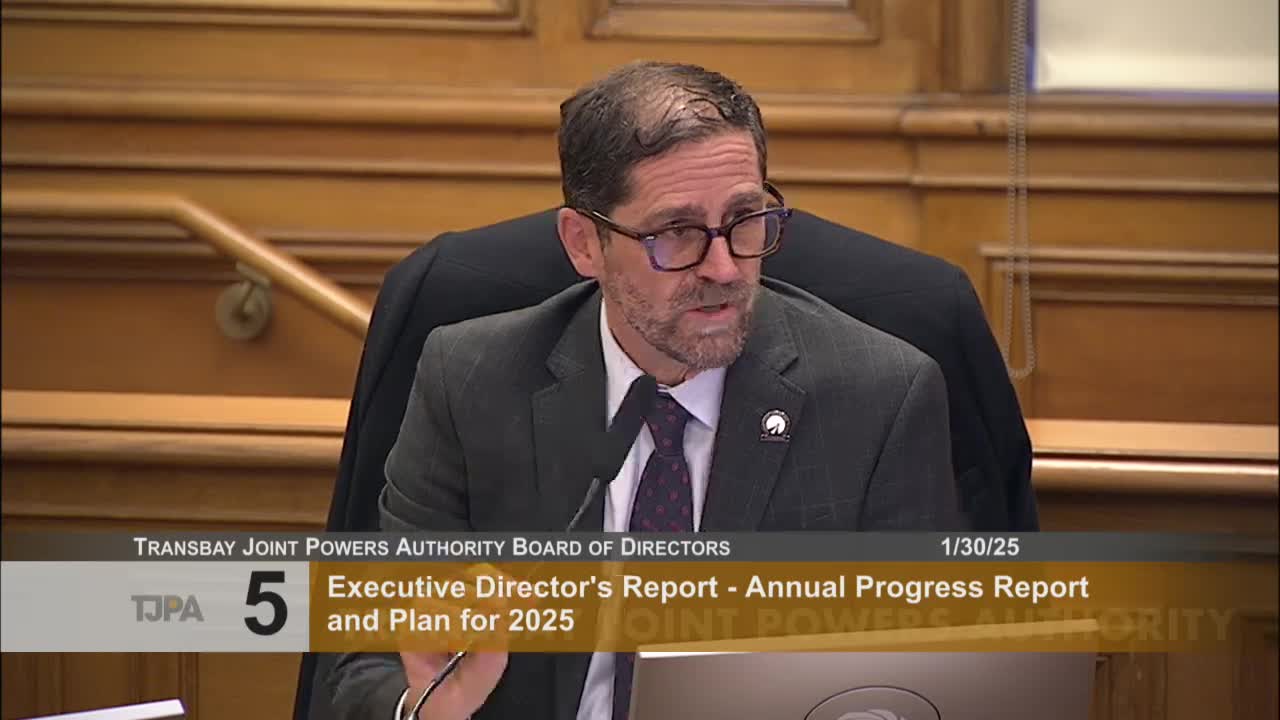
TJPA lays out master schedule and funding plan for DTX, advances interagency MOU
Summary
The Transbay Joint Powers Authority presented a revised master schedule and funding plan for the Downtown Rail Extension (DTX/"portal"), including a path to a Full Funding Grant Agreement (FFGA) targeted for July 2027 and an interagency implementation memorandum of understanding signed by partner agencies.
The Transbay Joint Powers Authority on Jan. 30 presented a revised master schedule and funding plan for the Downtown Rail Extension (the portal), saying staff has funding to advance engineering and preconstruction work over the next several years while continuing advocacy to close a remaining construction funding gap.
The update, delivered by TJPA Executive Director Willie Vandewater, portal Project Director Alfonso Rodriguez and Chief Financial Officer Sheema Mirzai, set a target FFGA date of July 2027 and an initial revenue service target in 2035 under the program's unconstrained schedule. Board members then authorized the chair to execute an implementation memorandum of understanding (MOU) with partner agencies to formalize collaboration on the portal implementation.
Why it matters: The portal is the project to connect Caltrain and future standard-gauge/high-speed rail into the Salesforce Transit Center. Completing the engineering, critical third‑party agreements and preconstruction activities would position the project to request and negotiate an FFGA with the Federal Transit Administration (FTA). Staff said those steps are necessary to make the project competitive for federal and state matching funds.
Key points from staff presentations
- Funding posture: Staff presented a program-level funding picture that includes the Federal Transit Administration Capital Investment Grants (CIG/New Starts) commitment and a set of committed and budgeted local, regional and state funds. The presentation shows an FTA CIG commitment of about $3.38 billion and a remaining share of project funding to be secured from state cap-and-trade, regional measures and other discretionary sources. TJPA staff said roughly $250 million in additional funds will be needed by 2027 to stay on the FFGA schedule.
- Work priorities: The plan prioritizes advancing the largest construction package (40CT — civil and tunnel) to approximately 60% design through a progressive design-build procurement, so the selected contractor can provide preconstruction services and later negotiate a guaranteed maximum price. Staff said they have funds to complete preconstruction work advancing design to a level that reduces contingency and risk.
- Procurement approach: Rodriguez described a two‑phase award for the 40CT progressive design‑build contract: NTP1 for preconstruction services (design advancement to ~60%) and NTP2 for construction after negotiation of a guaranteed maximum price. Staff intend to release the civil and tunnel RFP in the coming months, subject to final board approvals and funding availability.
- Risk and alternative scenarios: Staff acknowledged risks that affect contingency — especially unknown subsurface utilities and right‑of‑way work — and described an alternative if major matching funds (for example, a cap‑and‑trade allocation or federal grants) do not arrive on schedule: advance additional design and durable deliverables while deferring some construction activities (notably parts of utility relocation and station fit‑out) until funds are secured.
- Interagency MOU: The board authorized the chair to execute the portal implementation MOU, a multiagency agreement that the Federal Transit Administration treats as a critical third‑party document for FTA funding. According to presenters from the San Francisco County Transportation Authority, the MOU formalizes the governance and annual work-plan process among partner agencies and aligns responsibilities for advancing the project.
Discussion highlights
Vice Chair Mandelmann and other board members pressed staff on the funding gap before an FFGA and asked what would happen if regional or state sources did not materialize. CFO Mirzai said the near-term plan uses existing funds to advance design and ready the project for construction so that any future discretionary dollars can be applied to work with an immediate, usable payoff. Rodriguez said utility relocation construction was one activity that could be deferred to preserve funds for design advancement, but that deferral pushes those risks and costs later in the schedule.
Board Chair Jeff Gee and Director Vandewater urged continued advocacy with the Bay Area’s federal and state delegations and with the Metropolitan Transportation Commission as regional funding discussions proceed.
What comes next
Staff said they expect to release the civil and tunnel RFP in the coming months and continue pursuing federal discretionary grants (including CRISI and CIG/New Starts), state cap-and-trade funds and regional measure allocations (RM2/RM3). The MOU execution will be used to demonstrate interagency commitment in future funding requests.
Speakers quoted or referenced in this article include Alfonso Rodriguez (portal project director), Willie Vandewater (executive director, TJPA), Sheema Mirzai (chief financial officer, TJPA), Jesse Kaylor (Rail Program Manager, San Francisco County Transportation Authority) and Chair Jeff Gee.
Ending: Board members praised the interagency agreement as a strengthening step for advocacy while noting the funding gap ahead. TJPA staff said they will return with procurement actions for the civil and tunnel package and with supplemental updates on funding progress in future meetings.