Get Full Government Meeting Transcripts, Videos, & Alerts Forever!
Get email alerts on the Public Lands Disposal topic
No spam. Unsubscribe anytime.
Committee approves joint resolution urging Congress to dispose federal public lands to Wyoming
Summary
Senate Joint Resolution 2, urging Congress to transfer former federal territorial public lands and subsurface resources to Wyoming, passed the Agriculture, State & Public Lands & Water Resources Committee 4-1 after extended public comment from ranchers, conservation groups, tribal representatives and state officials.
Senator Eyde told the Agriculture, State & Public Lands & Water Resources Committee that Senate Joint Resolution 2 seeks congressional action to “dispose of the federal title in those public lands and subsurface resources in this state,” invoking Article IV, Section 3, Clause 2 of the U.S. Constitution and Wyoming’s act of admission.
The resolution directs the Wyoming legislature to ask Congress, by Oct. 1, 2025, to confirm an intent to transfer federal title to lands and resources it holds within Wyoming so the state may “obtain full admission into the Union . . . upon an equal footing” with the original states. The resolution explicitly contemplates negotiations that would preserve lands of national interest; the sponsor said that national parks and monuments could be the subject of separate disposition discussions.
Testimony showed a wide range of views and detailed fiscal concerns. Alec Underwood of the Wyoming Outdoor Council urged the committee to reject SJ2, citing economic and recreational values of federal public lands and data that in 2024 outdoor recreation accounted for $2.2 billion and about 15,000 jobs in Wyoming. Underwood also noted recent federal Payments in Lieu of Taxes (PILT) totaling roughly $102 million from 2022–2024 and warned of the state’s potential fiscal and management obligations if it took on millions of additional acres.
Supporters, including representatives of the Wyoming Farm Bureau and several speakers at the hearing, said state control would give Wyoming residents and elected officials greater influence over land use decisions, grazing access and road and trail management. Testimony from Scott Brown of Bighorn County urged committee members to uphold their oath to the U.S. and Wyoming constitutions; several supporters emphasized perceived federal overreach in land-management decisions.
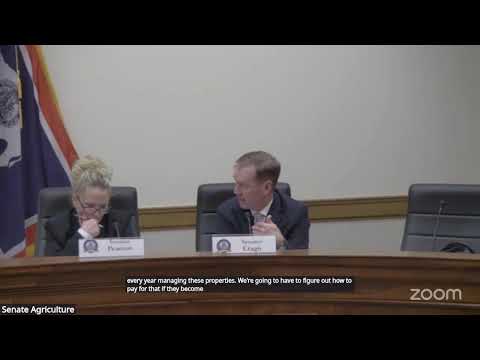
Committee discussion addressed practical and legal complications. Senator Crago asked about the scale of the transfer and whether subsurface mineral estates on private lands would follow the surface. Sponsor Eyde cited LSO research provided to the committee showing roughly 30,000,000 acres of federally held surface within Wyoming (about 47% of the state’s surface area) and that the federal government retains roughly 69% of the state’s subsurface mineral estate. Multiple commenters and committee members warned that mineral ownership is legally complex: some historic patents reserved minerals to the federal government in a checkerboard pattern, producing disparate mineral ownership that would require extensive title work if jurisdiction changed.
Other witnesses urged guardrails. Richard Garrett of the Greater Yellowstone Coalition and Josh Metten of the Theodore Roosevelt Conservation Partnership highlighted risks that converting federal lands to state control could change access rules and management mandates; Metten noted that many state trust lands have distinct fiduciary rules and do not guarantee public access. Several witnesses advised more study and a cautious approach to avoid unintended consequences.
The committee voted to pass SJ2 on a roll-call vote, with Senator Crago recorded as voting no and Senators Eyde, McEwen, Pearson and Chairman French voting aye. The committee’s 4–1 vote advances the nonbinding joint resolution; if enacted and signed by the governor, the resolution directs the secretary of state to transmit copies to the president, congressional leaders and Wyoming’s congressional delegation and expresses the legislature’s readiness to negotiate with Congress over lands of mutual national interest.