Get Full Government Meeting Transcripts, Videos, & Alerts Forever!
Get email alerts on the Diversity Equity Inclusion topic
No spam. Unsubscribe anytime.
Wyoming Senate committee approves bill to restrict DEI offices and mandates at state entities
Summary
Senator Sherry Steinmetz, sponsor of Senate File 103, told the Agriculture, State & Public Lands & Water Resources Committee that she brought the bill to “terminate and defund diversity, equity and inclusion” at state entities and educational institutions.
Senator Sherry Steinmetz, sponsor of Senate File 103, told the Agriculture, State & Public Lands & Water Resources Committee that she brought the bill to “terminate and defund diversity, equity and inclusion” at state entities and educational institutions.
The measure, as described by Steinmetz at the committee hearing, would prohibit state agencies, higher-education institutions and other entities that receive state appropriations from establishing DEI offices, requiring DEI statements, or promoting programs “designed or implemented in reference to race, color or ethnicity,” with repeated carve-outs in the text for activities necessary to comply with state or federal law or an applicable court order.
Supporters said the bill protects students and taxpayers from mandatory coursework and training they regard as ideological. “When children are coming home from school and saying that they wish that they weren’t white based on what they are learning in the education system, that’s a problem for me,” Senator Paul Pearson told the committee during public comment in support of the bill. Advocates from statewide groups also urged the committee to restrict use of state money on DEI programming.
Higher-education leaders and tribal counsel raised practical and legal concerns. Erin Taylor, who said she was appearing with Dr. Brandon Cossing, interim president of Casper College, asked how the bill would affect use of private donations, federal grants and basic classroom instruction such as concepts taught in psychology and sociology. Dr. Cossing asked that “human services” be explicitly eligible for the exemption for academic programs with accreditation-driven content. Claire Johnson, in-house counsel for the Northern Arapaho Tribe, asked for clarification whether the bill’s categories (race, color, ethnicity) would affect Native American political or cultural programs; the sponsor said she did not intend to impede tribal programs and would meet with tribes to discuss language.
University of Wyoming representatives said much of the university’s work already responded to prior legislative direction. Mike Smith of the University of Wyoming told the committee that the university “closed the office by the deadline” required by last year’s budget footnote and has removed diversity statements from hiring practices while maintaining a temporary position to review programs and ensure grant compliance.
Committee members and the sponsor tightened some language during the hearing. The committee adopted a correction to fix the repeated typo “gender dysphonia” to “gender dysphoria.” A floor amendment the sponsor proposed for the committee of the whole was withdrawn so the sponsor could work with institutions and tribes to clarify exemptions for accreditation, federal grants, private donations and programs focused on serving underserved students.
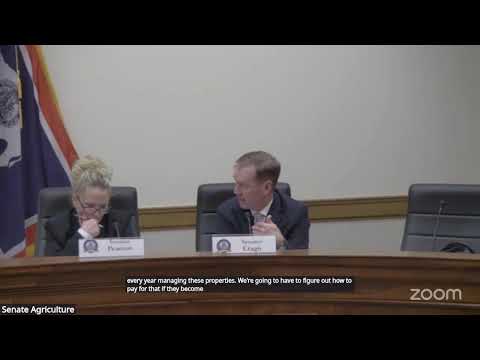
On a roll-call vote, the committee approved Senate File 103 (as amended) by a 5-0 vote. The roll call recorded ayes from Senator Crago, Senator Eyde, Senator McEwen, Senator Pearson and Chairman French. The sponsor told the committee she will consult with colleges, the University of Wyoming and tribal representatives to propose clarifying language ahead of further consideration.
The bill’s text and the sponsor’s handout referred to a January 22, 2025, federal executive order cited as background, and the measure repeatedly states that nothing in the act shall prevent compliance with applicable state or federal law or an applicable court order.
Senate File 103 now moves toward the full Senate; the sponsor and several institutional representatives said they expect additional drafting and potential committee-of-the-whole changes before crossover.