Get Full Government Meeting Transcripts, Videos, & Alerts Forever!
Get email alerts on the Agricultural Processing topic
No spam. Unsubscribe anytime.
Loudoun panel backs loosening of agricultural-processing rules, asks staff for detailed standards
Summary
The Transportation and Land Use Committee heard farmers and conservationists urge changes to Loudoun's zoning rules for agricultural processing and directed staff to draft options to allow shared facilities, loosen the on-site sourcing standard and clarify definition and screening rules.
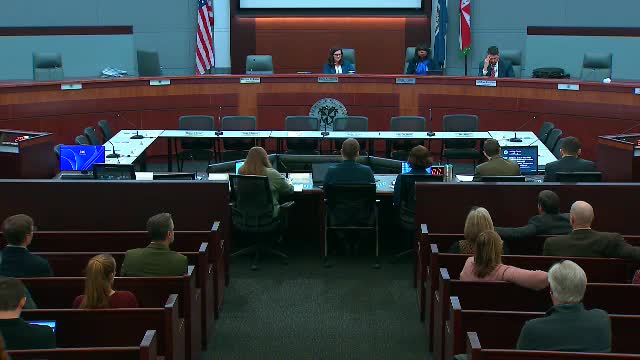
The Loudoun County Transportation and Land Use Committee on Jan. 29 directed staff to pursue revisions to the county's agricultural-processing rules, including changing the existing on-site sourcing requirement and clarifying the definition of "agricultural processing." The committee also asked staff to develop standards that would allow shared processing facilities for multiple farmers and to consider prepared-food production as part of the agricultural-processing framework.
Committee members and staff said the existing accessory-use rule requiring that at least 51% of products processed be produced on the same parcel is impractical for small and leased farms. They asked staff to prepare ordinance language that would instead measure sourcing over a broader area, with the group indicating a preference for a majority (about 51%) of inputs coming from within a specified local radius or from Loudoun and adjacent counties.
Agricultural-processing rules matter because they determine whether farmers can co-invest in local pack houses, kitchens, small-scale value-added facilities and shared equipment without triggering a more burdensome site-plan or commercial review process. Farmers told the committee the current rules discourage collaboration and penalize small operations that rely on leased acreage.
Staff presentation and committee direction David Schneegenberg, planner with Zoning Administration and the project manager for the Western Loudoun Zoning Ordinance Amendment (ZOAM) project, reviewed the existing ordinance framework, noting that agricultural processing is treated differently depending on whether it is an accessory use (tied to on-site agricultural production) or a principal use in AR-1 and AR-2 districts. Schneegenberg reiterated that accessory processing currently requires a majority of products to be produced at the parcel where the processing takes place and that principal processing must satisfy the use-specific standards in section 40812, including limits on acreage, employees, equipment and structure size.
Farmers and conservation officials told the committee the 51% on-site requirement is a barrier. Chris Van Black of the Loudoun Soil and Water Conservation District said the percentage requirement "discourages farmers from collaborating on processing and also is nearly impossible for farmers like myself that rely on leased land to comply with." Stephen Bradford Rose of Potomac Vegetable Farms and others urged a county- or region-based sourcing rule to support shared facilities and regional food production.
The committee heard multiple specifics to address in a rewrite: change the sourcing test from parcel-specific to county or regional sourcing (committee direction favored a local majority standard), explicitly allow shared processing facilities where multiple producers bring in product, clarify whether certain post-harvest activities (washing, cutting, curing) are within the definition of routine agriculture or constitute "processing," and align equipment, screening and hours-of-operation requirements to rural farm realities.
Site plans and public access Staff clarified that a site plan is required when a use involves public access or substantial physical changes; accessory processing limited to farm employees and participating producers generally does not require a site plan. The committee asked staff to draft objective language so farmers and reviewers can reliably determine when a farm processing use remains accessory versus when commercial/site-plan review is required.
Other items staff will draft - A revised agricultural-processing definition, with attention to the state's value-added language and to distinguishing routine farm activities (sorting, washing, drying) from higher-intensity processing. - Options to permit prepared-food production at a smaller commercial scale while flagging health-department and state food-safety requirements. - Clarification of "heavy equipment" and removal or narrowing of screening and privacy-fence rules that currently require industrial-style enclosures around farm equipment. - A staff study of scaled slaughterhouse options and possible new use standards for small, medium and large livestock processing (with attention to state and federal food safety regulations).
"The definition for ag processing needs to be cleaned up," said Supervisor Kirschner during the meeting, noting that the ordinance was adopted with large operations in mind and does not fit many of the small, cooperative farms now operating in Western Loudoun.
What happens next The committee directed staff to return with draft ordinance language and concrete examples at a future stakeholder meeting (meeting 7 in the series). Staff summarized the committee's near-term direction as: adjust the 51% accessory sourcing rule to a county- or region-based majority test, accommodate prepared-food activities where feasible, and revise screening/hours/equipment limits to reflect farming practice.
Community and enforcement context Speakers asked the county to avoid requiring industrial-style buffering that hides farming from view in the Rural Policy Area and to clarify whether the equipment limits were intended to control back-hoes and cranes or ordinary tractors and harvest machinery. Several farm operators said permitting rules should encourage co-investment in processing infrastructure, which can be prohibitively expensive for small producers acting alone.
The committee did not take a formal vote on a final ordinance; it directed staff to draft options and return for stakeholder review and additional committee action.