Get Full Government Meeting Transcripts, Videos, & Alerts Forever!
Get email alerts on the Snow Operations topic
No spam. Unsubscribe anytime.
Overland Park public works outlines snow response after two major January storms
Summary
Public Works presented a debrief of two consecutive January storms that produced ice and up to about 11–13 inches of snow, described operational successes and challenges, and said it will perform a self-assessment and bring interim updates to the committee.
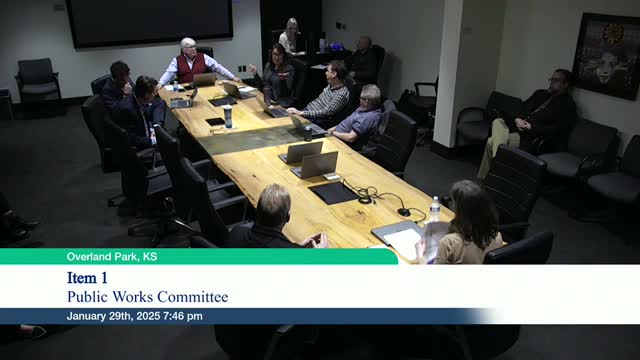
Lorraine, director of public works, gave the Public Works Committee a detailed debrief of the department’s snow operations after two consecutive storms in early January that produced freezing rain followed by heavy snow. The presentation described the timeline of response, the department’s priorities and staffing, equipment limitations experienced during the event, and planned follow-up actions including a self-assessment and periodic updates to the committee.
The storms began with sleet and freezing rain the evening of Saturday, Jan. 4, creating an initial ice accumulation. The first major snow event began in the early hours of Sunday, Jan. 5, and continued into that night with snowfall rates the department described as “about 1 and a half to 2 inches per hour.” By 9 p.m. Jan. 5 the department reported citywide accumulations ranging from about 10 to 13 inches, with an average near 11.5 inches. A second storm started the night of Jan. 9 and ended early Jan. 10, adding about 3 or more inches while the first event’s snowpack and frigid temperatures were still in place.
“The storm began Jan. 4 with freezing rain, quickly going to ice, massive amounts of snow, and so it required round upon operations,” Lorraine said, summarizing the conditions the crews faced. Lorraine described the city’s two-phase plow operations: initial operations focused on priority thoroughfares and collectors to preserve mobility, followed by secondary cleanup (bridges, intersections, cul-de-sacs) once priority routes were passable. She said typical storms of under 4 inches take roughly 24–48 hours to complete citywide under favorable conditions, but that the duration and temperature profile of these events extended operations from Jan. 4 through Jan. 17.
Lorraine reported what the department characterized as operational successes: broad coordination across departments and sustained crew effort. She said roughly 159 staff participated in the response and provided a staff-hours figure stated in the presentation as “75,100 plus staff hours” (as reported to the committee). The department also received both complaints and praise from residents during and after the response.
Committee members pressed on operational details and public communication. Councilmember Scott asked whether the city pretreated with a sand-and-salt mix; staff clarified the city is no longer using sand for pretreatment, relying instead on salt-based treatments to improve traction while avoiding spring cleanup issues. Councilmember Sam and others asked whether the city could stage contractors earlier in an event; Lorraine said contractors already operate about 13% of routes and that the department deploys additional contractors later to assist with cleanup such as cul-de-sac snow removal. The committee discussed trade-offs between holding additional contractor capacity year-round versus scaling up only for exceptional storms.
Several committee members and staff discussed the department’s public map and the automatic vehicle location (AVL) tracking used to show operations. Committee members described resident confusion when the public map appeared to mark streets “done” before they were cleared. Greg Scharf, a Public Works staff member, explained the AVL system lays “bread crumbs” behind vehicles and that some AVL units failed or reported incorrectly during the response; dispatchers sometimes asked drivers to verify coverage when the AVL trace did not match expectations. Lorraine said the department considers the internal operations tool functional for short operations but acknowledged it did not serve well for this extended event and that improving public-facing communication is a priority for the assessment.
Committee members also raised crew wellness and staffing experience. Lorraine said roughly half of snow plow drivers had one year or less of plowing experience and that about 75% had never plowed in conditions like those encountered during the storms. The committee discussed shift lengths, breaks and how to explain long-duration operations to the public.
Lorraine outlined next steps: a formal self-assessment of snow operations to examine scalability, contractor use, public communication (including mapping), and quality-control practices for trouble spots (for example, cul-de-sacs). She said the department plans interim updates to the Public Works Committee as improvements are identified and implemented. She invited councilmembers to submit questions and feedback during the assessment.
The committee praised staff for safety outcomes and the lack of major crashes or injuries during a prolonged response. Several members emphasized the need for clearer public communication about the department’s level-of-service priorities (thoroughfares and collectors first; residential streets and cul-de-sacs afterward) and for better troubleshooting and redundancy for AVL and public-map data.
Lorraine closed by reiterating that the event will inform an action plan to optimize snow operations before the next winter season and thanking staff and committee members for feedback.