Get Full Government Meeting Transcripts, Videos, & Alerts Forever!
Get email alerts on the Critical Infrastructure topic
No spam. Unsubscribe anytime.
Committee shifts reporting of land conveyances near critical infrastructure to Homeland Security; bill passes
Summary
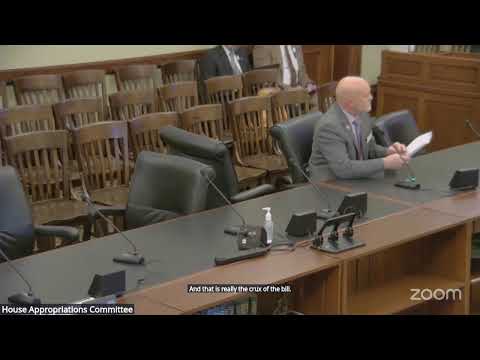
The House Appropriations Committee advanced House Bill 97 on a voice/roll call after adopting a clarifying change to how distance is described.
The House Appropriations Committee advanced House Bill 97 on a voice/roll call after adopting a clarifying change to how distance is described. The bill transfers from county clerks to the director of the Office of Homeland Security—and to the Division of Criminal Investigation—the responsibility for identifying recorded conveyances near designated critical infrastructure and investigating potential security concerns. The committee voted 7–0 to pass the bill with amendments.
The bill was presented to the committee by Representative Nicholas, who said the change responds to problems county clerks reported after last year’s foreign property ownership law. "The clerks didn't want to do it and they didn't really have the, the capacity, many of them to do it and basically the Office of Homeland Security said we can do it," Representative Nicholas said, summarizing the working group’s recommendation.
Committee counsel and staff described the mechanics: county clerks will continue to record and report all conveyances; they will no longer be required to determine whether a conveyance falls within a five-mile zone of critical infrastructure. Instead, the Office of Homeland Security and the Division of Criminal Investigation will use the governor's map of designated critical infrastructure zones and evaluate recorded conveyances to determine whether they are within—or "up to"—five miles of those zones, and whether any conveyance involves a designated foreign country or person under federal definitions.
Director Lynn Budd of the Office of Homeland Security told the committee the change reverses the prior flow of information and keeps sensitive zone data off county courthouse systems. "That is very sensitive information. ... We didn't wanna be putting that out into the wind," she said, describing why the state should control identification and investigation. Budd and other witnesses also flagged how a five-mile radius can cover entire population centers: "When talking about the 5 mile radius, if you look at a 5 mile radius around F. E. Warren Air Force Base, it covers the entire city of Cheyenne," she said, noting the department's interest in keeping zones as narrow as necessary.
Mary Langford, representing the County Clerk's Association, told the committee clerks support the compromise because clerks lack capacity to do the required comparisons and want to avoid storing sensitive critical-infrastructure information at county courthouses. She said clerks will electronically transmit recorded conveyances to homeland security and the Division of Criminal Investigation every 15 days as the bill requires.
Committee members debated language describing the five-mile measure. A motion by Representative Johnson (seconded by Representative Smith) struck the word "within" and replaced it with "up to" in three places to make clear the department's duty is a potential investigative scope rather than a mandatory investigation of every parcel within a literal five-mile ring; the committee adopted that change. An earlier proposed amendment to change a verb to "shall" died for lack of a second.
Under the bill, the statutory definition of "conveyance" is expanded to include leases and leasehold interests and the text brings the real-property definition into the bill rather than pointing to a different statute. The bill also updates a federal regulatory citation related to the definition of a "designated country or person." The bill sets an effective date of July 1, 2025.
Action and next step: the committee voted to advance the bill to the floor, and Representative Nicholas was designated to present the measure on the House floor.