
UN Mine Action Service warns of explosive-ordnance risk as civilians return to Gaza; reports rise in West Bank
Get AI-powered insights, summaries, and transcripts
Sign Up Free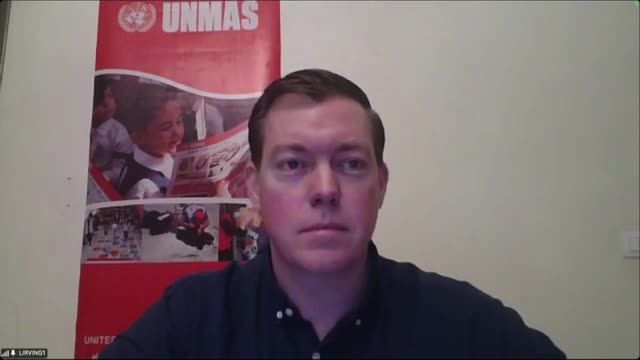
Summary
Luke Irving, head of the Mine Action Service in the occupied Palestinian territory, told a United Nations briefing that teams are finding aerial bombs, mortars, rockets, grenades and improvised explosive devices across Gaza and the West Bank as people return home and humanitarian access increases.
Luke Irving, head of the Mine Action Service in the occupied Palestinian territory, told a United Nations briefing that teams working in Gaza and the West Bank are encountering a wide range of explosive ordnance as civilians return to previously inaccessible areas and as humanitarian access increases.
Irving said the Mine Action Service and partners have documented a range of items "including aerial bombs, mortars, rockets, projectiles, grenades, and improvised explosive devices," and that such items "have killed and injured civilians in Gaza, and they have risked preventing humanitarian activities from taking place safely." He said primary data reported to the service's public information system show "at least 92 people have been killed or injured from explosive ordinance since October 23." Irving added that since the ceasefire he and colleagues have received unverified reports of 24 victims, averaging "over two people a day."
The nut graf: The United Nations Mine Action Service (UNMAS) said the threat of unexploded ordnance is both impeding humanitarian operations and posing immediate danger to civilians returning to homes and sites of damaged infrastructure. UNMAS described its current priorities as risk education for civilians and explosive-hazard assessments of critical infrastructure so humanitarian and public services can resume safely.
UNMAS told reporters that, as access has improved since the ceasefire, humanitarian convoys and returning residents increasingly find explosive items. "We accompany humanitarian convoys along the highest risk routes and conduct risk assessments of areas to see whether they're safe for activities to take place," Irving said. He said UNMAS and partners had "conducted 42 tasks in support of the humanitarian community since the ceasefire."
Irving described the agency's immediate operational priorities as: warning and educating civilians about explosive-ordnance risks, and conducting explosive-hazard assessments focused on hospitals, power stations, clinics and other infrastructure needed to restore services. "So the prioritization is the highest need humanitarian needs... hospitals, power stations, clinics, etc. — all the facilities to sort of return life back to normal is what we're prioritizing," he said.
On capacity, Irving said five highly qualified technical operators are currently working in Gaza and that the number "will double next month" as UNMAS and the wider mine-action community scale up. He repeatedly declined to estimate the total number of operators needed until baseline surveys better define the scope of contamination. On specific contamination levels across territory, he said it was "too soon to speculate" and emphasized that areas of active fighting typically produce contamination that only thorough survey work can map.
Discussing the West Bank, Irving said UNMAS has "reported a significant increase in the number of explosive items found over the past months throughout the West Bank, including in populated areas," and that the agency is providing risk education to internally displaced persons and working with the Palestinian Authority's mine action center on capacity building. He said reports of casualties in the West Bank had been received but were unverified.
On funding and access, Irving told reporters that the UNMAS operation in the occupied Palestinian territory does not currently receive U.S. funding for that operation and that, within the scope he can speak to, the program in Gaza was "unimpacted" by recent U.S. funding decisions. He also said UNMAS works with multiple stakeholders to secure permissions and logistics but did not provide detailed descriptions of those arrangements. When asked whether UNMAS would identify the origin of munitions, Irving said the unit's priority is to remove threats and "we don't speculate on where the weapon systems have come from."
Risk-education work noted by UNMAS includes leaflets, posters and training sessions tailored for different audiences — children, agricultural workers and humanitarian personnel — and accompanying convoys to the highest-risk routes. Irving said UNMAS and partners have delivered such education and are scaling these activities in line with humanitarian priorities.
The briefing did not record any formal decisions or directives by the United Nations beyond operational descriptions and priorities provided by Irving. UNMAS has operated in Gaza and the West Bank since 2009, Irving said. He described the scale-up as urgent but contingent on clearer access and on the results of baseline surveys.
The briefing was followed by reporter questions from outlets including the Associated Press, AFP and Reuters probing casualty details, contamination scope, the identity of munitions and whether U.S. funding decisions affected UNMAS operations.
Ending: UNMAS said it will continue to prioritize life-saving infrastructure and public risk education as teams scale up operations; precise contamination maps and a final toll of casualties will depend on expanded access and further survey work.