Get Full Government Meeting Transcripts, Videos, & Alerts Forever!
Get email alerts on the Homestead Exemption topic
No spam. Unsubscribe anytime.
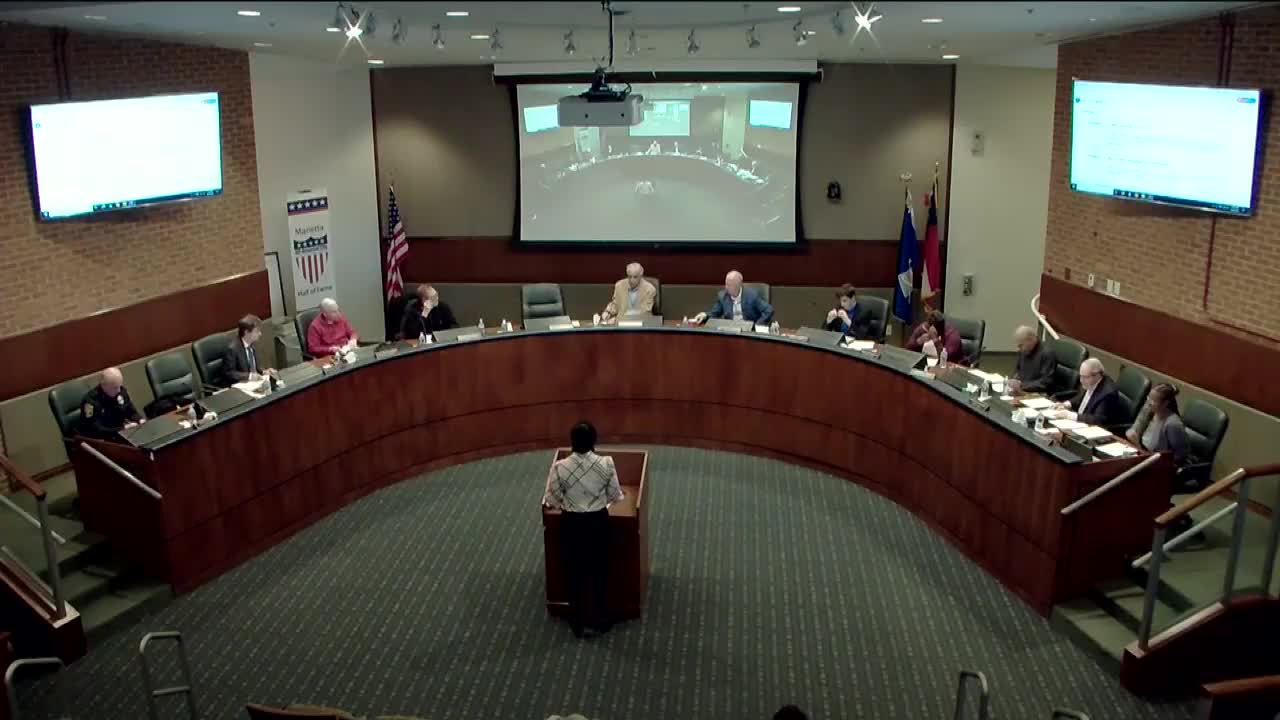
Marietta holds public hearing on HB 581; staff recommends opting out to keep local homestead freeze
Summary
City staff explained how HB 581's statewide "floating" homestead exemption differs from Marietta's longtime freeze during a public hearing; residents asked for clarifications about tax notices and how school and city tax lines appear on bills. No final vote was taken.
Interim Finance Director Bettina Brown walked the council and the public through the state law and how it compares with Marietta’s current homestead exemption policy.
Brown said HB 581, signed April 18, 2024 and contingent on a November 2024 referendum, "incorporates 3 new tax provisions" and includes "the implementation of the statewide floating homestead exemption," which she said "is gonna apply starting in 2025. ... It'll include an adjustment factor, and the adjustment factor allows the assessment of homestead properties to rise annually by the rate of inflation." Brown emphasized the difference between the state approach and Marietta's existing practice: "the homestead exemption that was established 23 years ago does not include an adjustment factor. So this is where I mean about a freeze. The inflation rate, unlike HB 581, is not included in Marietta's, floating homestead." (Interim Finance Director Bettina Brown.)
Why it matters: Brown and other staff told the council that Marietta’s local policy — a freeze of the taxable base year value for owner‑occupied homesteads so long as ownership does not change — is, in many cases, more favorable to long‑term homestead owners than the state’s CPI‑linked floating exemption. Brown said the city’s practice "provides the best benefit to the taxpayer, and that's why we're choosing to opt out." (Interim Finance Director Bettina Brown.)
What staff presented Staff gave numerical examples comparing a hypothetical home under (a) Marietta’s existing freeze, (b) the state’s floating homestead under HB 581, and (c) a non‑exempt home. In the staff example the home’s initial taxable value was $350,000; under the city freeze the taxable value remained $350,000 and the sample city tax bill stayed at $657. By contrast, staff showed that a comparable non‑exempt home’s taxable value rose to $425,427 and produced a city tax of $798 in the example; under HB 581 in that example the taxable value rose to $386,335 and the tax to $725.
Brown also told the public that state law requires jurisdictions to offer whichever exemption is most beneficial to the taxpayer when multiple local exemptions exist: "When a local jurisdiction has a base value exemption already in place, by law, the taxpayer must receive the exemption that is most beneficial." (Interim Finance Director Bettina Brown.) She reiterated operational points: if the city opts out of the statewide program it would not change Marietta’s current exemption practice or the city millage rate, and the city would still have to meet state advertising and disclosure rules when it sets a millage rate.
Public questions and staff responses Residents at the hearing pressed staff for plain‑language clarifications about why tax notices sometimes differ from final bills and why nearby homeowners can see different homestead values. "So what I'm trying to find clarification for is why does my neighbor get a different homestead floating exemption than I do from 1 year to the other and his taxes stay the same and mine go up?" Resident Adam Tillery asked. Tillery added that notices posted by the county can confuse homeowners because they are preliminary assessments and not final bills.
Brown and other city staff explained that the county assessor issues preliminary assessment notices that are estimates and that the city separately applies exemptions and final millage before bills are mailed; staff offered to pull an individual owner’s actual bills at the meeting and compare earlier notices to final billed amounts. Staff also noted that school taxes on a single mailed bill may change even when the city portion does not, because school and county assessments and exemptions are handled separately.
No formal action yet The council conducted the public hearing on HB 581 and closed the hearing after no one else came forward; staff indicated the city is prepared to pursue an "opt out" of the state's floating homestead method and recommended that course to preserve Marietta's existing freeze-style protection for long‑term homestead owners. Council did not take a final, recorded vote on the opt‑out at the hearing. Staff said further procedural steps — advertising and formal council action — would be required before a formal opt‑out is finalized.
What happens next Staff told the council the city will advertise the required disclosures during the billing cycle and that the council will consider the formal action at a subsequent meeting. The city also plans to hold additional hearings and to publish explanatory material on the city website; staff said the same charts shown at the hearing are available online.
Speakers cited Interim Finance Director Bettina Brown, city staff member (conducting presentation), Resident Adam Tillery (public commenter). Ending note: Council held the public hearing, accepted public comment and closed the hearing; no formal vote was recorded on whether Marietta will opt out of HB 581 at this meeting.