Get Full Government Meeting Transcripts, Videos, & Alerts Forever!
Get email alerts on the Budget Finance topic
No spam. Unsubscribe anytime.
City finance staff present cost-allocation study; board debates timing and water/sewer impacts
Summary
A draft cost-allocation study based on 2023 data shifts more overhead to the general fund and would provide little relief to the water and sewer fund for 2024; directors urged delaying implementation to 2025 and discussed alternatives to protect bond covenants and address water leaks.
Andy Richards, the city’s chief financial officer, presented a draft departmental cost-allocation study at the Fort Smith Board of Directors study session on Jan. 28, 2025.
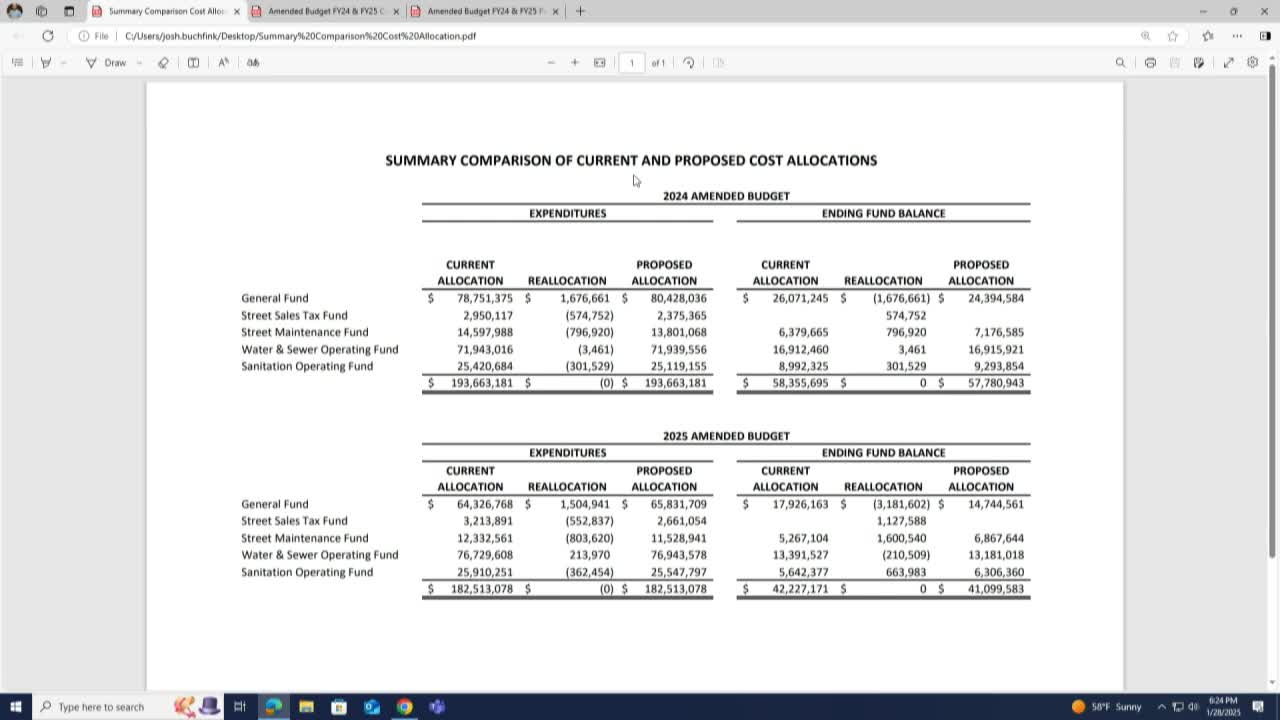
Richards said the study—prepared by Landmark and based on 2023 data—had two parts: a review of an indirect cost rate and a direct allocation of departmental costs across funds. He said the report estimated indirect cost rates around 10.63 percent but noted the federal de minimis administrative rate for grants had risen from 10 percent to 15 percent, making the simpler de minimis approach more beneficial for grant charging. Richards recommended applying changes beginning in 2025 rather than retrospectively to 2024 because the reallocation did not achieve the intended relief for the water and sewer fund in 2024.
Using the draft percentages on the amended 2024 budget would shift $1,676,000 in costs to the general fund, Richards said; the sales-tax fund’s allocation would fall by $574,000, the street maintenance fund would see $796,000 in relief, and the water and sewer operating fund would gain only $3,400 in relief. For some scenarios Richards showed a total cumulative reallocation of $3,181,000 to the general fund when both 2024 and 2025 adjustments are applied; implementing only for 2025 would reduce that adjustment to about $1,504,000. Richards also noted a recent $4,000,000 building purchase had not been included in his figures because the amendment posted after he ran the numbers.
Directors debated the study’s underlying data, the timing of implementation and priorities for which allocations should remain in the general fund. Director Settle argued that basic government services—mayor and board, city administration, city attorney and sustainability—should be funded by the general fund rather than charged to enterprise funds; he estimated shifting those five departments out of non-general-fund allocations would total about $2,320,000, with roughly $1.2 million of that coming from water and sewer. Director Neil Martin and others pressed for preserving more funds in water and sewer to protect debt-service coverage tied to a consent decree and upcoming bond financing. Martin said $9,160,000 currently comes out of water and sewer to fund other services and urged greater protection of water and sewer balances to avoid additional rate increases.
Directors also noted one-time changes of city practice: removing merchant credit-card processing fee subsidies would reduce charges currently allocated to utilities. Richards confirmed the city’s total credit card fees were roughly $1,500,000 citywide, of which about $800,000 had been charged to water and sewer in the past. Several directors described the city as facing near-term budget and covenant risks: Richards said the city’s debt-service coverage was 108 percent in 2023 (below a 110 percent target) and cautioned that persistent shortfalls could lead to bond-rating downgrades and higher future borrowing costs.
Multiple directors urged more direct investment in water system repairs—particularly leak repair and related capital—to reduce operating losses and improve long-term fiscal position rather than shifting allocations in ways that do not address the root causes. Director Kemp suggested a “stair-step” approach and temporarily postponing retroactive application to 2024; Richards recommended implementing the new allocation percentages in 2025 and continuing to refine the model and assumptions.
No formal board action was taken at the study session. Directors asked staff to return with clearer year-end numbers, updated debt-service coverage estimates and more information about how allocation changes would affect water and sewer before making any final decision.
Why it matters: The cost-allocation study determines how internal administrative expenses are distributed across enterprise and operating funds. Changes affect the general fund balance, enterprise fund coverage of debt covenants and the level of rate pressure placed on utility customers.
What’s next: Staff to finalize 2024 year-end figures, re-run allocation impacts with updated data and present options—including a 2025-only implementation and alternatives focused on protecting water and sewer funds—before the board takes final action.