Get Full Government Meeting Transcripts, Videos, & Alerts Forever!
Get email alerts on the Communications topic
No spam. Unsubscribe anytime.
Consultants present communications assessment; city schedules Feb. 27 virtual workshop
Summary
Consultants from Tripeppi Smith summarized a yearlong audit of Richland’s communications, highlighted platform reach and gaps, and recommended measures including a stronger email strategy, monthly metrics reporting and consideration of Nextdoor. A virtual community workshop is set for Feb. 27 to help prioritize implementation.
Consultants from Tripeppi Smith presented a communications assessment to the Richland City Council on Jan. 28, detailing platform metrics, audience reach and recommended steps for a citywide strategic communications and community engagement plan.
The consultants said the assessment reviewed a full year of the city’s digital platforms (September 2023–September 2024), interviews with staff and stakeholders, and the city’s community survey that informed the 2024 strategic plan. They recommended a mix of quicker “wins” and longer-term investments, and scheduled a virtual community workshop for Thursday, Feb. 27 at 6 p.m. to get public priorities before drafting an implementation plan.
The report summarized how many residents the city currently reaches on each channel and noted distribution limits on social platforms. Ryder Smith, a consultant with Tripeppi Smith, said the firm’s working principle is “content times distribution equals impact,” and argued the city should pair stronger content with targeted distribution so produced materials are actually seen.
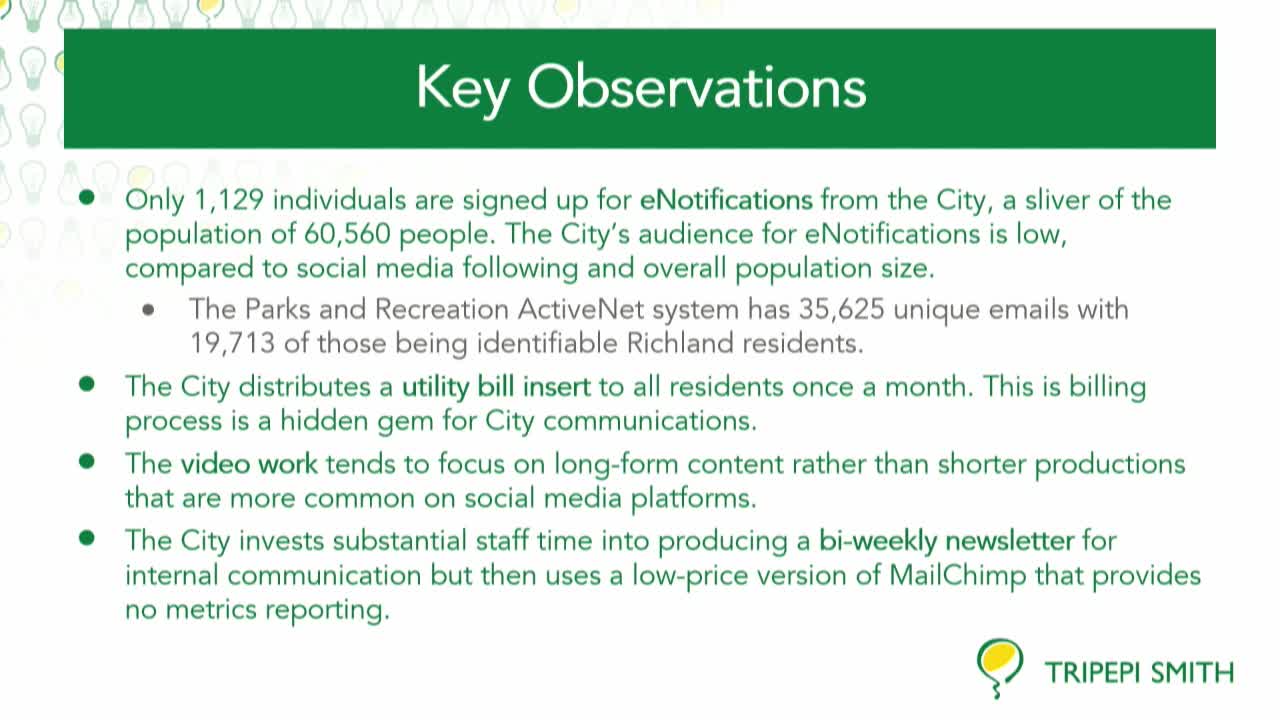
Key findings the consultants highlighted include: an estimated city population of about 63,000; Facebook followers for the city page at roughly 18,000; registered voters at about 41,000; Instagram and LinkedIn followings noted in the tens of thousands; and a business email list in the mid‑20,000s. The consultants noted Facebook’s organic distribution often reaches only about 4–7% of followers, while Nextdoor can yield 25–50% distribution for local audiences. Sydney Overly said the team pulled platform metrics through a social‑media management tool and can provide definitions of the engagement measures on request.
Recommendations in the assessment include: adopt a monthly metrics report to measure reach and prioritize spending; strengthen the city email strategy as a low‑cost direct channel; consider adding Nextdoor to platform mix while weighing monitoring capacity; formalize brand pillars and a style guide; and expand distribution tactics (boosted posts, geotargeted ads) to make videos and other investments more effective. The city has already hired a new graphic designer, a point the consultants flagged as addressing one recommended item.
Consultants described a two‑phase approach: the assessment (completed) and a phase to convert findings into a prioritized strategic plan with cost estimates and timelines. They said phase‑two work will map to staff capacity and budget priorities and aim to return a draft plan in roughly three months. The Feb. 27 virtual workshop will feed public input into that prioritization.
City communications staff and council members posed questions about resource allocation, youth engagement, and whether the city should push more people to the city website as the system of record. Consultants said email remains “the killer app” for direct outreach when the city has sufficient penetration, and that some content can be repurposed across platforms to improve ROI.
The consultants also recommended using utility‑bill inserts and variable message boards as high‑reach, non‑digital touchpoints. They stressed monitoring and responsiveness—acknowledging public feedback and acting on it—as essential to maintaining trust during major initiatives.
The consultants will return with a draft strategic plan and proposed implementation steps if the city proceeds with phase two.