Get Full Government Meeting Transcripts, Videos, & Alerts Forever!
Get email alerts on the Year End Report Strategic Plan topic
No spam. Unsubscribe anytime.
Homelessness Oversight Commission to draft year-end report, form working group for 2025 strategic plan
Summary
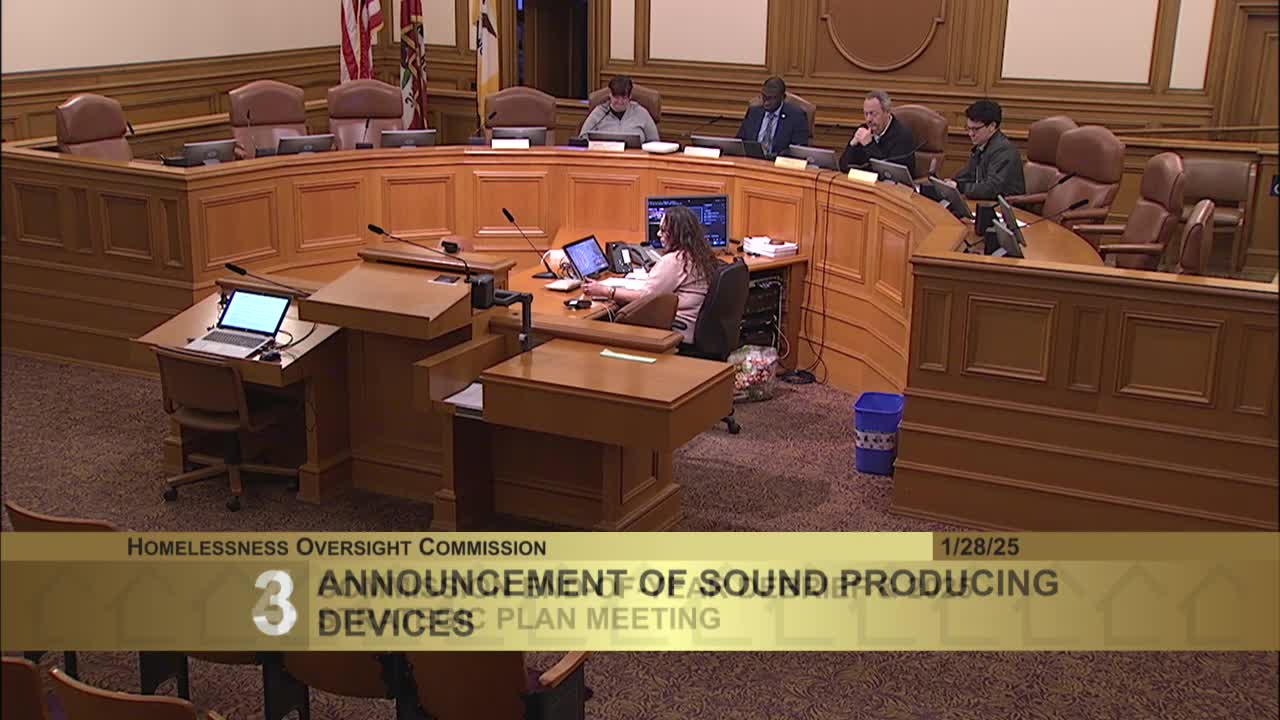
The San Francisco Homelessness Oversight Commission met Jan. 28 at City Hall to prepare a year-end report of its first two years and to form a working group to develop the commission’s input on a 2025 strategic plan.
The San Francisco Homelessness Oversight Commission met Jan. 28 at City Hall to prepare a year-end report of its first two years and to form a working group to develop the commission’s input on a 2025 strategic plan.
The commission’s chair, Jonathan Butler, opened the meeting saying the session would “prepare for our year end report summarizing our accomplishments from last year and also to establish a working group tasked with developing our 2025 HOC strategic plan.” The meeting focused on commissioners’ reflections about the commission’s role, oversight activities to date, data and transparency needs, and how the body should engage with the Department of Homelessness and Supportive Housing and other agencies going forward.
The commission emphasized public education, data transparency and clearer lines of collaboration with city departments and providers. Vice Chair Kristen Evans said commissioners should aim to be constructive partners for the department: “I want to continue to move towards being additive to the department and not creating a relationship where they feel like they just have to placate us,” she said. Chair Butler told the commission he would “ask as a working group, commissioners, Evans, Guerrero and myself to work together” to draft the year-end materials and strategic-plan input.
Members reflected on accomplishments and remaining gaps. Commissioners highlighted the commission’s role in public outreach and convening, the development of a public-facing data video, and increased appointment activity to advisory bodies the commission fills. Commissioners noted concrete oversight findings raised in the past two years: racial disparities in eviction data from permanent supportive housing; persistent vacancies in PSH that the department and providers have at times addressed with one-time repairs; and shelter “denial-of-service” exit rates the commission discussed, which staff reported at roughly 7% systemwide and up to about 15% at some sites. Commissioners also flagged the recent point-in-time count, noting it showed an increase in homelessness for the first time in the period discussed, and raised concerns about outcomes for transition-age youth.
Budget transparency and the department’s vacant positions were named as areas where the commission could add value. Commissioners proposed compiling clearer budget context (for example, what a dollar figure represents within a multi-year contract or the department budget) and examining long-standing vacant positions to evaluate whether funds could be repurposed to housing or services.
The commission agreed on several concrete next steps. Commissioners Butler, Evans and Joaquin Guerrero will serve as a working group to draft a year-end report that: tracks statutory duties (as set out in the ordinance creating the commission), enumerates meetings and hearings (the commission cited 22 meetings since its formation), summarizes major hearings and data findings, and proposes a process for ongoing review of budgets and performance standards. Commissioners suggested producing an executive-summary snapshot for public distribution plus a fuller report for the record, and a 360-degree feedback effort soliciting input from the department, providers and people with lived experience.
Public commenters urged better access to policies and procedures (for example, clearer indexing of shelter, SRO and related rules) and said the commission could use the year-end report to help explain what the commission can and cannot change. Commissioners raised the idea of short informational materials or a brief SFGTV segment explaining the commission’s role and the three bodies to which the commission appoints members (the Local Homeless Coordinating Board, the Shelter Monitoring Committee and the Shelter Grievance Committee).
No formal votes were taken on the strategic plan or the year-end report at the meeting; the working group is to draft materials for future commission review. The one recorded motion was a procedural motion to adjourn, which was moved and seconded and carried by voice at the end of the meeting.
The commission scheduled follow-up agenda time in upcoming monthly meetings to address statutory duties item-by-item so that each meeting can dedicate time to a specific statute-driven oversight task and feed material to the working group.
Commissioners repeatedly commended Director McFadden’s leadership of the department; several said they want to maintain constructive dialogue between the commission and the mayor’s office. Commissioners also reiterated a recurring theme of this body’s oversight work: oversight is distinct from management, and the commission’s most practical power has been to surface data, convene stakeholders and recommend changes rather than to directly implement department operations.
The meeting adjourned after public comment and brief closing remarks.