Get Full Government Meeting Transcripts, Videos, & Alerts Forever!
Get email alerts on the Immigration Policy topic
No spam. Unsubscribe anytime.
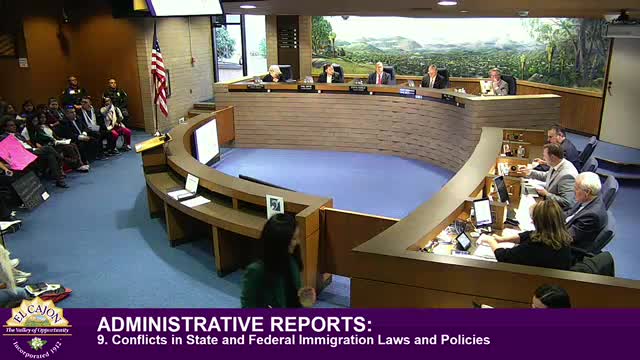
El Cajon council fails to adopt resolution on cooperating with federal immigration enforcement after marathon public comment
Summary
After more than three hours of public testimony and council debate, the El Cajon City Council declined to adopt a proposed resolution about cooperating with federal immigration authorities and SB 54, with two separate motions failing on 3–2 votes.
The El Cajon City Council on Jan. 28 considered a staff‑drafted resolution aimed at clarifying whether the city would cooperate with federal immigration enforcement and how that intent squared with California’s SB 54 (the California Values Act). After more than 100 members of the public spoke for and against the proposal and council members debated alternate language, council members declined to adopt the measure when two competing motions both failed on 3–2 votes.
City Manager Grama Mitchell, who introduced the item to the council, said staff had reworked the language after the council’s earlier direction and the office of the California attorney general had replied to the city’s questions. “The revised version says the City of El Cajon declares its intent to comply with the enforcement of federal immigration law to the legal extent permissible under SB 54,” Mitchell told the council, adding staff had prepared the draft to request clarification and to make the city’s public‑safety goals explicit.
The proposal touched off a sustained public comment period: attendees delivered sharply divergent views on whether local police should assist ICE in locating people who illegally re‑entered the country or whether such cooperation would erode trust between immigrant communities and local law enforcement. Dr. Joanna Rose Benavides, a retired U.S. Air Force veteran, told the council, “By involving local police in ICE activities, you're shattering the trust between community and law enforcement.” Maria Chavez, immigration legal director for the Partnership for the Advancement of New Americans, said, “Policies that prioritize detention and expedited removal jeopardize community trust and the economic stability of our city by targeting our families.”
Council members debated the legal and practical limits of any local action. Several speakers — including Councilmember Steve Goble and others who urged cooperation with federal authorities — said their priority was removing violent criminals from the community. The city manager’s memo and public packet acknowledged a tension: SB 54 restricts local law enforcement cooperation with federal immigration authorities in many circumstances, while the city also has an interest in removing violent offenders.
Councilmember Michelle (listed in the record as Michelle) framed the issue as one of public safety and trust. She said the meeting exposed a range of community concerns and emphasized the different circumstances that separate a low‑level immigration violation from a violent criminal act. Mayor Bill Wells moved to adopt a resolution declaring the city’s intent to cooperate with federal immigration enforcement to the extent legally permissible; a substitute motion proposing alternate wording was offered and considered first.
Both motions failed. The substitute motion failed on a 2–3 vote that was announced as “Motion fails by a 2–3 vote with Mayor Bill Wells, Councilmember Ortiz and Councilmember Mitchell voting no.” After returning to Mayor Wells’s original motion, the council again did not reach the votes needed: the council clerk announced the original motion failed with Councilmember Gary Kendrick, Mayor Bill Wells and Councilmember Mitchell recorded as voting no. Because neither proposal passed, the council did not adopt formal direction or a new policy on cooperation with federal immigration enforcement.
The meeting record shows the council and staff repeatedly referred to the Jan. 19 response from the California attorney general’s office and to the legal framework of SB 54 and the U.S. Constitution’s supremacy clause. Multiple commenters raised practical and humanitarian concerns — including possible chilling effects on reporting crimes, on children attending school, and on residents seeking medical care — while other speakers urged the city to take every available step to remove violent criminals they said were present in the region.
The council did not set a new timeline for further action on the item during the meeting. After the votes and a short closed session on unrelated litigation, the council adjourned and scheduled its next regular meeting for Feb. 11, 2025. Staff did not present a substitute resolution that passed; the city remains operating under existing state and federal law and the interpretations communicated by the attorney general’s office, according to materials given to council members.
The agenda item and public comment drew an unusually large turnout, representing a broad cross section of community organizations, residents and local nonprofit legal advocates. Speakers represented positions ranging from calling for unconditional cooperation with federal immigration enforcement for removal of violent offenders to urging the council to decline measures that would involve local police in immigration enforcement and that might erode trust with immigrant communities.