Get Full Government Meeting Transcripts, Videos, & Alerts Forever!
Get email alerts on the Rezoning Hampton Road topic
No spam. Unsubscribe anytime.
DeSoto planning commission backs reduced Hampton Road rezoning, forwards recommendation to council
Summary
The City of DeSoto Planning and Zoning Commission voted 6–1 to recommend that City Council rezone 221 properties along Hampton Road to five new character-code districts (case Z1514-24), after staff described a smaller boundary and public outreach that produced 20 written objections and dozens of phone calls and emails.
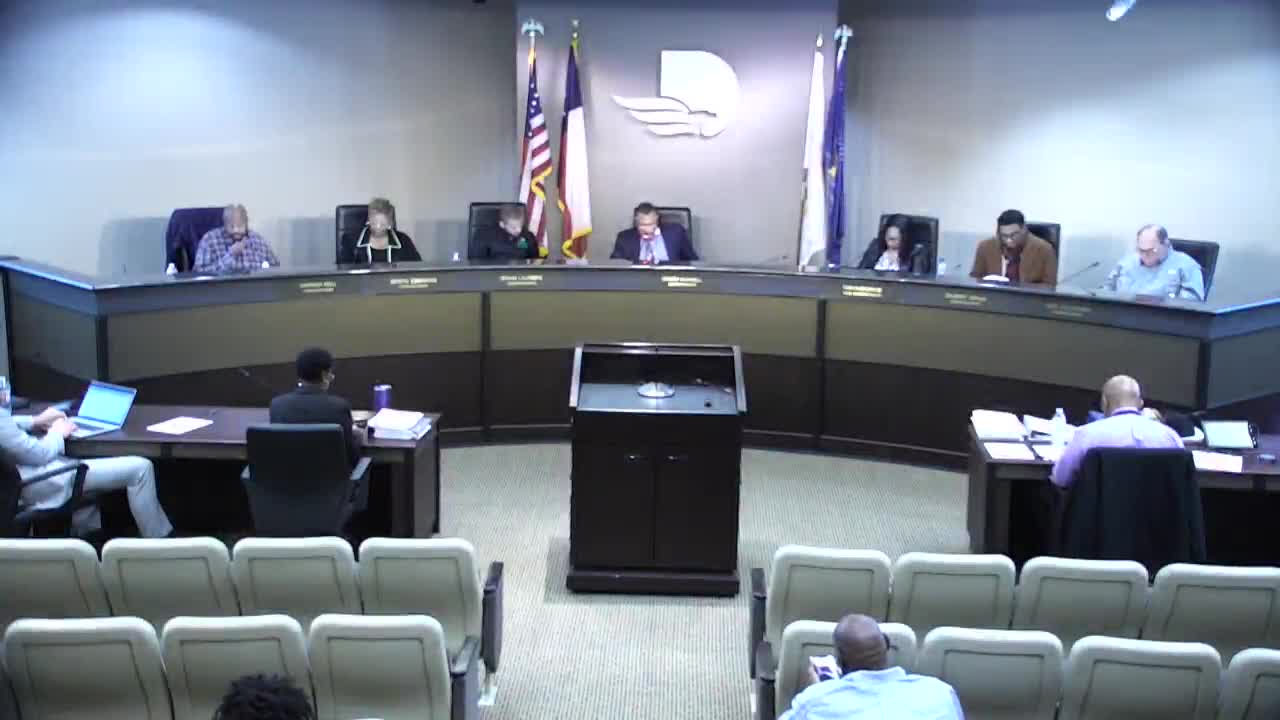
The City of DeSoto Planning and Zoning Commission on Jan. 28 voted 6–1 to recommend City Council approve a rezoning of properties along the Hampton Road corridor, forwarding case Z1514-24 for a final decision at the Feb. 18 council meeting.
Planning staff described the item as a request to rezone properties within a reduced, “reenvisioned” Hampton Road character-code boundary into five new districts — Urban Center, Urban General, Neighborhood Services, Urban Neighborhood and Neighborhood Transition — that would allow combinations of retail, offices and mixed housing along the corridor. “This is a request for the commission to conduct a public hearing and consider making a recommendation to the city council regarding the rezoning,” Planning Manager (presenter) said during the staff presentation.
The proposal narrows an earlier, larger rezoning area. Staff told commissioners the original boundary covered more than 400 properties; the reduced boundary before the commission includes about 221 parcels. Staff said the smaller area was created in response to earlier resident opposition and to limit the number of properties that would become nonconforming under the new rules; staff estimated 21 properties in the reduced boundary would become nonconforming.
Why it matters: The rezoning is intended to create concentrated mixed-use development along Hampton Road — with ground-floor restaurants and retail and apartments or townhomes above — and to attract developers who have reportedly expressed interest but were awaiting zoning changes. Staff and multiple commissioners said the changes are part of a longer planning effort that includes a 2005 Hampton corridor redevelopment plan, a 2019 economic assessment, a 2022 Tax Increment Reinvestment Zone and streetscape plan, and the city’s new comprehensive plan adopted in December 2024.
Public comment was split but leaned against the rezoning among those who engaged directly. Staff said 883 mailed notices were sent to property owners and residents within the rezoning area and the 200‑ and 400‑foot notification rings. Staff reported receiving 20 written letters in opposition (six from owners inside the rezoning area and 14 from addresses within the 200‑foot notification ring), about 9–10 emails, and roughly 50–60 phone calls or in‑person inquiries at the planning counter since Jan. 16, the date staff said the letters were delivered to the post office. “The date the letters were sent to the post office was January 16,” Permit Technician Trent Carroll said.
Speakers raising concerns focused on traffic, notification timing and impacts to specific properties. Charlondra Thompson, speaking for property owner Val Berkeley, said the owner’s half‑acre corner at Hampton and Pleasant Run would be an “island” of rezoned property that makes mixed‑use redevelopment “difficult or impractical.” Other speakers said they had received late mailings, worried about traffic with increased density, or wanted more time and clarity on design details such as setbacks and unit sizes.
Supporters, including several business owners and developers who spoke, said the corridor rezoning would bring restaurants, shops and housing options that DeSoto lacks. “This development will bring a lot of good things into the City of DeSoto,” said Isak (Ashley) Ahmed, a property owner who said he plans a multimillion‑dollar strip center in the rezoning area.
Commission discussion touched on several procedural and policy points: how the city notified residents (mailings, postcards, digital message boards and multiple public meetings), the role of the Zoning Board of Adjustment if a property owner seeks a variance after a catastrophic loss, and the percentage thresholds in state law and city code that govern nonconforming‑use rebuild rules. Assistant city staff and the planning director (Mr. Brewer) told the commission that Texas Local Government Code 211 and the city zoning ordinance establish the framework for nonconforming uses and that the Zoning Board of Adjustment is an independent quasi‑judicial body that hears hardship appeals.
Staff also explained notice differences required by state law and a recent statute requiring special language for certain property notices; staff said the special language (sent to a subset of 23 owners whose curb‑side uses appeared likely to become nonconforming) was included pursuant to Senate Bill 929 and city practice. Staff said larger public outreach included six informational meetings in December and January and that the meetings drew 38 participants in total.
The commission’s recommendation: Vice Chair Brooks moved and Commissioner Bell seconded a motion to recommend approval of the rezoning to City Council. The motion passed with a vote tally the chair recorded as 6 in favor and 1 opposed; the recommendation will go to the City Council for a final vote on Feb. 18.
What happens next: The matter will be published in the city’s official newspaper and go before the City Council on Feb. 18. City staff said they will continue outreach and that property owners outside the reduced boundary are not removed from future consideration; staff said additional rezoning could be revisited at a later date.
Numbers and key details from the hearing: staff reported 221 parcels in the reduced boundary, 21 parcels that would be nonconforming under the proposed zoning, 883 mailed notices, 20 written letters of opposition, six informational meetings in December–January (total attendance reported as 38), about 9–10 emailed comments and roughly 50–60 phone inquiries at the planning counter. Final action on the rezoning is scheduled for Feb. 18 before the City Council.
Commissioners and staff thanked Planning Manager (presenter) for her presentation and public outreach work; the commission closed the public hearing and forwarded the recommendation to council.