Get Full Government Meeting Transcripts, Videos, & Alerts Forever!
Get email alerts on the Storm Recovery topic
No spam. Unsubscribe anytime.
Austin Energy reviews winter‑weather readiness, damage assessment and outage‑communication upgrades
Summary
Austin Energy described winter-weather safeguards and storm-recovery improvements, including increased substation inspections in winter, a formal damage-assessment process with phased restoration priorities, expanded mutual aid, and outage-map and notification upgrades.
Austin Energy Chief Operating Officer Lisa Martin briefed the committee on winter-weather preparedness and recent enhancements to storm recovery after lessons learned from prior storms.
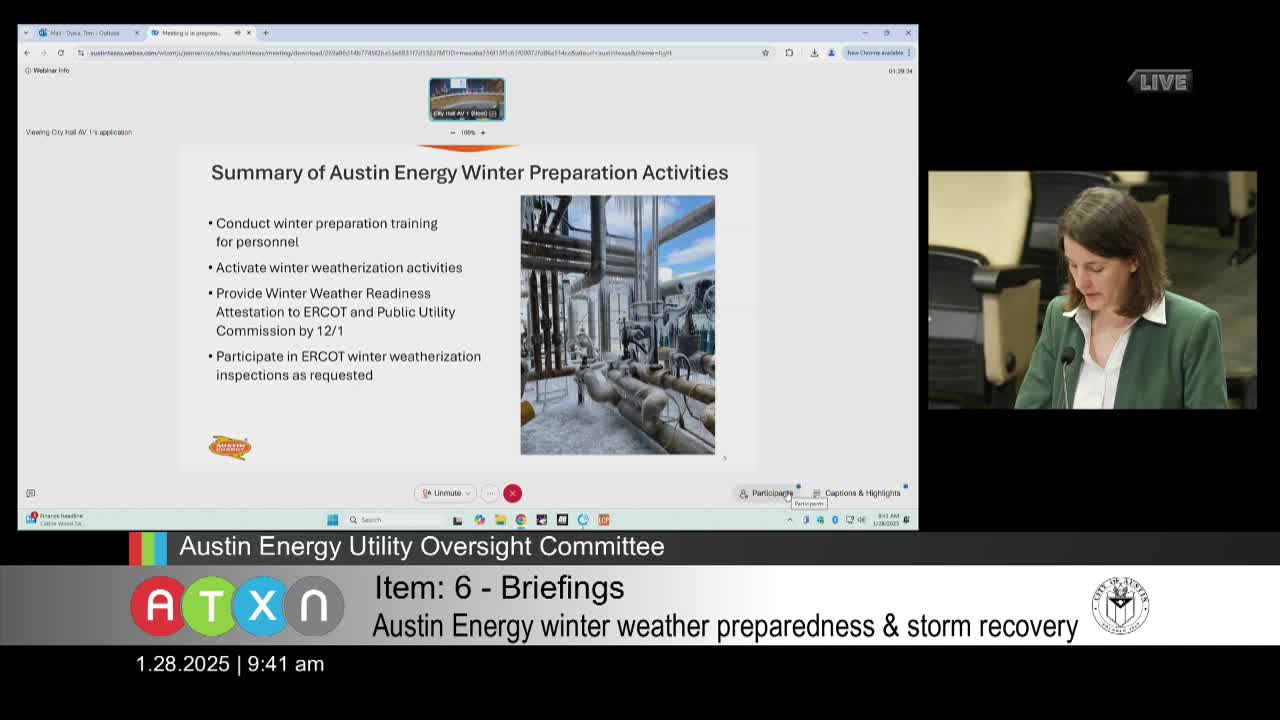
Martin said the utility increases substation inspections from every 8–12 weeks to monthly during winter, installs protective measures (insulation blankets, heat tracing and wind barriers) at plants and substations, and that the general manager signs an annual Winter Weather Readiness attestation to ERCOT and the Public Utility Commission of Texas.
Martin described a clarified, three-phase restoration prioritization: Phase 1 restores the backbone of the grid (critical loads and main circuit breakers at substations); Phase 2 addresses large outages serving hundreds of customers; Phase 3 resolves small, localized outages (singles and doubles), which sometimes require customer-side repairs before crews can safely restore power.
To speed Phase 3 resolution, Austin Energy created “single ticket teams” that assess customer-side damage earlier in the process and leave door hangers with guidance and contact information. Martin said the utility has expanded mutual-aid agreements and maintains membership in statewide and national mutual-aid networks; the utility also both sends and receives assistance when large events require additional crews.
On customer communications, Martin said Austin Energy uses an online outage map (vendor: COBRA), improved the platform’s capacity after the 2023 ice storm, implemented auto‑enrollment for outage notifications for customers with a phone number on file, and updated automated messaging templates to reduce timeouts and duplicate messages.
Council members asked about metrics and reporting cadence. Martin said reliability metrics include frequency and duration indices (System Average Interruption Frequency Index and duration measures) and that she provides a quarterly operations report on a cadence of the second month of every quarter.
Language and access: Council members raised translation and accessibility for door hangers and QR codes. Martin said communications are translated into multiple languages and call center support can locate a translator when needed; council members suggested adding QR codes for translated content directly on door hangers.
Ending: Martin said the utility continues to refine incident management, staffing for damage assessment, mutual-aid processes and emergency-management software integrations, and will bring ongoing updates to the committee.