Get Full Government Meeting Transcripts, Videos, & Alerts Forever!
Get email alerts on the Resource Generation Plan topic
No spam. Unsubscribe anytime.
Austin Energy outlines implementation steps to meet 2035 carbon‑free goal; battery storage RFP to launch
Summary
Austin Energy officials summarized next steps to implement the Resource Generation and Climate Protection Plan 2035, including newly launched solar offerings, a battery storage RFP this month and an aim to reach at least 125 megawatts of storage by 2027.
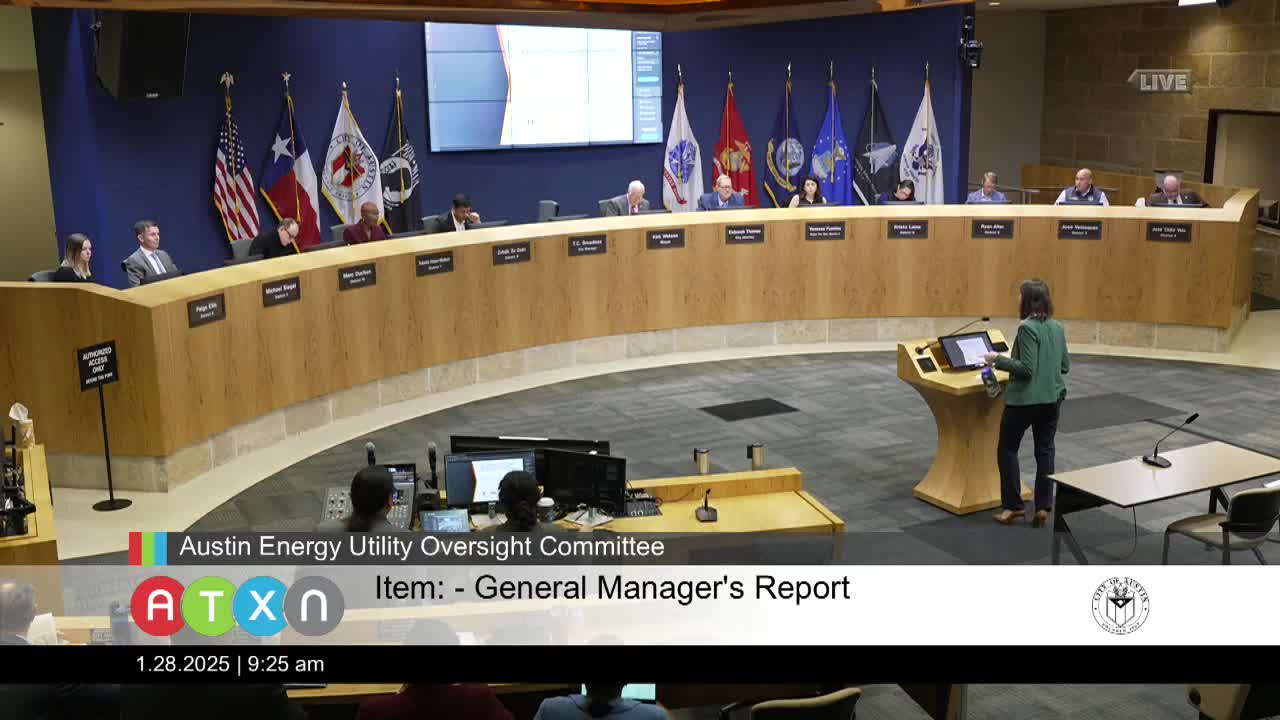
Lisa Martin, Austin Energy’s chief operating officer, briefed the Austin Energy Utility Oversight Committee on implementation priorities for the recently adopted Resource Generation and Climate Protection Plan 2035.
Martin said the plan — which the committee heard was approved unanimously in December — sets a target of 100% carbon-free electricity by 2035 and establishes an ‘‘order of priority’’ that begins with customer energy solutions such as rooftop solar, energy efficiency, demand response and batteries.
Key near-term items Martin listed include the launch earlier this month of a solar standard-offer program, an upcoming study on market potential and greenhouse-gas avoidance, a battery-storage request for proposals (RFP) expected by the end of the month, and a geothermal pilot expected to break ground in the near term. On storage, Martin and staff told the committee they plan to solicit roughly 100–150 megawatts of 2-, 3-, or 4-hour energy storage through power-purchase agreements and have a goal of getting “at least 125 megawatts by 2027.”
Martin described why the metric for carbon-free generation can fluctuate: Austin Energy reported 72% carbon-free generation for fiscal year 2024, compared with higher shares previously (the utility was at about 77% in 2022), and Martin cited load growth, transmission congestion and occasional curtailment as causes for variability.
Reporting and oversight: Martin said the plan commits Austin Energy to an annual council check-in on progress and semiannual, more granular reporting on topics such as local battery installation, stack emissions, progress toward ending coal use, and carbon-intensity guardrails.
Longer-term items Martin listed include greenhouse-gas avoidance tracking, a full suite of beneficial electrification incentives, a distributed energy resource management system, work to increase transmission import capacity, continued innovation work and exploration of advanced nuclear.
Council questions focused on whether Austin could increase storage targets, benchmarking against larger municipal utilities, and timing for adoption of the 2024 International Energy Conservation Code. Martin repeated that the battery RFP will use PPAs for quicker procurement and reiterated the 125-megawatt target by 2027; she said the IECC code package is planned for an April council adoption and will be presented as part of a coordinated building-code update.
Ending: Martin said staff will return to the committee semiannually and provide the annual plan check-in to Council so elected officials can monitor progress against the plan’s guardrails and goals.