Get Full Government Meeting Transcripts, Videos, & Alerts Forever!
Get email alerts on the Land Use Assembly Venues topic
No spam. Unsubscribe anytime.
Bountiful council hears amended Lakeview Mortuaries proposal to allow event venues in residential zones; raises noise and traffic concerns
Summary
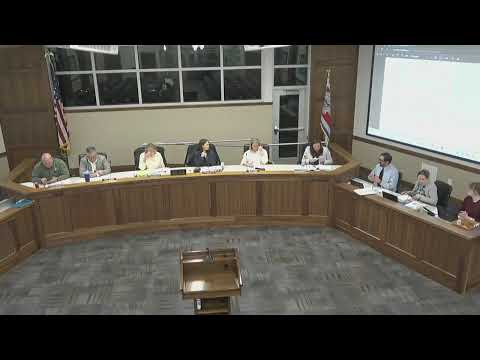
The Bountiful City Council on Jan. 28 reviewed a staff report and a Planning Commission recommendation on a code amendment proposed by Lakeview Mortuaries to permit public or private assembly uses in residential zones, with the matter returned to staff for code language and conditions.
The Bountiful City Council on Jan. 28 reviewed a staff report and a Planning Commission recommendation on a code amendment proposed by Lakeview Mortuaries to permit public or private assembly uses in residential zones, with the matter returned to staff for code language and conditions.
The proposal would add a defined “assembly” use to the land‑use code and allow such uses only after approval through a conditional-use permit or by specific code provisions. The applicant amended its request during the application process to propose a minimum site size of 10 acres (up from 3 acres in the Planning Commission recommendation), a minimum setback of 150 feet from property lines (up from 75 feet), restricted access routed to Bountiful Boulevard, and a maximum measurable sound level of 78 decibels measured at 150 feet from the gathering space.
The amendment attracted sustained council discussion because the proposed venues could bring larger gatherings close to existing single‑family neighborhoods. Francisco (planning staff), who presented the staff report coauthored with Amber Corbridge, said the Planning Commission forwarded a positive recommendation and that the applicant’s updated proposal came after a Jan. 16 meeting with staff. Francisco noted that the land‑use action could be implemented either by adding a permitted/conditional use in the code or by handling mitigation through conditional‑use review at the project level.
Council members repeatedly identified three central concerns: spatial separation from residences, traffic and driveway placement, and event noise. Councilman Higginson said he was “not super comfortable introducing this use to that part of our city,” citing the intensity of events and the location on the hillside. Councilwoman Bradshaw and others described how sound can travel downhill and affect neighborhoods below Bountiful Boulevard; Bradshaw said outdoor events “would be impactful to those neighborhoods.”
Several council members questioned specific elements of the applicant’s package. The applicant’s written materials (included in the staff packet) state the venue operator would limit access to Bountiful Boulevard and would submit a traffic study as part of a conditional‑use/site‑plan process. The applicant representative explained the motivation was to provide a nonreligious, multiuse space for memorial services and receptions and said the setback and the 78‑decibel cap were offered to address neighborhood concerns.
On hours and amplified sound, the applicant initially proposed restricting operating hours rather than altering the citywide noise ordinance; staff noted Bountiful’s current noise period extends to 11 p.m. Some council members proposed a stricter limitation on outdoor amplification. One council member suggested “no amplification outdoors after 9 p.m.,” while others favored 10 p.m. and noted the council, as the legislative body, could set a different standard for this use. The council did not take a formal vote at the work session; instead members gave directional guidance to staff. Francisco summarized that staff had the direction needed to draft code language reflecting the applicant’s amended proposals and the council’s limits on outdoor amplification, with outstanding differences about whether the cutoff should be 9 p.m. or 10 p.m.
On traffic, opinions split. Several council members requested a traffic and parking study to evaluate driveway location and neighborhood circulation; others said existing arterial patterns made a study unlikely to change expectations. Francisco told the council that the typical process is to require traffic analysis as part of a concurrent site‑plan and conditional‑use submittal and that the Planning Commission could make the traffic study a condition of approval. The council did not make a final decision to remand the item to the Planning Commission; several members said remand would be appropriate if the council wanted the commission to address specific additional directions.
The Planning Commission’s positive recommendation (reported by staff as unanimous) and the applicant’s amended text are now to be formalized in draft code language for a future legislative hearing and/or conditional‑use process. No ordinance or permit was approved at the Jan. 28 work session.
What’s next: Staff will prepare draft code language and conditional‑use criteria reflecting the council’s direction (including the applicant’s amended setbacks and measurable noise limit). The matter is expected to return for formal consideration in a regular meeting or to the Planning Commission if the council directs remand.