Tennessee Department of Revenue reviews liquor-by-the-drink rules, bonds, reporting and inventory requirements
Loading...
Summary
Department of Revenue staff explained who owes the 15% liquor-by-the-drink tax, new bond requirements that took effect July 1, 2024, price-schedule and monthly filing rules, inventory and closing procedures, and exemptions during a Jan. 28, 2025 webinar for taxpayers and hospitality operators.
Tennessee Department of Revenue officials outlined requirements for the state’s liquor-by-the-drink tax during a Jan. 28, 2025 webinar for hospitality taxpayers.
Katie Julian, a presenter with the Department’s taxpayer services group, said the tax — commonly called liquor by the drink (LBD) — applies to retail sales of alcoholic spirits, wine and high-alcohol-content beer for consumption on the premises and that the tax rate is 15 percent.
The webinar focused on practical compliance steps for operators. Department staff emphasized registration and bond requirements, how to prepare and maintain a price schedule of drinks, monthly filing and how to report inventory and handle disposition or business closures.
The LBD tax covers sales of liquor (spirits), wine (fermented juice up to 21 percent ABV) and high-alcohol-content beer (more than 8 percent ABV). Julian told attendees that “with very few exceptions, if you sell, at retail, alcoholic beverages … for consumption on the premises, you must pay the liquor by the drink tax on the gross sales of those beverages.” She said the Department’s guidance is current as of Jan. 28, 2025 but noted the legislature remains active and laws can change.
Registration, bonds and annual reviews were a focal point. Kellen Wheeler, of the Department’s miscellaneous tax unit, advised taxpayers to register tax accounts with the Department before completing ABC license applications to avoid delays. Wheeler and other staff described an annual bond review process: the Department reviews bond needs each Oct. 1 and will notify taxpayers if their required bond increases; license renewals can be delayed or canceled if the bond is not increased within the notice period. Department staff said a legislative change effective July 1, 2024 set a $10,000 minimum bond for LBD licensees.
Field auditors described filing and record expectations. Logan Hall, a field auditor who handles liquor-by-the-drink audits, repeatedly stressed correct reporting of gross receipts: “I cannot stress that enough that we need whatever is on the receipt goes into the report correctly and that you're filing correctly.” He explained that gross sales (including liquor tax, sales tax and any mandatory tips) go on the return’s gross line, and the return’s calculations then back out sales and liquor taxes to produce the taxable base.
On the price schedule, staff said every LBD licensee must file a price schedule before opening and at least annually thereafter; businesses may amend the schedule after three months if actual prices or pour sizes differ materially. The schedule is used to estimate pour sizes, selling prices and product mix for audit and return reconciliation. Department staff recommended using point-of-sale product-mix reports where available and grouping drinks with identical price/pour into a single line on the schedule.
Inventory, breakage and disposition rules were explained in detail. Licensees must report beginning and ending inventory on the monthly LBD return. For loss by theft, breakage or acts of nature, the Department can issue a certificate to document the loss but a Department representative must inspect the loss. When closing, businesses must file a final return and pay any outstanding amounts within 15 days of the last sale, surrender their ABC license, and either sell remaining inventory back to wholesalers, pay use tax if they keep inventory, or destroy inventory in the presence of a Department employee. Staff said Department auditors will perform ending-inventory visits when required and that open bottles can be reported fractionally (for example, 0.5 for a half bottle) for costing purposes.
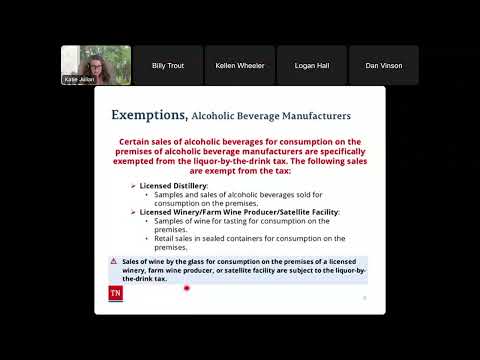
The presenters listed recurring exemptions: some sales by distilleries and wineries (for example, distillery samples and certain sealed retail sales) and sales under special-occasion licenses issued to charitable or nonprofit organizations are not subject to LBD. The Tennessee Alcoholic Beverage Commission handles licensing; Department of Revenue staff described the tax and registration steps needed in addition to ABC licensure.
Staff also answered industry questions raised in chat, including: salons that offer a complimentary glass of wine must register and are liable for the LBD tax on the free serving; complimentary drinks are taxable and should be reflected on the price schedule and monthly return; transfers of inventory to a new owner may be permitted where the new entity has an approved ABC license and an LBD account and Department auditors will verify the transfer; receipts may combine sales tax and LBD charges if the combined charge is calculated correctly, though itemizing on receipts simplifies reconciliation; and hemp-derived/THC beverages are taxed and licensed under separate rules (a 6 percent tax scheduled on the sales-tax return and licensing through the Tennessee Department of Agriculture) and are not the same as LBD-regulated alcoholic beverages.
Department staff directed attendees to online resources including the Department’s alcohol tax manual, the LBD topic page on tn.gov/revenue, and email/phone contacts (general tax line and the miscellaneous tax unit). Billy Trout, manager of taxpayer services in the taxpayer education section, summed up the practical priority: “registration drives everything that we do,” and urged businesses to keep bookkeeping and point-of-sale setups accurate to ensure correct reporting.
The webinar was part of the Department’s ongoing taxpayer education series; staff said the recording and the PDF slide materials would be posted on the Department’s webinar video library and linked from the LBD help pages.
Less-critical technical and administrative clarifications from the session (for example, how to request a bond refund if a cash bond was posted, and the Oct. 1 bond-review timing) were covered in audience Q&A and are included in the Department’s manuals and help pages noted above.