Get Full Government Meeting Transcripts, Videos, & Alerts Forever!
Get email alerts on the Sustainability topic
No spam. Unsubscribe anytime.
Leesburg presents 2024 sustainability report highlighting building energy tracking, EV charging and composting
Summary
Town sustainability staff reviewed the 2024 report, describing a new energy-management tool, pilot solar and EV work, a food-waste composting drop-off, and a $170,000 flood-preparedness grant; council members asked about charger fees, recycling and grant risks.
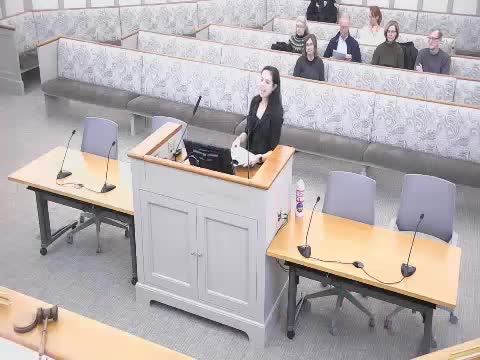
Deb Moran, a sustainability staff member for the Town of Leesburg, presented the town’s 2024 sustainability report at the council work session on Jan. 27. She summarized progress across six categories, including building energy, transportation, land use, water, solid waste and parks and open space.
The report highlighted the town’s new energy-management software, Energy Cap, which Moran said “is going to be the backbone of all of the work that we do in terms of energy efficiency.” The tool aggregates roughly 150 monthly town energy bills, allows cost-per-area comparisons between buildings, and performs bill audits to flag abnormal charges for staff review.
Moran recapped the town’s established energy targets: a 50% reduction in purchased energy for most municipal operations (excluding water and wastewater) and a 10% reduction target for water and wastewater facilities. She also described solar efforts: a partnership with Solarize VA that helped seven residents install solar systems, “bringing over 81 kilowatt hours of energy, of solar energy production into the town,” and a planned study to identify cost-effective sites for municipal solar installations.
On transportation, Moran said the town aims to convert 40% of its non-emergency fleet to alternative-fuel vehicles by 02/34; she reported three vehicles have been transitioned so far and described a grant from Virginia Clean Cities that covered the incremental cost of EVs. She said the town expects its first public charging stations to be installed on Lassiter Way this spring and that a separate installation at the town garage is planned as phase two, pending available funding.
The report noted a Community Flood Preparedness grant the town received to update a 1990 stormwater master plan. Moran described that award as a $170,000 grant to “help update the stormwater management master plan” with a focus on mitigating new climate-related flood risks.
On solid waste, the town launched a food-waste composting drop-off in December and is averaging about 400 to 500 pounds per weekly pickup for commercial composting. Moran said the town will introduce an app called Recycle Coach to tell residents “what goes where,” show collection schedules and allow staff to update recycling guidance rapidly. In parks and open space the town identified 50 bare medians and planted roughly 420 trees and shrubs; the effort contributed to Leesburg earning recognition from Tree City USA.
Council members asked follow-up questions during the presentation. One member asked whether charging fees for EV stations are retained by the town; Moran replied the town will charge 20 cents per kilowatt-hour and a $2 per 30-minute idling fee, and she confirmed the revenue will go to the town. Questions also covered whether Recycle Coach will include guidance on glass and plastics (Moran said the town will control the app content and can change guidance) and how composted material is handled (Moran said it is processed and sold locally by commercial partners).
Council member concerns included risks to federal or grant funding after recent federal executive actions; Moran said she had not heard of any interruption to the $170,000 flood-preparedness grant but that other charging-related funding had been paused. Council members also asked for more detailed cost and lifecycle analyses for EV fleet conversions; Moran offered to provide more specific numbers on request.
Moran closed by thanking colleagues who contributed to outreach and pilot efforts and invited questions and feedback for 2025 priorities.
The presentation generated discussion but no formal council action during the session.