Get Full Government Meeting Transcripts, Videos, & Alerts Forever!
Get email alerts on the Air Quality Nozone topic
No spam. Unsubscribe anytime.
Indianapolis Office of Sustainability outlines NoZone air-quality outreach and action-day guidance
Summary
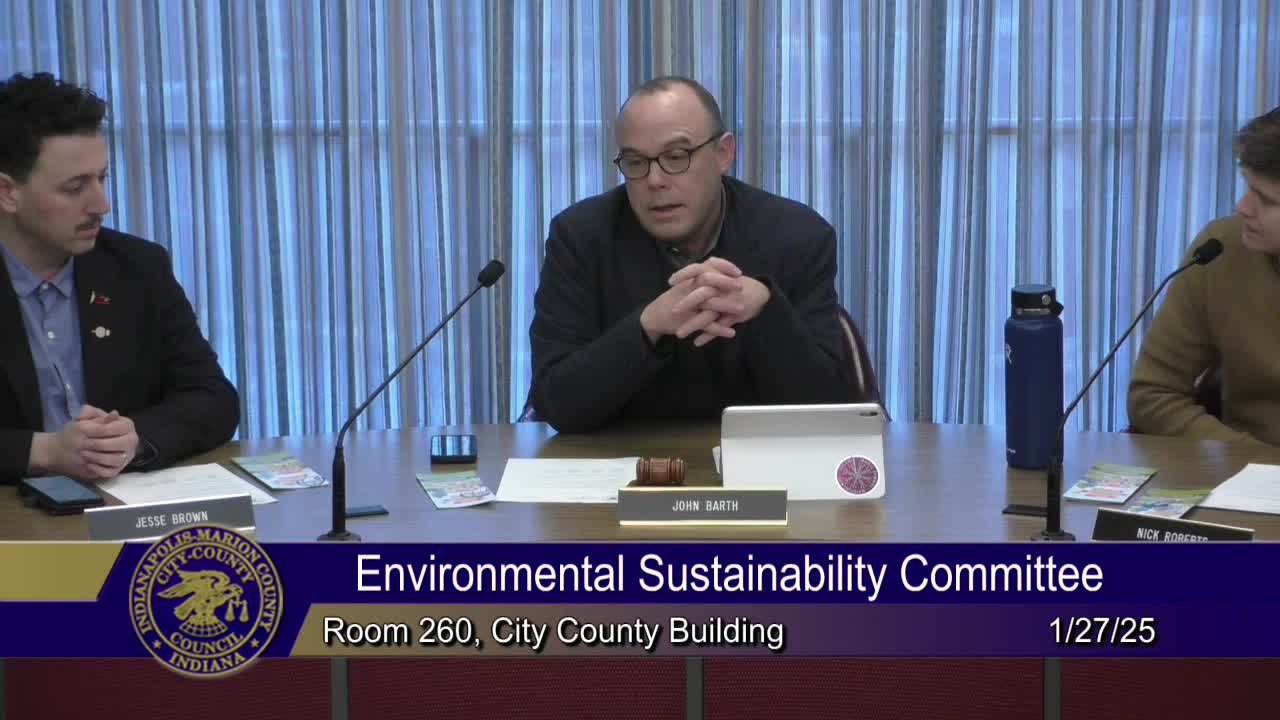
Interim director Mo McReynolds told the Indianapolis City-County Council’s Environmental Sustainability Committee that the city’s NoZone program combines AQI monitoring, public messaging and outreach across a nine-county region and encourages individual and institutional actions on poor-air-quality days.
Interim director Mo McReynolds of the City of Indianapolis Office of Sustainability on Monday described the city’s NoZone air-quality program and how the office communicates Air Quality Index (AQI) alerts and action-day guidance to residents in central Indiana.
McReynolds told the City-County Council’s Environmental Sustainability Committee that NoZone consolidates AQI information — driven by ozone and PM2.5 measurements — and issues public advisories intended to reduce exposure and emissions on poor-air days. “We’re gonna talk a little bit about no zone, what actions is our office taking, and what can residents do about it,” McReynolds said.
The Nut Graf: NoZone is the office’s public-facing brand for daily air-quality information and action-day messaging. McReynolds said NoZone materials explain the AQI color scale and provide “good, better, best” behavior suggestions for residents, while the office also coordinates with partner agencies to change government operations—such as adjusting Department of Public Works mowing schedules—on action days.
McReynolds said AQI combines ground-level ozone and PM2.5, particulate matter roughly 2.5 microns in diameter, and noted that while stratospheric ozone is protective, ground-level ozone is harmful. She called attention to the diversity of PM2.5 sources — “pollen, mold, soot, organic matter, various chemicals” — and said the office is trying to inform residents about both visible events, such as wildfire smoke, and less perceptible poor-air days that still carry health risk.
On outreach, McReynolds said roughly 70–75% of residents are aware of NoZone and that about 65% of those take some action when an alert is issued. The office uses social media, billboards funded in part by Federal Highway Administration sources routed through the Metropolitan Planning Organization (MPO), Channel 16 and direct communications to city staff. McReynolds also described an education strand that promotes electric vehicles and other long-term strategies to reduce tailpipe emissions. “Other examples of things you can do in your home, turning off your lights, using LED light bulbs…,” McReynolds said while outlining the “good, better, best” guidance for residents.
Committee members praised the office’s communication approach but asked how the office ensures messages reach populations that do not follow city social channels. McReynolds said the office seeks new partners and relies on a network of community organizations and schools to extend its messaging. She also said the NoZone program covers a nine-county region in coordination with the MPO, not just Indianapolis and Marion County.
Questions from council members included the program’s funding and regional reach. McReynolds said the MPO channels Federal Highway Administration funds that support the billboards and regional messaging. Councilor Brianne Delaney asked about the funding relationship and McReynolds confirmed the MPO and federal highway funding help support NoZone’s regional communications.
The office also flagged a multi-day spike in action days in recent years: McReynolds said the program logged 22 action days in a recent year, a number she described as “pretty scary,” and attributed spikes in part to extraordinary events such as wildfire smoke from Canada.
Ending: McReynolds said NoZone will be part of a wider set of presentations this committee will hear this quarter — including water-quality briefings later in the year — and encouraged councilors to share suggestions for partners to broaden outreach.