Get Full Government Meeting Transcripts, Videos, & Alerts Forever!
Get email alerts on the Downtown Government Campus Redevelopment topic
No spam. Unsubscribe anytime.
Boca Raton hears four competing redevelopment plans for government campus; CBRE outlines next steps
Summary
City staff and CBRE on Jan. 27 presented four unsolicited proposals to redevelop the city'owned government campus downtown. Proposals differ on size, uses, revenue model and public benefits; council set a ranking schedule and more public outreach.
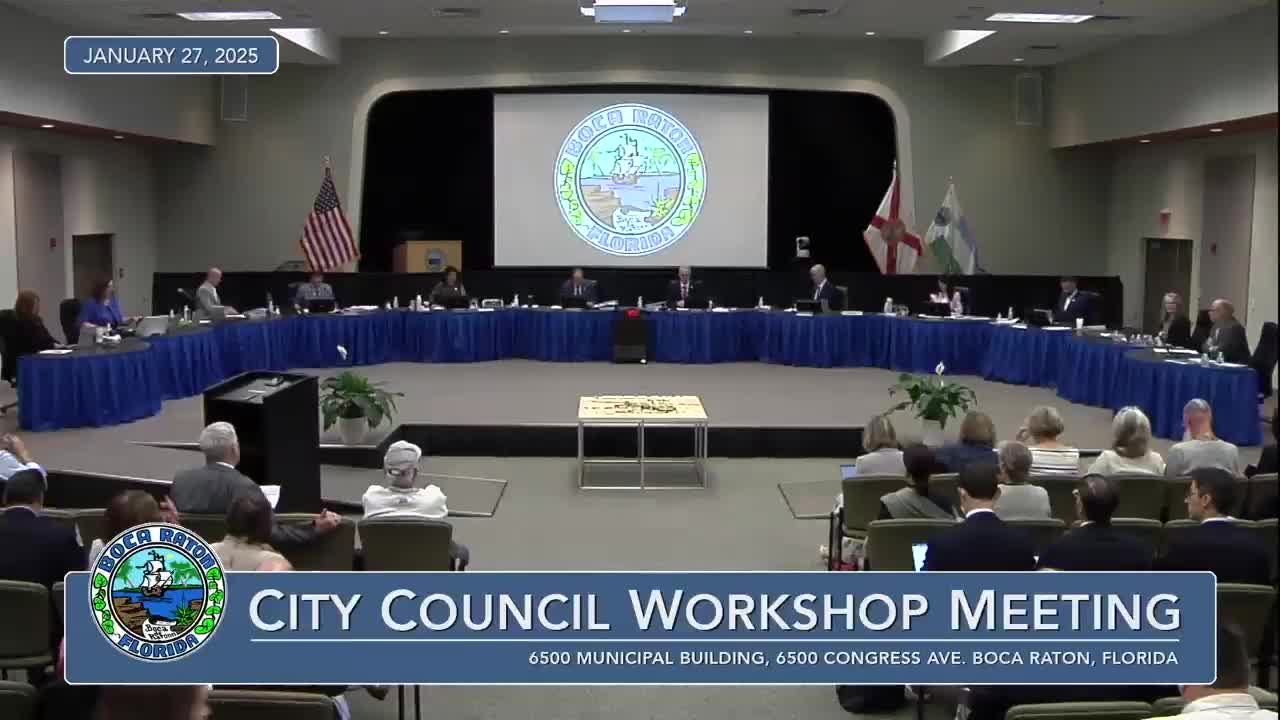
Boca Raton City Council on Jan. 27 heard detailed presentations from CBRE and four teams that submitted unsolicited proposals to redevelop the city-owned government campus near the Brightline station, with council and staff outlining a Feb. 11 ranking of proposals and an open house set for Feb. 19.
CBRE's project lead, Leanne Korst, described the presentations as a digestible summary of 'volumes of information' and said the city will 'rank those proposals on Feb. 11' and negotiate a nonbinding interim agreement with the top-ranked team by March 18. Korst said staff and CBRE have engaged independent subject-matter experts to review planning, traffic, infrastructure, fiscal impact, environment and sustainability.
The four proposals vary widely in scale and financial approach. CBRE senior analyst Mike McShay summarized the Terra/Frisbie proposal as offering roughly $4 million a year in guaranteed ground rent and presenting a lower building height and a mix of retail, hotel and residential; CBRE's early analysis assigned a net present value to the Terra/Frisbie ground-lease stream in the low hundreds of millions of dollars. Effie Namdar's Namdar Group proposed a much denser plan built around transit, telling the council it would deliver up to 8,000 residential units and build the public infrastructure and buildings the city would need if the city accepts the higher density. Related Ross presented a plan with a substantial office component intended to bring year-round employment near downtown; Related Ross representatives emphasized jobs and long-term fiscal revenue. RocaPoint Partners proposed a model that prioritizes constructing the municipal facilities and site infrastructure first and preparing pad sites for later private development.
Why it matters: The selected approach will determine the city hall/civic campus design, how much park and open space remains downtown, whether athletics and recreation sites are relocated, how much new residential and hotel capacity is built, and the timing and scale of tax revenues and ground-lease income. City staff said the review will continue with more public outreach, technical studies and negotiations before any binding agreement.
Key details and differences
- Timeline and outreach: CBRE and staff provided a public schedule that includes public input events and an open house on Feb. 19 from 6 to 8 p.m., a Feb. 11 ranking of proposals, and a target of completing a draft interim agreement with the top-ranked firm by March 18. Korst said staff meets weekly with CBRE and independent consultants to refine fiscal, traffic and sustainability assumptions.
- Size and uses: CBRE's summary put the range of residential units across proposals roughly between the mid-hundreds and multiple thousands (CBRE cited proposals from about 650 units up to 8,000 units). Hotel components ranged from roughly 150 to 400 keys across proposals. Office square footage varied from roughly 100,000 square feet in some concepts up to nearly 1 million square feet in Related Ross's submission.
- Financial models: McShay described a variety of revenue models: fixed ground rent (example cited: Terra/Frisbie at about $4 million per year in the numbers CBRE analyzed), percentage rent above a hurdle in some proposals, and Namdar's pitch to deliver a large amount of public infrastructure in exchange for very high density. Related Ross said its plan would generate both ground rent and substantial tax revenue tied to office and retail uses.
Council questions and points of concern
Council members repeatedly pressed staff and the consultants for more engineering analysis of aging underground utilities on the west side of the tracks, traffic and parking impacts, and where the city would relocate athletic and recreation facilities now on the campus. Councilman Wigder warned, 'we don't know yet what we're going to find' under the existing site and urged early geotechnical and subsurface work. Several council members asked staff to compare the cost of building a new city hall on the campus versus leasing municipal space elsewhere while the development proceeds.
Several council members also sought clarity on affordable/workforce housing commitments and the term lengths for deed restrictions or covenants; one presenter said some workforce units were budgeted on a 15-year basis while council members asked for 30-year commitments where the city's affordable housing program requires it. Staff and developers repeatedly told the council that many details remain to be negotiated.
Public comments and next steps
Speakers during the public comment period raised questions about outreach and visibility of project materials, the amount and height of new development, and safe pedestrian and bicycle connections from west of the site. Residents asked to see the city's outreach materials and feedback summaries made available online. Staff said the site will require relocation of certain athletic facilities and that the Beach & Park District and city staff are coordinating locations for replacement fields.
What happens next: City staff and CBRE will continue the evaluation, hold the Feb. 19 open house, publish additional technical findings for the public and return with a ranked recommendation after Feb. 11. Staff said independent consultants will corroborate CBRE's fiscal and traffic assumptions before the city begins binding negotiations with any proposer.
Quotes attributable to meeting speakers
- Leanne Korst, CBRE: 'We wanted to put the proposals together in a digestible format.'
- Mike McShay, CBRE: 'The ground rent that would be generated from their [Terra/Frisbie] proposal totals $4,000,000 per year.'
- David Martin, CEO, Terra: 'We want to listen to the community' (presenting Terra/Frisbie's vision for a pedestrian-friendly, green-centered neighborhood).
- Councilman Wigder: 'We don't know yet what we're going to find' under the west-side infrastructure and we need engineering to assess replacement needs.
What the article does not assume or decide
This article reports proposals and questions that were presented at the workshop; it does not describe any city council selection, award, or binding agreement. Where speakers provided estimates (for example, ground rent or potential tax revenue), the article attributes those figures to the speaker or to CBRE's analysis and notes that staff and consultants said many fiscal details remain subject to negotiation and verification.
Ending
The council must still decide which concept (if any) it will pursue. Residents may review posted materials on the city project webpage and attend the public open house on Feb. 19. Staff told council members it will return with refined technical analysis and an interim-agreement draft for the council to consider after the Feb. 11 rankings.