Get Full Government Meeting Transcripts, Videos, & Alerts Forever!
Get email alerts on the Permitting topic
No spam. Unsubscribe anytime.
Committee advances Fast‑Track Permits Act, sets deadlines for local permitting and a fee‑penalty for late changes
Summary
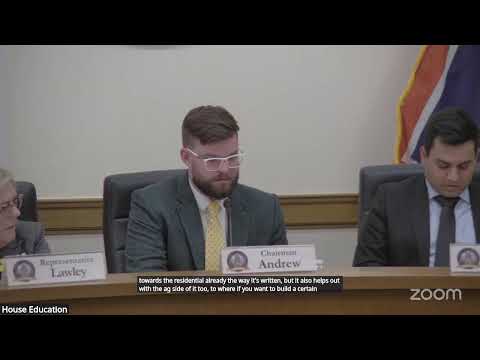
House Bill 202, dubbed the Fast‑Track Permits Act, advanced from the House Education and Miscellaneous Topic Committee on Jan. 27, 2025, after a 6‑3 committee vote; the bill sets deadlines for local permit review and a fee reduction for late post‑approval changes.
House Bill 202, dubbed the Fast‑Track Permits Act, advanced from the House Education and Miscellaneous Topic Committee on Jan. 27, 2025, after public testimony and a roll‑call vote that passed the bill 6‑3.
Sponsor Representative Feiler said the bill is intended to reduce permitting delays for projects that are permitted uses under local zoning. The bill sets several timelines: local government entities must notify an applicant in writing within 15 days whether an application is complete; after a completed submission the entity must approve or deny the request within 60 days (with enumerated exceptions); and if a local government imposes requirements missed during plan review after approval, the applicant is entitled to a 10 percent reduction in fees. The bill excludes conditional use permits, rezoning, subdivisions and temporary zoning uses from the fast‑track process.
Supporters argued the measure would bring predictability and accountability to permitting. Jeff Daugherty, testifying in support, said the 10 percent refund mechanism places responsibility on local elected officials to correct administrative problems and that many delays occur “in the field” and are not visible to elected officials until brought to their attention.
Witnesses for local government pushed back. Nick Agopian, representing the Teton County board of commissioners, said only about 10 counties have comprehensive zoning regimes and argued the bill risks undermining local control: “This bill addresses only title 16 … instead of addressing the specific municipal statutes, title 15 and the specific county statutes title 18,” Agopian said, and urged narrowing the bill’s scope rather than a statewide timeline. The Town of Jackson also testified in opposition and suggested requiring jurisdictions to publish timelines on their websites rather than imposing a uniform state mandate.
Cheyenne Mayor Patrick Collins told the committee he could not find consistent, specific examples of widespread permitting failures in his jurisdiction and cautioned that complex commercial projects and zoning changes would not fit the bill’s timelines. Several committee members and witnesses said the bill is primarily targeted at routine building permits and permitted uses rather than complex conditional approvals.
National‑model testimony came from Michael Barrett, a former Utah building official, who described Utah’s timeline statutes (which limit review and inspection turnarounds on residential permits) and said similar rules had improved predictability in jurisdictions that adopted them. Tyler Linholm of Americans for Prosperity also spoke in support, citing regulatory efficiency and business certainty.
After testimony the committee debated amendments but ultimately voted to advance the bill. The roll call recorded votes as follows: Representative Bratton, Aye; Representative Erickson, Aye; Representative Guggenmoss, Aye; Representative Kelly, No; Representative Lalley, No; Representative Singh, Aye; Representative Strock, Aye; Representative Williams, No; Chairman Andrew, Aye (6‑3). The bill moves forward from committee with that recorded recommendation.
Committee discussion noted points for possible refinement: narrowing the bill to certain permit types (residential vs. commercial), clarifying exclusions for conditional uses and rezoning, and reconsidering the 60‑day approval window (some witnesses recommended shorter timeframes for routine residential plan reviews). The bill as passed by committee leaves implementation details—such as how local governments will meet timelines and how the 10 percent fee adjustment will be administered—to later rulemaking or statutory clarification.