Get Full Government Meeting Transcripts, Videos, & Alerts Forever!
Get email alerts on the School Restroom Policy topic
No spam. Unsubscribe anytime.
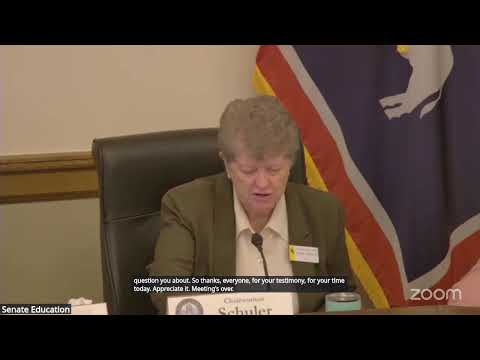
Senate Education Committee advances bill requiring use of birth-assigned restrooms in public schools
Summary
The Senate Education Committee advanced Senate File 62 on Jan. 24, approving an amended version that would require public school districts to designate multiple-occupancy restrooms and changing rooms by a student’s sex as recorded at birth and to provide a "reasonable accommodation," such as a single-occupancy restroom, for students who do not use those facilities.
The Senate Education Committee advanced Senate File 62 on Jan. 24, approving an amended version that would require public school districts to designate multiple-occupancy restrooms and changing rooms by a student’s sex as recorded at birth and to provide a "reasonable accommodation," such as a single-occupancy restroom, for students who do not use those facilities. The committee voted to send the bill to the Senate floor, 4-1.
Supporters, led by the bill sponsor Senator Larson, told the committee the measure responds to requests from at least one local superintendent who sought statewide direction rather than a district-by-district approach. Senator Larson said the measure creates a new statute and defines multiple-occupancy restrooms and changing rooms, and directs school boards to adopt policies implementing the requirements. Larson said the bill would require districts “to use restrooms that align with their *** at birth” and provide “reasonable accommodations.”
The committee amended the bill during the hearing. Members removed language that would have stripped a district’s accreditation for noncompliance and adjusted several operational provisions, including allowing adults who are not employed by the school district to accompany coaches in certain circumstances and adding an explicit exception for adults rendering assistance to students because of age or disability. After those amendments, the committee approved the bill on a voice/roll call vote 4-1; Senators Brennan, Olson, Scott and Chairwoman Schueller voted yes, and Senator Rothfuss voted no.
Why it matters: supporters described the bill as a way to give school administrators legal clarity and to create uniform expectations across districts; opponents and several education groups said the proposal would create new liabilities, risk costly litigation and could harm transgender students’ safety and mental health if enacted without additional changes.
What the bill would do under the amended version approved by the committee: - Require each public school district that serves prekindergarten through 12th grade to designate every multiple-occupancy restroom or changing room for the exclusive use of the male sex or the exclusive use of the female sex as determined at birth. The bill text presented to the committee used redacted language ("***") for the statutory definition of sex and cited an internal statutory reference for that definition. - Require districts to provide a "reasonable accommodation" for any student who does not wish to use a multiple-occupancy restroom or changing room; the bill lists a single-occupancy restroom or changing room as an example of a reasonable accommodation. - Create exceptions allowing entry to multiple-occupancy rooms for custodial, maintenance, repair or inspection purposes; to render emergency medical assistance; and to permit a coach to enter a locker room before, during or after school-sponsored activities if certain conditions are met (the amendments relaxed the requirement that an accompanying adult be employed by the district). - Preserve a private right of action for a parent or legal guardian to sue a public school for noncompliance with the statute (the committee rejected a motion to remove that private right of action). - Make clear that charter schools are covered by the statute as if they were school districts (committee members confirmed staff advice that charter schools are already covered).
Testimony and concerns - Several current and former school officials urged caution about the bill’s operational details. Boyd Brown, executive director of the Wyoming Association of School Administrators, said many districts address accommodation needs now and warned that using accreditation as a penalty would be inappropriate. Brian Farmer, executive director of the Wyoming School Boards Association, urged removal of the accreditation language, saying accreditation is normally tied to academic performance and state supports rather than a single statutory requirement; Farmer told the committee he would "suggest striking that" accreditation provision.
- Jay Curtis, superintendent of Park County School District No. 1, said his district supports a state-level directive to give local boards confidence to adopt policies without inviting immediate litigation, but he also said he opposed penalties such as loss of accreditation and opposed adding a new statutory penalty. Curtis said he supported the bill’s concept while asking that punitive elements be removed.
- Civil-rights and education groups opposed the bill’s approach and warned of harms to transgender students. Tate Mullen of the Wyoming Education Association pointed to studies tying targeted legislation to increased anxiety and suicidal ideation among transgender youth and called the bill risky for students and districts. Sarah Burlingame of Wyoming Equality and several transgender witnesses said state-level mandates would strip local boards of discretion and could stigmatize an already vulnerable population.
- Parents and students spoke on both sides. Taylor Peters, a 16-year-old student who attends Powell High School, urged lawmakers to retain the bill’s enforcement language and said she felt unsafe sharing girls’ facilities with a male-identifying student. Patricia McCoy read a statement from her adult daughter urging the committee to require single-person gender-neutral restrooms in schools to protect LGBTQ youth.
Legal and implementation issues raised - Witnesses debated how the bill would intersect with federal law, including Title IX and Equal Employment Opportunity Commission (EEOC) guidance; panelists noted active litigation in other states and in federal courts about restroom policies. Brian Farmer and others warned that federal litigation and differing federal decisions have left uncertainty about how state statutes will fare in court.
- Several school officials raised practical questions about small districts that lack additional adult staff, how to manage accommodations for very young children and students with disabilities, and how to implement the coach-accompaniment requirement during away events and in districts with limited personnel. The committee adopted at least one amendment responding to those concerns.
Votes and next steps The committee approved Senate File 62, amended, and sent it to the full Senate. Vote at committee: 4-1 (Yes: Brennan, Olson, Scott, Chairwoman Schueller; No: Rothfuss). Sponsor Senator Larson indicated willingness to work with committee members on additional language; committee members said they may bring further amendments on the Senate floor.
Context and state-level implications Supporters argued the bill brings uniformity so districts competing athletically and otherwise know statewide expectations. Opponents and several education groups urged local solutions and flagged litigation risk, implementation burdens and potential harms to transgender students, describing a history of contested court cases in other states. Committee discussion and adopted amendments removed the accreditation penalty and added several clarifications, but legal uncertainty and debate over operational details remain likely as the bill moves to the Senate floor.
Sources and evidence: committee testimony from Senator Larson, school superintendents, the Wyoming Association of School Administrators, Wyoming School Boards Association, Wyoming Education Association, Wyoming Equality and multiple private citizens. Evidence spans sponsor remarks introducing the bill, expert testimony about accreditation and implementation, and direct statements from students and parents during public testimony.