Get Full Government Meeting Transcripts, Videos, & Alerts Forever!
Get email alerts on the Zoning Development Process topic
No spam. Unsubscribe anytime.
Lexington staff outlines ordinance rewrite to comply with House Bill 443, limits on commission discretion
Summary
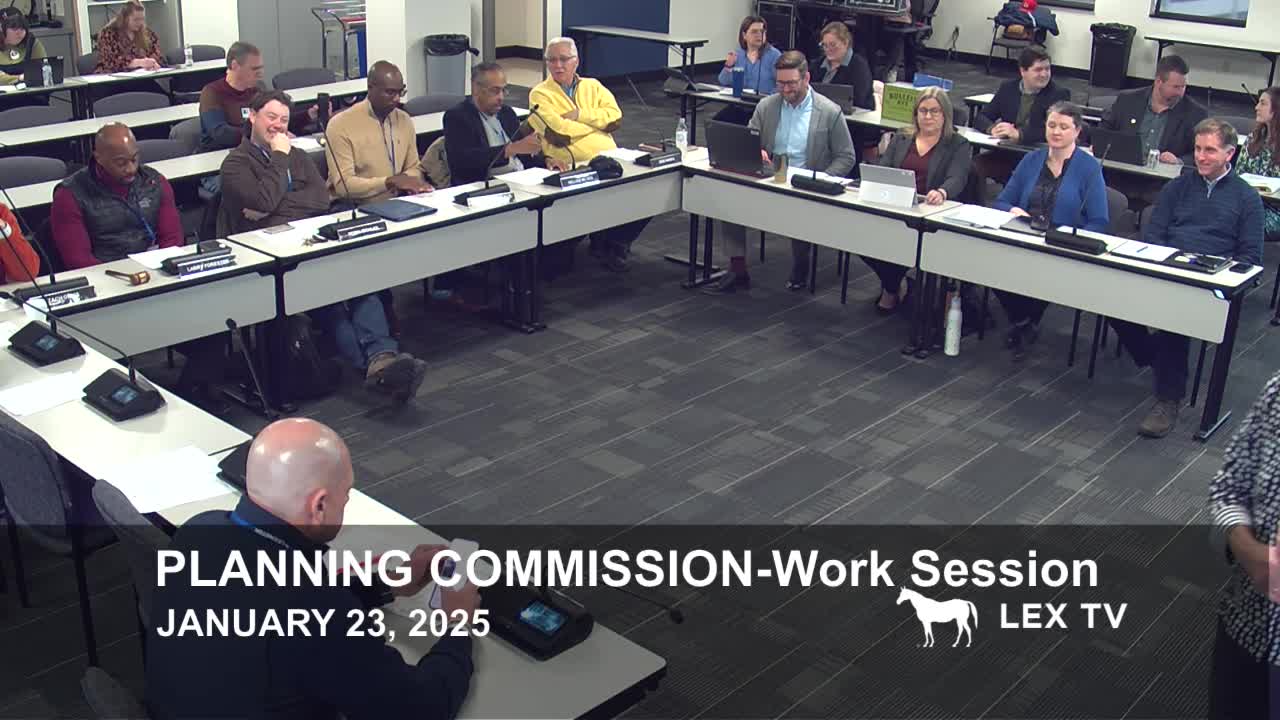
Lexington planning staff briefed the Planning Commission on January 23 about changes they will propose to the city's zoning and subdivision regulations to comply with House Bill 443, and the timetable to have the changes in effect by July 1, 2025.
Lexington planning staff briefed the Planning Commission on January 23 about changes they will propose to the city's zoning and subdivision regulations to comply with House Bill 443, and the timetable to have the changes in effect by July 1, 2025.
The discussion centered on the law's requirement that local rules for subdivision plats and development plans be "objective standards" and administered ministerially under KRS 100. "House Bill 443 was adopted April 4, 2024, in order to create a new section of KRS 100 that ... mandates that local governments update their processes," Tracy Wade, planning staff presenter, told the commission. Wade said the staff has drafted text amendments to update definitions and many articles of the zoning ordinance, revise development-plan procedures, and clarify when the commission can exercise discretion.
Why it matters: The staff said the changes will constrain the commission's current practice of using judgment on some development-plan details. Wade said many aspects of the current zoning ordinance already use objective, measurable standards (setbacks, height limits) but that some provisions and procedures will have to be rewritten so approvals that meet adopted standards can be handled administratively without further hearings.
Staff described the practical effect: preliminary development plans tied to zone changes will continue to come to the commission because zone changes are discretionary, but many final development plans that meet objective criteria will be certified and approved through staff technical review and may never reach the commission. When an applicant does not meet every objective requirement, the applicant may be offered a one-month revision window to comply; if the applicant declines or cannot comply, the staff would forward a waiver or discretionary request to the planning commission and subdivision committee for review.
Wade and a City Law Department attorney warned the commission that the statute leaves little room for subjective standards such as "substantial compliance." The law department attorney said staff should avoid open-ended terms in notes attached to approvals. "If we go to that route where we ask for them to do something that is gonna open the door for an interpretive of what does that mean, we may run afoul of the statute," the attorney said.
Key policy and process items staff identified include: revising ordinance definitions for clarity; removing discretionary criteria where objective standards can be used; specifying a clear waiver request process with explicit grounds and notice; adopting commercial access standards from Traffic Engineering; and clarifying which changes to conditional zoning restrictions require a second council hearing.
Public notice and timing: Staff said it will provide initiation text to the commission next week and mail notices in February to registered neighborhood associations. The schedule staff presented calls for zoning committee discussion and a public hearing in March, referral to Urban County Council in May–June, and an adoption target of July 1, 2025, to meet the statutory deadline. Wade said staff will recommend borrowing language from Louisville’s ordinance for the waiver/waiver-notice model and that Louisville notifies adjacent property owners when waiver requests are considered.
Commissioners asked how the changes might affect creative or contextual design outcomes that previously relied on discretionary discussion at commission hearings. Commissioner (recorded in transcript as) Mister Nichols/Nickel raised the concern that some innovative projects have relied on negotiated, discretionary agreements made at zone-change hearings. Staff said those agreements will need to be much more explicit and objective if they are to be enforceable, and that where applicants voluntarily commit to match renderings, those commitments should be written in objective terms rather than "substantial compliance." Staff said they will continue reviewing opportunities to add design standards if the commission wants regulatory tools to enforce design expectations.
Next steps and transparency: Staff plans to circulate the initiation text on Wednesday by 5 p.m., host outreach and open-house opportunities, and be available to neighborhood groups. Staff recommended the commission review the proposed draft and suggest edits ahead of initiation. Wade also said staff anticipates updating cross-referenced articles (notably Article 21 development plans and Articles 23 and 28) and may incorporate small changes requested by Environmental Services and Traffic Engineering.
Ending: Commissioners and staff acknowledged the transition will be substantial for applicants, the commission and staff. Wade repeated the statutory deadline: the city must be compliant by July 1, 2025, and urged commissioners to review the draft initiation text when it is circulated.