Get Full Government Meeting Transcripts, Videos, & Alerts Forever!
Get email alerts on the State Investments Gold topic
No spam. Unsubscribe anytime.
Revenue Committee advances Wyoming Gold Act after testimony from precious‑metals industry
Summary
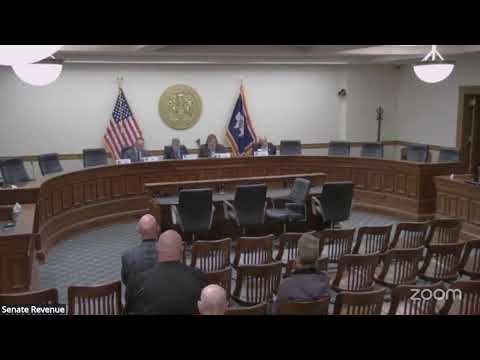
The Revenue Committee voted 3–2 to advance Senate File 96, the "Wyoming Gold Act," after testimony from a Casper precious‑metals manufacturer and debate over where state‑held gold would be stored and overseen.
The Revenue Committee advanced Senate File 96, known as the Wyoming Gold Act, by a 3–2 roll‑call vote after hearing industry testimony and debate over how the state would hold physical gold.
The bill would require the state to hold not less than $10,000,000 in specie or specie legal tender in a specified account; committee members amended the draft to direct the holdings specifically to the Permanent Mineral Trust Fund and to insert the word “capital” before “financing” in one cross‑reference.
The measure drew testimony from Joshua Fair, who identified himself as a Casper business owner and the operator of Scottsdale Mint and the Wyoming Reserve Opportunity Zone Fund Corporation. Fair described vaulting, insurance and audit practices used by private vault providers and said central banks and large banks provide liquidity and buyback arrangements for physical gold. “When gold comes into our facility, it is insured, fully,” Fair said, describing quarterly and surprise audits and the option for a client’s holdings to be placed in a separate cage inside a Class 3 vault.
Deputy State Treasurer Dawn Williams testified about the treasurer’s office role during committee discussion. Asked whether every investment the treasurer’s office made had been profitable, Williams answered, “No. No. No, not every investment has made money. We’ve experienced losses over time.” Committee members also discussed language in the bill requiring a study; Williams said the bill’s current study directive read as a broad, policy‑centric mandate she did not view as appropriate for the treasurer’s office to execute alone.
Committee discussion produced two floor amendments the committee adopted. The first, offered by Senator Eyde and seconded on the floor, replaced the phrase “across all state managed accounts” with a reference to the Permanent Mineral Trust Fund and changed plural “accounts” to the singular “account.” The second amendment inserted the word “capital” before “financing” in the committee reference on page 3, line 19. Both amendments passed on voice votes or aye‑voice confirmations.
Senators voiced differing views on the policy. Senator Wright argued the $10,000,000 minimum is a small allocation relative to the state’s sovereign wealth and described the purchase as a hedge and learning step. Senator Pappas said she was concerned the measure would “lock up $10,000,000” and that holding physical gold would incur storage and transaction costs without producing yield. Senator Case expressed concerns about volatility and implementation costs and said he would not support the bill.
On the roll call, the committee recorded votes as follows: Senator Case — No; Senator French — Aye; Senator Eyde — Aye; Senator Pappas — No; Chairman McEwen — Aye. The committee reported the bill as approved, 3 ayes and 2 nays.
The bill will proceed from the Revenue Committee; no final enactment or subsequent floor action was recorded in the committee transcript.