
Committee advances bill to regulate ‘chemical abortion’ waste and water testing; DEQ flags technical limits
Get AI-powered insights, summaries, and transcripts
Sign Up Free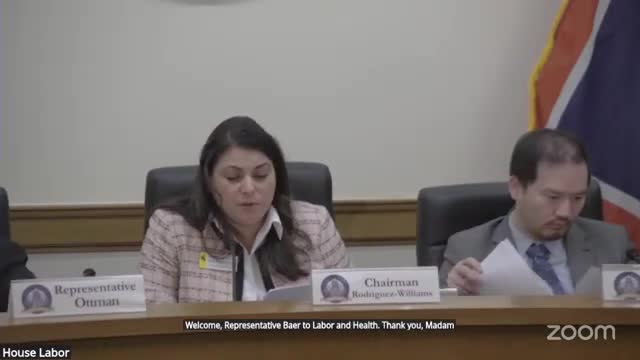
Summary
The House Labor, Health & Social Services Committee advanced House Bill 159, a proposal to regulate disposal and testing for byproducts of medication abortions and to assign civil liability to manufacturers if residues are found in public water systems.
The House Labor, Health & Social Services Committee passed House Bill 159, a 25‑page measure the sponsor described as designed to protect water and public health from byproducts of medication abortions and to require physician oversight and specified disposal procedures for medication‑abortion waste.
Representative Bair (bill sponsor) told the committee the measure does not prohibit abortion but would require a physician to examine patients before prescribing mifepristone/misoprostol, require the physician be physically present when the first pill is taken, and require a follow‑up visit within seven days. The bill would also require providers to give patients a medical-waste bag and a “catch kit” to prevent drug residues and tissue from entering public wastewater; the draft includes civil and criminal liability for noncompliance and assigns liability to manufacturers if residues are detected in public water systems.
The bill prompted technical questions and lengthy public comment. Jennifer Zignet, water quality administrator for the Wyoming Department of Environmental Quality (DEQ), told the committee that DEQ recognizes concerns about pharmaceuticals and endocrine-disrupting compounds but warned the agency lacks EPA‑approved analytical methods for the two primary chemicals discussed, that developing state water‑quality criteria would require toxicology contracts (DEQ’s fiscal note estimates roughly $300,000), and that sampling is unlikely to detect trace compounds because of dilution and sporadic releases. Zignet also said DEQ does not implement the Safe Drinking Water Act in Wyoming (EPA does) and suggested that some disposal standards might better fit the state’s solid and hazardous waste division.
Representative Bair cited an unpublished study the sponsor described as finding trace levels in potable water in three tested cities — figures the sponsor read as roughly 11.6 parts per trillion in one city and 2.6 parts per trillion in another — and urged the committee to address potential endocrine effects on wildlife and human reproductive health. Committee members pressed about source attribution, where Representative Clauston asked how a plaintiff would identify a manufacturer and Bair replied the bill apportions liability among manufacturers if a specific source cannot be identified.
Medical and public‑interest witnesses were sharply divided. Dr. Renee Henkel, an OB‑GYN in Cheyenne, testified that the FDA had concluded environmental exposure to mifepristone at estimated levels would not have a significant effect on the human environment and that metabolites were not shown to be teratogenic in animals. By contrast, proponents including Students for Life and several veterans and residents urged the committee to require manufacturer responsibility for cleanup and to mandate disposal and documentation of fetal tissue and byproducts.
Public‑comment speakers raised implementation concerns for small towns and water utilities. Several county officials and municipal representatives said local utilities lack staff and budget to carry out expanded testing or disposal protocols. DEQ warned that if the legislature directs DEQ to develop criteria and sampling rules, the agency would need contract toxicologists and potentially significant funding for lab analysis; commercial contract labs, DEQ said, may charge $400–$500 per sample per compound if analytical methods exist.
After discussion and a failed motion to reduce criminal penalties and fines (no second), the committee moved and passed HB159. The roll call showed six ayes, two noes and one member excused; the chair announced that Representative Bair will carry the bill to the House floor.