Get Full Government Meeting Transcripts, Videos, & Alerts Forever!
Get email alerts on the Energy Eor topic
No spam. Unsubscribe anytime.
Senate panel advances two bills to support enhanced oil recovery using Wyoming CO2
Summary
The Wyoming Senate Appropriations Committee voted to advance Senate File 17, which would seed a state fund to equalize payments for CO2 used in enhanced oil recovery, and Senate File 18, which would exempt certain enhanced oil recovery production from part of the severance tax. Both measures passed the committee by recorded roll calls.
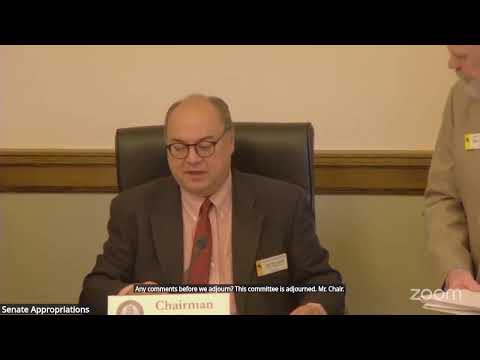
Chairman Salazar presided as the Senate Appropriations Committee advanced two related bills aimed at encouraging enhanced oil recovery (EOR) projects using Wyoming-source carbon dioxide.
Pete Obermuller, president of the Petroleum Association of Wyoming, told the committee that Senate File 17 includes an appropriation intended as startup money for a new state fund. "The appropriation is, it essentially is seed money in order to get the program started, but, under the under the legislation, it will be, both refilled and then self funded with severance taxes into the future," Obermuller said. He described the plan as a Wyoming "plus up" to federal incentives tied to the federal 45Q tax credit.
The bills are intended to address differences in federal payments under the 45Q tax credit, which provide different per‑ton values depending on how CO2 is used. Obermuller said the state measure would provide an additional roughly $10 per ton for CO2 used in EOR so that sellers of CO2 would have similar tax incentives whether they sell for permanent sequestration or for EOR.
Senate File 18 is a separate measure that would reduce the severance tax paid on oil produced using Wyoming‑sourced CO2. Lon Whitman, director of the Enhanced Oil Recovery Institute, told the committee the two bills are "keenly important, but very different," with SF17 supporting the sale of CO2 to EOR operators and SF18 providing a severance tax benefit to operators who produce oil using CO2 EOR.
Committee members asked how the proposals would be funded. Obermuller said operators would still pay the base severance tax on production, and that the bill creating the fund would reinvest 3% of the existing severance tax on EOR production into the new fund until the seed appropriation was replenished. He said there is no cut to the industry’s severance tax rate in SF17; rather, the bill directs a portion of future severance receipts into the fund. For SF18, committee members were told the change would reduce the effective severance levy to 3% for qualifying EOR production.
Senator Gru noted a corrected copy of SF18 shows a de minimis administrative expense of $77,000 for the department related to the measure. Whitman and Obermuller emphasized the bills are two different mechanisms to reach similar goals and said both have been advanced to let subsequent legislative steps resolve which approach moves forward.
The committee recorded roll‑call votes on both measures. For Senate File 17 the clerk recorded five ayes — Senator Driscoll, Senator Gru, Senator Larson, Senator Smith and Chairman Salazar — and the motion passed. The committee likewise recorded five ayes on Senate File 18 and passed that bill out of committee.
No specific dollar amount for the seed appropriation in Senate File 17 was stated during committee discussion; the transcript records the existence of an appropriation but does not specify its amount.
Committee discussion distinguished between proposals that would (1) put initial funds into a new state account to "equalize" payments for sale of CO2 and (2) reduce severance tax on produced oil when Wyoming‑sourced CO2 is used. Members repeatedly noted the two bills could theoretically both pass, but committee witnesses said the expectation was that only one approach would prevail as the bills move forward.