Get Full Government Meeting Transcripts, Videos, & Alerts Forever!
Get email alerts on the Transportation Budget topic
No spam. Unsubscribe anytime.
UDOT outlines FY26 base, fee adjustments and transfers; flags bridge maintenance and Cottonwood Canyon legal issues
Summary
The Utah Department of Transportation presented its FY26 base budget snapshot, proposed fee changes, nonlapsing intent requests and a set of transfers and operational requests — including staffing for lighting and an expanded litter program — at a Jan. 24 Subcommittee hearing.
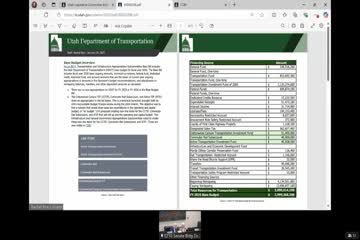
The Utah Department of Transportation (UDOT) gave an overview of its FY26 base budget and a package of fee, transfer and project requests at a Transportation Infrastructure Appropriations Subcommittee meeting on Jan. 24.
LFA background and base budget: Rachel Bowe, financial analyst for the Legislative Fiscal Analyst (LFA), said the FY26 base budget contains no new appropriations to UDOT in the operating capital base and noted prior interim work that added line items to display certain sales tax expenditures in the operating and capital budget (for example, the Cottonwood Canyon Transportation Investment Fund, the Commuter Rail Subaccount and the Active Transportation Investment Fund). She also reviewed a list of nonlapsing intent language that IGG approved in October and reported UDOT requested an increase in one nonlapsing intent for highway maintenance equipment purchases because vendor delays prevented expenditure in FY25.
Fee group review and proposed fee changes: Bowe described an interim review of agency fees under the statutory process cited in the transcript (63J‑1‑504 language was referenced). UDOT proposed quantity and rate changes across several fee groups that staff recommended the subcommittee consider approving; the fee groups included access‑management permits (type 1–4 tiers tied to expected average daily trip counts), encroachment permits (landscaping, manhole access, inspection and overtime inspection), utility encroachment fees (low/medium/high/excess impact by duration and traffic impacts), special event permits and express‑lane administrative fees. LFA summarized that some fees historically understated estimated quantities and the agency adjusted quantities based on recent charging history.
Transfers, reductions and LFA recommendation: LFA presented potential reduction options to yield state savings. Among them was a proposed $6.6 million ongoing reduction of general fund appropriation into a TIF capital projects fund; staff said this equaled roughly a 2% reduction of that ongoing appropriation and presented it as an option for the subcommittee to consider. LFA recommended the committee approve the listed nonlapsing intent language and consider the fee and reduction options as they prioritize the subcommittee’s budget recommendations to Executive Appropriations.
UDOT strategic context and condition concerns: UDOT Director Carlos Braceras presented the department’s strategic framework and asset management outlook. He said the department manages about $62 billion in transportation assets and inspects bridges at least once every two years. Braceras noted the age distribution of bridges includes many structures built in the 1960s and 1970s and indicated those assets present a continuing preservation challenge; the department said it was anticipating a need to shift additional funding from pavement work into bridge preservation to hold target conditions.
Key operational and new requests: UDOT asked the committee to approve a range of transfers and new transfers into operations and other line items. Notable items included: - Lighting technicians: request to add six lighting technicians (about $2.0 million ongoing plus $665,000 one‑time for trucks and equipment), and a proposed statutory change so the department would maintain signal lighting in places where local governments currently hold maintenance responsibility. - Litter program: a request to restore $1.8 million previously removed in 2021 and add $1.0 million new ongoing funding (total $2.8 million) to expand scheduled litter pickup contracts on key routes. - Consultant staffing and rotational engineers: requests to convert consultant positions to state employees ($480,000 ongoing) and fund 10 additional rotational engineers ($1.25 million ongoing) to maintain in‑house capacity for design and construction oversight. - Surplus property sales: one‑time $3.0 million to help prepare and market surplus UDOT parcels for sale (UDOT said it has a backlog of potentially sellable parcels and last year generated roughly $25 million from sales of about 100 parcels). - Construction inspection training: $1.25 million (combination of ongoing and one‑time funds) to build a training program to replace retiring inspectors and ensure consistent inspector training for consultants and staff. - Aeronautics items: transfers and one‑time funding to support Civil Air Patrol, aircraft registration staffing, overhaul of a Cessna engine, two to three electric aircraft charging stations ($2.0 million one‑time), and a general‑fund ask for an aeronautics hangar at Salt Lake City International ($9.0 million one‑time requested in the governor’s package; transcript indicates total project cost is about $36.0 million and that future requests would follow).
Cottonwood Canyon Transportation Investment Fund and EIS litigation: Director Braceras explained the Cottonwood Canyon Transportation Investment Fund was created by prior legislation and cited a $200 million package to implement a phase 1 bus option for Little Cottonwood Canyon (the transcript references roughly $150 million general fund plus about $50 million from the fund). He said litigation on the Little Cottonwood Canyon environmental impact statement created several claims and that implementation of phase 1 will require resolving some, but not necessarily all, claims; he said the department and plaintiffs were in continued dialogue about a path forward for the bus stations and tolling components. He also said the appropriation language requires legislative appropriation to spend from the fund and that the department does not have unilateral authority to reallocate those funds.
Federal funding dependency and bridge preservation: Committee members asked how dependent Utah is on federal funding for bridge and pavement work. Braceras said Utah is less dependent than many states but noted the state does rely on federal highway dollars and that changes at the federal level would have budgetary consequences. He said UDOT is monitoring deteriorating bridge conditions and expects to shift resources to bridal preservation when necessary.
Next steps and committee questions: Committee members asked for further documentation on fee units and cost‑per‑unit, details on which projects the proposed reduction would affect, and for UDOT to provide cost or unit metrics for fees (square feet, linear feet, inspections per hour) before the committee votes. LFA said it would add unit‑cost detail to the voting packet. No legislative action was taken at the Jan. 24 meeting; UDOT and staff were asked to provide additional information for subcommittee consideration.