Get Full Government Meeting Transcripts, Videos, & Alerts Forever!
Get email alerts on the Reproductive Health topic
No spam. Unsubscribe anytime.
Community Health Committee forwards $100,000 request for downstream reproductive services to full council
Summary
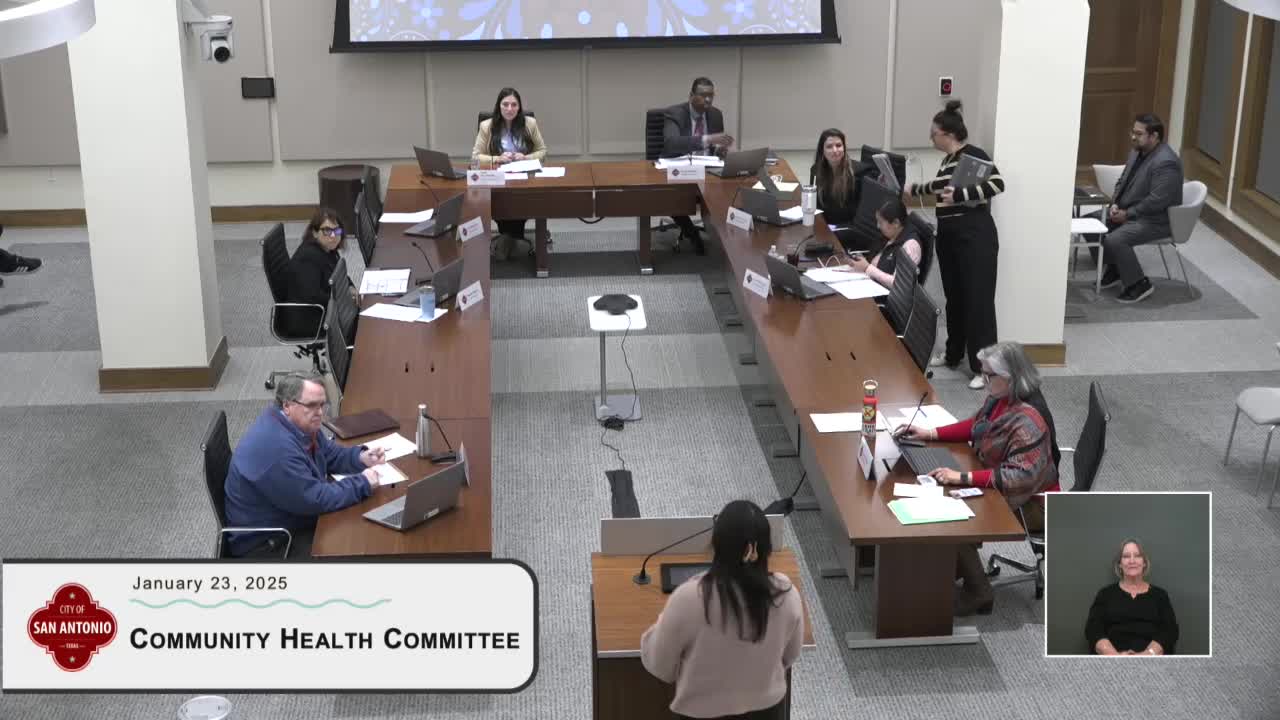
The San Antonio Community Health Committee voted on Jan. 23 to forward to the full City Council a request to allocate $100,000 for downstream reproductive health services from the municipal budget, the committee chair said after a voice vote that included at least one no and one abstention.
The San Antonio Community Health Committee voted on Jan. 23 to forward to the full City Council a request to allocate $100,000 for downstream reproductive health services from the municipal budget, the committee chair said after a voice vote that included at least one no and one abstention.
The $100,000 would be added to the city's existing reproductive justice funding pool and used for downstream services described in the memo from Councilwoman Melissa Cabello Haverda's office, including transportation and other direct supports where legally permissible. Committee members heard public comment, a presentation from the Metropolitan Health Department and questions from council members before moving the item to the full council for action.
Why it matters: Committee members and public speakers framed the request as a targeted, short timeline effort to fill service gaps that the initial funding round did not cover. Supporters said downstream services would directly assist residents seeking prenatal care, STI screening and, where allowable by law, out-of-state abortion travel and navigation. Opponents urged caution about using general-fund dollars for services that might expose the city to litigation.
Dr. Claude Jacob, director of MetroHealth, briefed the committee on the proposal and the department's recommendation to restrict the new solicitation to the original pool of 10 applicants and to use the same scoring matrix, with a 30-day solicitation and a three-day review period. "This slide is just a snapshot," Jacob said during the presentation, characterizing the staff summary of other cities' investments and the department's assessment of potential downstream activities.
Public commenters framed the issue in sharply different terms. Laura Molinar, co-founder and co-executive director of Suenos Sin Fronteras, asked the committee to support expanding the fund so nonprofits could propose collaborative solutions and overcome procurement barriers. "The urgency of this funding cannot be overstated," Molinar said, adding anecdotal examples of harm she said followed restrictions on reproductive care. By contrast, Jack Finger, a public commenter, called the proposal unlawful and warned of potential lawsuits and taxpayer liability if the city funded out-of-state abortion travel.
Council discussion focused on scope and procurement mechanics. Councilwoman Viagran said she wanted the $100,000 earmarked for "downstream services" broadly so providers could determine priorities and whether to include abortion navigation within their proposals. MetroHealth staff confirmed applicants from the prior RFP would be allowed to revise and resubmit applications under the proposed timeline. MetroHealth staff also said the additional $100,000 would be identified from the department's FY25 operating budget; the original $499,179 awarded last year came from the department's FY24 operating budget and the contracts expire Nov. 30, 2025.
Committee members also asked about legal and procurement risks. MetroHealth staff flagged possible barriers: vendor fear of litigation and open-records requests, staffing and contracting challenges for smaller organizations, and restrictions on advance payments. The committee recessed into executive session to consult with the city attorney on legal matters related to the item; no official action was taken during the executive session, and discussion resumed in open session.
After discussion, Councilwoman Viagran moved to forward the item to the full council for an additional $100,000 targeting downstream activities; the motion was seconded and passed by voice vote, with the chair announcing the motion carries after noting there was at least one no vote and one abstention. The item will appear on a future City Council agenda for final action.
Votes at a glance: The Community Health Committee moved the request to the full City Council for consideration of an additional $100,000 for downstream reproductive health services. The committee's voice vote included several ayes; the record shows at least one member opposed and one abstained. A roll-call tally was not recorded in the committee transcript.
What remains unclear: MetroHealth said the solicitation would be restricted to the original 10 applicants but left future expansions to the council's direction. The department also noted that in the prior RFP none of the final four awardees proposed abortion transportation or navigation; two of the original 10 respondents included those services as part of broader packages but were not recommended for award.
Next steps: The item will be scheduled for a full City Council meeting for final consideration and any formal appropriation or budget amendment. MetroHealth said it would follow the committee's direction on solicitation details and work with procurement and the finance department on expedited timelines.
Ending note: Supporters urged the committee to see the allocation as a stopgap to address immediate gaps in care, while opponents cautioned about taxpayer exposure and the proper role of city general-fund dollars. The full council will decide whether to approve the additional funding and the solicitation instructions when the item returns for a council vote.