Get Full Government Meeting Transcripts, Videos, & Alerts Forever!
Get email alerts on the City Budget topic
No spam. Unsubscribe anytime.
Redding council settles on 2.5% sales-tax forecast as revenues lag; $5M shortfall remains
Summary
At a Jan. budget workshop, City Manager Todd Tippen and Finance Director Greg Robinette outlined falling sales and other tax revenues. Councilors signaled consensus to use a 2.5% sales-tax growth assumption for budget planning while staff continues work to close an estimated $5 million gap.
City Manager Todd Tippen opened the Redding City Council’s budget workshop on Jan. 23 by framing the session as an early step in closing a growing gap between revenues and expenses. “So, we'll jump right into item 3.1, which is really the purpose we're here is a budget workshop,” Tippen said.
Finance Director Greg Robinette told the council that sales-tax and other revenues so far this fiscal year are below the assumptions used in the current budget. “Sales tax is about 15 a half 1000000 year to date. We forecasted just over 16,000,000,” Robinette said, adding that sales-tax receipts were roughly $400,000 below projections through December. Property tax collections through January exceeded projections, he said, rising about 4.5% year over year, while transient-occupancy tax and cannabis-related receipts remain below their forecasts.
The presentations outlined the city’s current budget posture: a total adopted budget of about $111 million, of which roughly $66 million is discretionary general-fund spending the council can affect. Personnel is the biggest discretionary cost; the presentation showed police and fire together account for more than 80% of discretionary spending. City staff said about $4 million in expense reductions already have been implemented, including holding several positions vacant and trimming operations and maintenance; staff still estimates a remaining gap of approximately $5 million to balance revenues and expenses for the upcoming budget cycle.
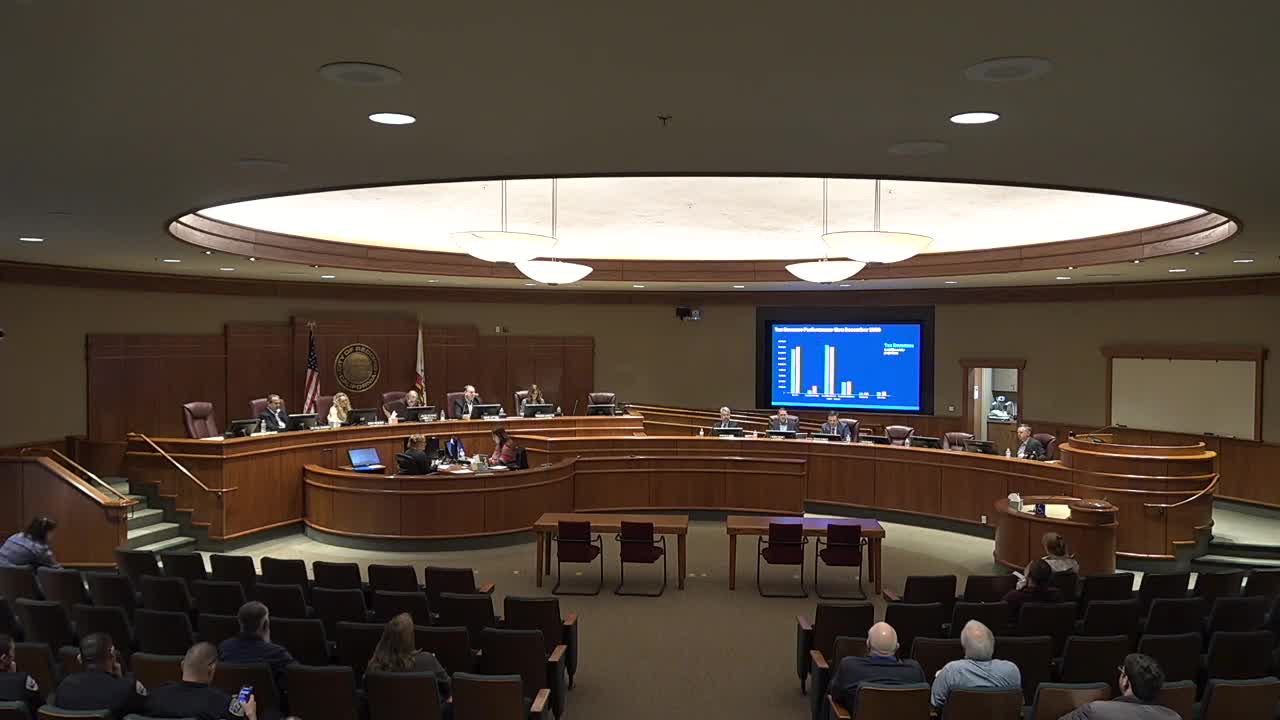
Tippen and Robinette walked the council through three multi‑year revenue scenarios for sales tax: a conservative path, a midline assumption that uses 2.5% annual growth, and a more optimistic line. Robinette described the 2.5% figure as consistent with the city’s long‑run historical baseline. Council members debated the appropriate assumption to use while staff awaits a February “true-up” of state sales‑tax allocations that will give firmer data for holiday quarter receipts. "In February, we'll actually be able to look at those real numbers instead of these kind of forecasted numbers that the state's giving us," Robinette told the council.
After discussion, several council members expressed support for the 2.5% forecast as a working assumption while staff continues to monitor actual collections. “I mean, I would be inclined to go with the recommendation of 2.5%, but I would also, wanna know that report at our next meet whenever it's available, that February, of what it actually what we're starting the year off at and if we're trending in that direction,” a council member said.
The workshop also reviewed pension obligations. Staff noted the city’s PARS (Public Agency Retirement System) unfunded liability has been eliminated, while the city’s PERS (California Public Employees' Retirement System) unfunded liability remains and appears as a long-term obligation on the balance sheet. Robinette summarized the accounting treatment and annual payment volatility driven by market returns and actuarial assumptions.
Officials emphasized the limits of the current workshop: the council will not adopt a final budget until the regular adoption process in June. Staff said council direction on revenue assumptions now will guide development of department budgets, and that more detailed proposals and options to close the remaining gap will be presented at a follow-up workshop in March and during regular quarterly updates.
Ending: Council members asked staff to return in February with the state sales-tax true-up and in March with additional budget scenarios and specific policy options for closing the remaining gap.