Cooper City, Optimist Club to negotiate new facility-use agreement after noncompliance letters; background checks, registration systems and field scheduling top
Loading...
Summary
Cooper City officials and volunteers with the Cooper City Optimist Club spent a workshop reviewing a 2012 facility-use resolution and planning a new agreement to address residency targets, state‑mandated background checks, registration technology and field scheduling and maintenance.
Cooper City officials and volunteers with the Cooper City Optimist Club spent a workshop reviewing a 2012 facility-use resolution and planning a new agreement to address residency targets, state-mandated background checks, registration technology and field scheduling and maintenance.
City staff said they want a new facility-use agreement finalized for Commission review by March and said they expect to complete initial drafting within about 45 days based on the direction given at the meeting. “We are trying to get back to the commission by the March meeting. We said 45 days to to get this done,” the city manager said.
Why it matters: The dispute touches several practical issues for families and volunteers — who gets field time, how registration and resident discounts are handled, who pays for and maintains equipment, how coach background checks are verified, and how the club’s finances and rosters are inspected for compliance.
Discussion and compliance history
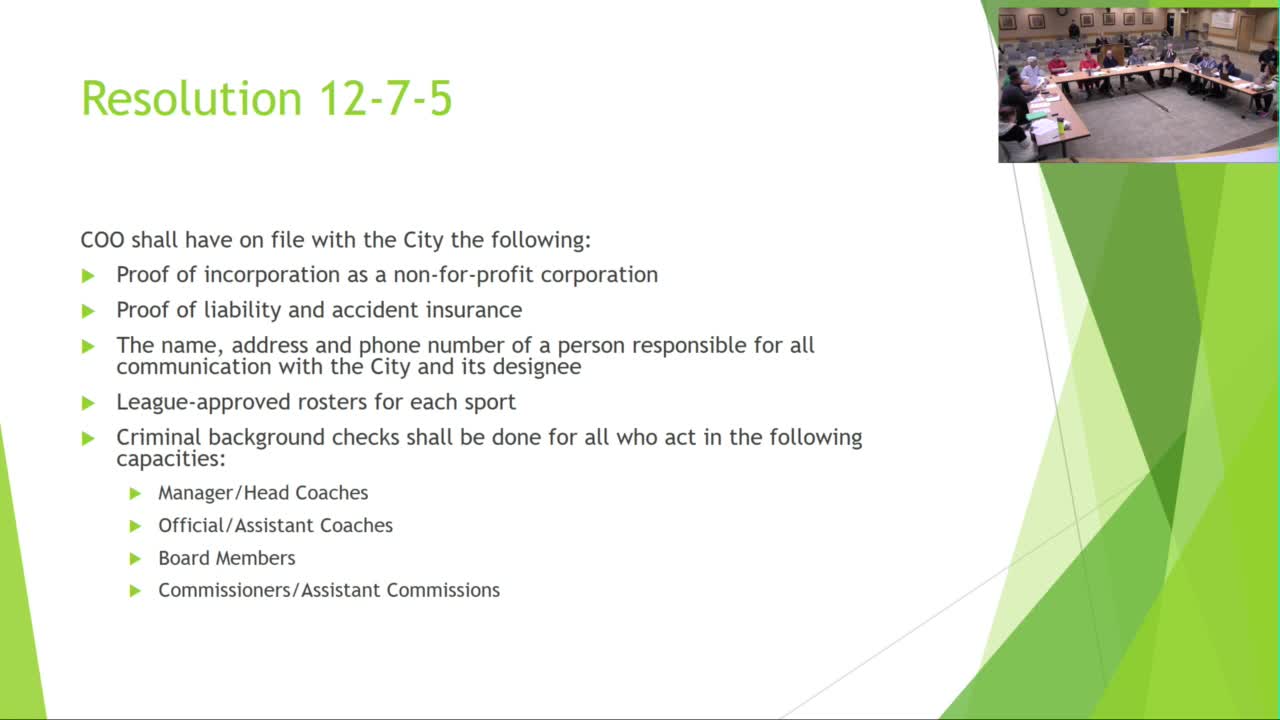
Deputy City Manager Jennifer McMahon told the group the city’s 2012 resolution (referred to repeatedly in the meeting as Resolution 12‑75) requires proof of nonprofit incorporation, insurance, contact information, league-approved rosters and criminal‑background screening for managers and coaches. McMahon said the city has issued two letters of noncompliance: one in November related to the city’s residency percentage requirement and a second, certified letter on Jan. 3 citing Section 943.0438 of the Florida Statutes and the requirement to complete Level 2 background screenings by Jan. 1.
City staff and multiple commissioners said the residency rule — commonly described in the workshop as a 70% resident / 30% nonresident split set by the 2012 resolution — has been enforced inconsistently and repeatedly raised in prior years. The city manager argued the meeting should focus on a forward-looking agreement that will codify accountability and operational details rather than relitigate older debates.
Background checks and state law
Staff and commissioners cited Florida law as the reason the Level 2 background-check requirement is now mandatory rather than optional. Jennifer McMahon said simply, “The background checks are going to be part of the new agreement.” Commissioners and club representatives discussed how other cities handle checks — for example, Miami Lakes charges a $5 per‑participant surcharge to cover background checks and identification — and noted cost was a persistent concern when prior drafts stalled.
Registration software, finance transparency and public‑records issues
City staff recommended expanding use of the city’s registration/CRM platform (RecTrac) so residents who already register for camps and programs would appear in a single database and the city could run residency reports without manually checking thousands of roster entries each year. The city manager framed RecTrac as both an operational and marketing tool: it would let staff “pull analytics at the within seconds,” schedule fields, send automated notices and produce budget/roster reports.
Optimist Club representatives said they would not refuse reasonable transparency, but they expressed concern about sensitive personal data and how public‑records rules would apply to volunteer background information. Mark (an Optimist board member) said, “We are not hiding anything. I promise you that,” while the city attorney noted that if the Optimist Club “is acting as an agent of the city” some records may be subject to public‑records disclosure and the city would have “an obligation to provide it upon request.”
Commissioners and staff discussed several practical options rather than immediate transfer of all transactions to the city. Those options included: (a) the club continuing direct registrations but exporting rosters into RecTrac for residency verification; (b) moving all registrations to the city’s system and sharing access with the club; or (c) hybrid arrangements that preserve data privacy for sensitive items while giving the city searchable, auditable financial and roster reports. The city said the final agreement will specify who holds money and how transactions are reported; “I don't care who gets it first,” said the city manager, “as long as we all know exactly how much money we got.”
Field scheduling, equipment and staffing
Commissioners and volunteers repeatedly raised field wear, maintenance and scheduling as core operational problems. Several speakers argued the program needs fixed seasonal field schedules with clear practice windows, limits on total participants per sport, and better tools for park attendants to verify authorized field use. One commissioner said, “What I'm looking for is for accountability,” calling for registration and scheduling practices that prevent residents from being displaced.
Staff and club members suggested capacity‑based approaches (set maximum participants per sport/facility) or discounts and early registration for residents instead of strict percentage quotas. Examples from neighboring jurisdictions discussed at the meeting included Miami Lakes (resident discounts and early registration) and Plantation (limits on teams per sport). The draft agreement discussed in 2020 had proposed a 55% resident threshold with a $2,500 penalty if not met.
Speakers also urged the city to codify which party owns and maintains equipment. Commissioners and staff said the city should list city‑owned equipment, club responsibilities, and liability/indemnity language in the agreement so turnover in volunteer leadership does not create gaps. Park attendant staffing was flagged as necessary to enforce schedules and to reduce reliance on volunteer coaches to move heavy equipment.
Next steps and directions
City staff proposed two parallel tracks: a small negotiating team to draft the facility‑use agreement (legal, parks staff and club representatives) and a technical implementation team (IT, parks staff and club IT volunteers) to scope RecTrac integration and timelines. The city manager said the agreement itself would be targeted for Commission review in March and that RecTrac implementation would be scheduled separately, possibly over several months.
Public comment
Multiple residents and coaches spoke in support of travel‑team opportunities and asked that travel practices not be displaced; others urged prioritizing recreational programming for Cooper City residents. Several parents who coach or volunteer said a predictable schedule and better field allocation would improve program quality.
No formal vote was taken at the workshop; staff were directed to meet with club representatives, draft a facility‑use agreement that codifies residency treatment, background checks, equipment responsibilities, reporting and scheduling, and return to the Commission with recommendations and timelines.