Get Full Government Meeting Transcripts, Videos, & Alerts Forever!
Get email alerts on the Education Funding topic
No spam. Unsubscribe anytime.
Appropriations panel advances bill to expand education savings accounts, trims startup appropriation to $30 million
Summary
The Appropriations Committee voted 6-1 to give House Bill 199 a do-pass recommendation as amended, advancing a proposal to remove the income cap on education savings accounts, raise scholarships to $7,000 and redirect certain federal mineral royalties to the ESA program while reducing the bill's startup appropriation to $30 million.
The Appropriations Committee voted 6-1 to give House Bill 199 a do-pass recommendation as amended, advancing a proposal to open the state's education savings account (ESA) program to families of all income levels, raise the per-student scholarship to $7,000 and change the funding flow for the program.
Representative Andrews, who presented the bill, said, "House Bill 199 expands our ESA program by opening it up to families of all income levels. It removes the income cap." He told the committee the bill also "increases the scholarship amount to $7,000" and redirects some under‑the‑cap federal mineral royalty revenue that currently flows to the School Foundation Program (SPF) into the ESA program account. Andrews said the bill includes a mechanism that would return surplus revenue to the SPF if the ESA account exceeded a funding threshold.
Andrews described a $50,000,000 startup appropriation in the original draft but recommended the committee reduce that amount. "I actually think that that probably the $30,000,000 would be sufficient," he said, explaining that $30 million matches a balance threshold where, if the account is above that and 150% of obligations are met, excess funds would flow back to the SPF.
In committee questioning, Andrews said the average per‑pupil amount the state allocates (an average daily membership, or ADM) is "more or less $18,000 right now," and contrasted that with the proposed $7,000 ESA scholarship, arguing the program could represent a long‑term savings to the SPF. He added that the funding reduction for a given student would phase out over three years.
Committee members asked for additional details and raised policy concerns. Representative Sherwood asked whether removing the federal poverty requirement might conflict with constitutional language about support for the poor (he referenced "Article 16, Section 6"). Andrews replied that the bill funds a public program that promotes education rather than making a direct appropriation to a named individual, and said he did not believe that provision applied.
Representative Sherwood also asked about the role of the state superintendent in adjusting the ESA amount for inflation. Andrews said the bill currently allows the state superintendent to consider an inflation adjustment for ESA amounts and that the committee could later choose to change that mechanism by further legislation.
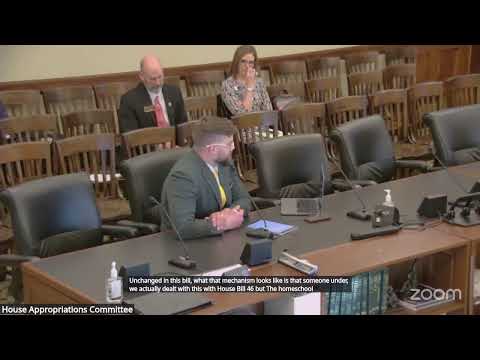
Representative Harrelson asked about how ESA students relate to the state's homeschool statute. Andrews said the distinction is already addressed in existing law (he referenced earlier work on House Bill 46): an ESA also fulfills compulsory attendance requirements but would not make a student a "homeschooler" under the homeschool statute.
There was no public testimony recorded on the bill during the committee meeting.
On motions, Representative Harrelson moved that House Bill 199 be given a do-pass recommendation; the motion was seconded by Representative Pendergraft. Representative Scott moved an amendment to reduce the startup appropriation from $50,000,000 to $30,000,000 (page 17, lines 22-23); that motion carried. A separate motion to delay the bill's effective date by one year (to July 1, 2026) was made and seconded by Representative Sherwood and also carried. The final roll-call vote on the bill as amended was 6 ayes, 1 no.
Vote record (roll call as recorded by the clerk): Representative Alemand: Aye; Representative Angelos: Aye; Representative Harrelson: Aye; Representative Pendergraft: Aye; Representative Sherwood: No; Representative Smith: Aye; Chairman Baer: Aye. The clerk announced, "6 ayes, 1 no."
The bill advanced from committee as amended; the committee did not specify further floor scheduling during the recorded session.
Clarifying details captured during the meeting include the $7,000 scholarship amount, an average ADM stated as about $18,000, a three-year phase-out of funding for students, a participation estimate initially described as "anywhere from 1,800 to 4,5100" and later corrected in committee discussion to "1,845," the redirected funding source described as under‑the‑cap federal mineral royalty revenue, and the amended startup appropriation of $30,000,000. The committee also adopted a one-year delay to the bill's effective date (July 1, 2026).
Members who spoke during the item and public-facing roles are listed in the committee record; direct quotes in this article are attributed to those members as recorded.
The committee adjourned following the vote.