Get Full Government Meeting Transcripts, Videos, & Alerts Forever!
Get email alerts on the Housing Development topic
No spam. Unsubscribe anytime.
Yolo County Housing Authority to Consider Partnership on 342‑Unit Davis Project with 69 Units Deed‑Restricted
Summary
Developers presented a missing‑middle new‑construction model using the California welfare tax exemption; Yolo County Housing staff signaled support to draft a regulatory agreement and offer a $25,000, 3% one‑year loan to meet state property‑tax abatement requirements, with final agreements targeted for the March meeting.
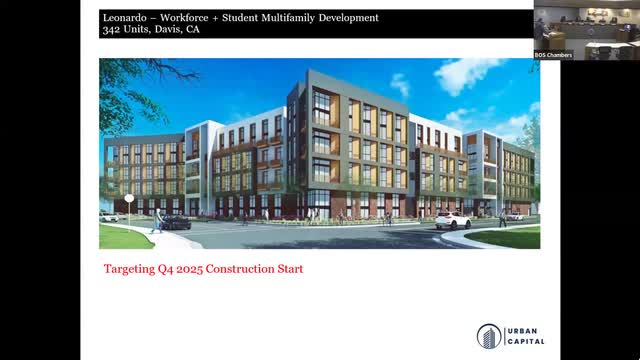
John Vinocchi, founder and managing partner of Urban Capital, on Jan. 22 presented a proposed 342‑unit new‑construction project at 1616 Da Vinci Court in Davis and asked the Yolo County Housing Authority to consider a partnership to secure a welfare tax exemption and deed‑restrict a portion of the building as workforce housing.
The project would replace an existing office building on a little more than 2 acres and, according to Vinocchi, would deed‑restrict 69 units — “slightly over 20% of the total” — at 80% of area median income in perpetuity. Vinocchi said Urban Capital plans to replicate a model used with the Capital Area Development Authority (CADAA) in Sacramento that uses the California welfare tax exemption, a small public assistance contribution and a nonprofit partner to administer income certification and programming.
The welfare tax exemption is a state property‑tax abatement involving a regulatory agreement and a showing of public assistance, Vinocchi said. He described the typical public assistance as a small, de minimis loan used to qualify the project for the exemption: “we utilize a similar public assistance of $25,000 loan for 12 months at 3% interest,” he said.
Ian Evans, executive director of Yolo County Housing, described the local role under the proposed model: the housing authority would establish the regulatory agreement, provide the $25,000 loan at 3% for 12 months that the Board of Equalization expects as the public subsidy, and perform annual verification duties of tenant self‑certification forms to maintain the exemption. Evans said Urban Capital and its nonprofit partner, CRDC, would handle development, ongoing property management and income verifications for filings.
Vinocchi said the project would be largely market‑rate construction with a permanent deed restriction on the 69 workforce units. He estimated the project’s hard cost at roughly $160,000–$168,000 per unit and predicted the building would still generate approximately $1 million per year in property tax revenue even after the exemption is applied.
Commissioners asked about accessibility, elevator provision and unit types; Vinocchi said the Davis building would be four stories with four standard elevators and that by code, elevators require accessible or adaptable units. Commissioners also asked whether units could be targeted to teachers or first responders; Vinocchi and Evans said specific occupant targeting would raise fair‑housing issues, though targeted marketing to those workforces is possible, and in some narrow cases (for example, teacher housing on school‑district‑owned land under specific state law) exemptions may permit restrictions.
No formal action was taken on Jan. 22. Commissioners and staff indicated support for drafting regulatory agreements and returning to the commission at its March meeting for consideration of the loan terms, per‑unit monitoring fees, and a proposed regulatory agreement. Evans said the March packet would include draft agreements and the proposed fee structure for monitoring.
If approved in March under the model described, Yolo County Housing’s role would not be ownership; rather, the authority would act as the regulatory monitor and provide the small loan that qualifies the project for the state property‑tax abatement, while the developer and nonprofit partner manage the asset and tenant services.
Ending: Staff will return in March with draft regulatory agreements, a recommended $25,000 loan agreement at 3% for 12 months, and proposed monitoring fees for the commission’s review and possible approval.