Get Full Government Meeting Transcripts, Videos, & Alerts Forever!
Get email alerts on the Corridor Construction topic
No spam. Unsubscribe anytime.
2016 mobility bond corridor work moves into construction; costs, coordination with TxDOT and drainage cited as constraints
Summary
Capital Delivery Services briefed the committee on progress and constraints for corridor projects funded by the 2016 mobility bond, reporting $255 million spent to date, roughly $100 million in leveraged funds, and a construction ramp-up in 2025 that will require coordination with TxDOT and watershed protection for several corridors.
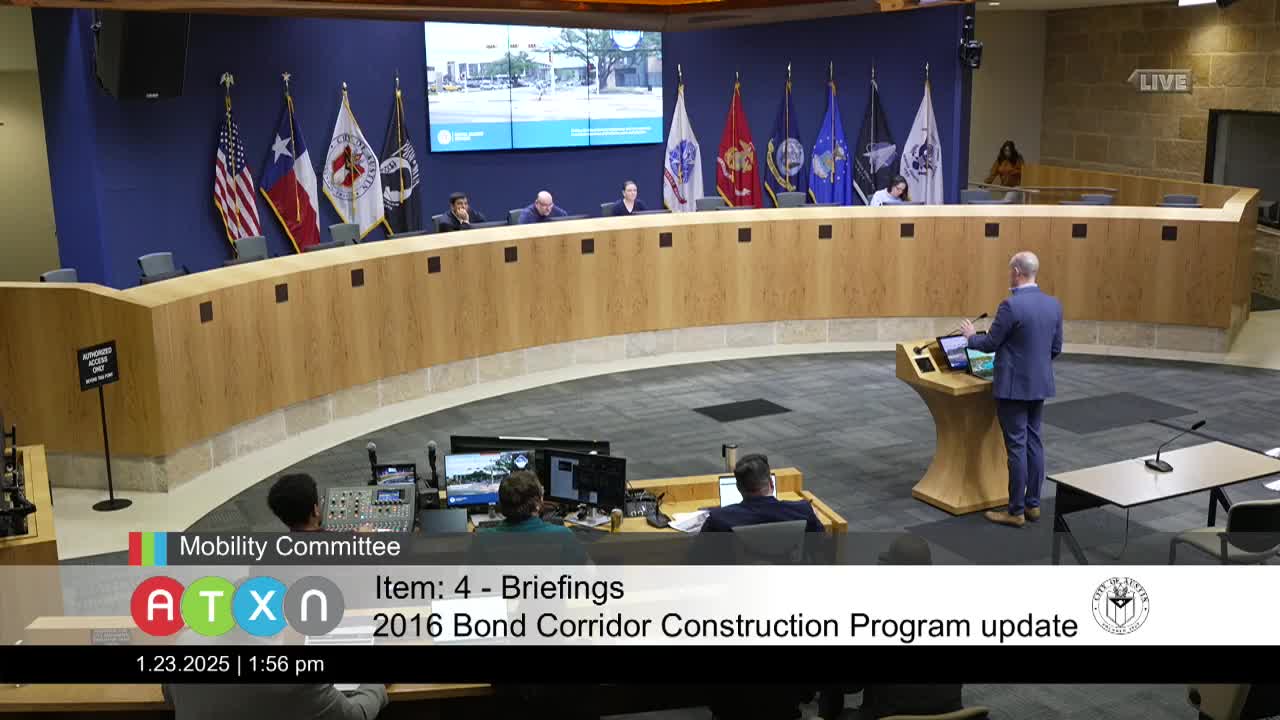
Capital Delivery Services told the Mobility Committee on Jan. 23 that the 2016 mobility bond corridor program has moved from planning into a construction phase but faces cost and interagency coordination challenges that changed original delivery plans.
"When the bond was approved, the plans throughout the corridors were in a concept level plan and not fully developed," said Eric Bailey, deputy director of Capital Delivery Services. As design work matured, teams discovered substantial stormwater and utility needs tied to adding sidewalks and shared-use paths; those drainage requirements in some corridors transformed what were intended as modest transportation projects into much larger, more expensive infrastructure efforts.
Bailey reported that the program has completed about $255,000,000 in spending and leveraged roughly $100,000,000 from grants, developers and internal partners. He said roughly $146,000,000 in corridor projects are estimated to go to bid and construction during calendar year 2025.
Notable corridor notes from the briefing: - Airport Boulevard: West-side shared-use-path extension from 55th to 45th is a near-term priority; staff said coordination with the I-35 project and TxDOT is critical to avoid repetitive work. - North Lamar: Signal and intersection improvements have been installed but larger corridor reconstruction is constrained by open-channel drainage that must be converted to piped systems before full sidewalks and bike facilities can be added. Staff described the drainage conversion as the work that must be completed to use the full right of way. - Burnet Road: Kramer Lane drainage work is nearing completion and will enable remaining Burnet improvements from 183 to Mopac; some sections will be delivered via an IDIQ (indefinite delivery/indefinite quantity) contract. - South Lamar: The segment from Barton Springs to IH-35 is the largest remaining project; Bailey said preliminary construction cost estimates for that South Lamar section are roughly $60,000,000 and the project is expected to go to bid in summer 2025. - Riverside and Guadalupe: Several safety and signal improvements were completed, but most corridor changes have been deferred pending integration with Project CONNECT alignments.
Bailey emphasized community engagement and public-facing project pages that consolidate previous materials into a smaller set of monitored web pages with schematic plans and contact information for questions. He told the committee that many corridor projects require partnership with Transportation and Public Works, Watershed Protection, Austin Water and TxDOT.
Committee members pressed for additional cost detail on North Lamar. Council Member Vela said neighborhood advocates expected earlier, more comprehensive work on North Lamar and asked how much additional funding would be needed to complete full corridor reconstruction. Bailey said additional funding would be required and that staff would provide more precise cost estimates after further review.
The committee did not take formal action on corridor scope or funding at the meeting; staff said several projects are scheduled to be advertised for construction in 2025 and that coordination with other agencies and permitting will continue.