Get Full Government Meeting Transcripts, Videos, & Alerts Forever!
Get email alerts on the Pompano Airpark Development topic
No spam. Unsubscribe anytime.
Pompano Beach planners recommend zoning, land-use and tree-buffer changes to clear way for airport development and training school
Summary
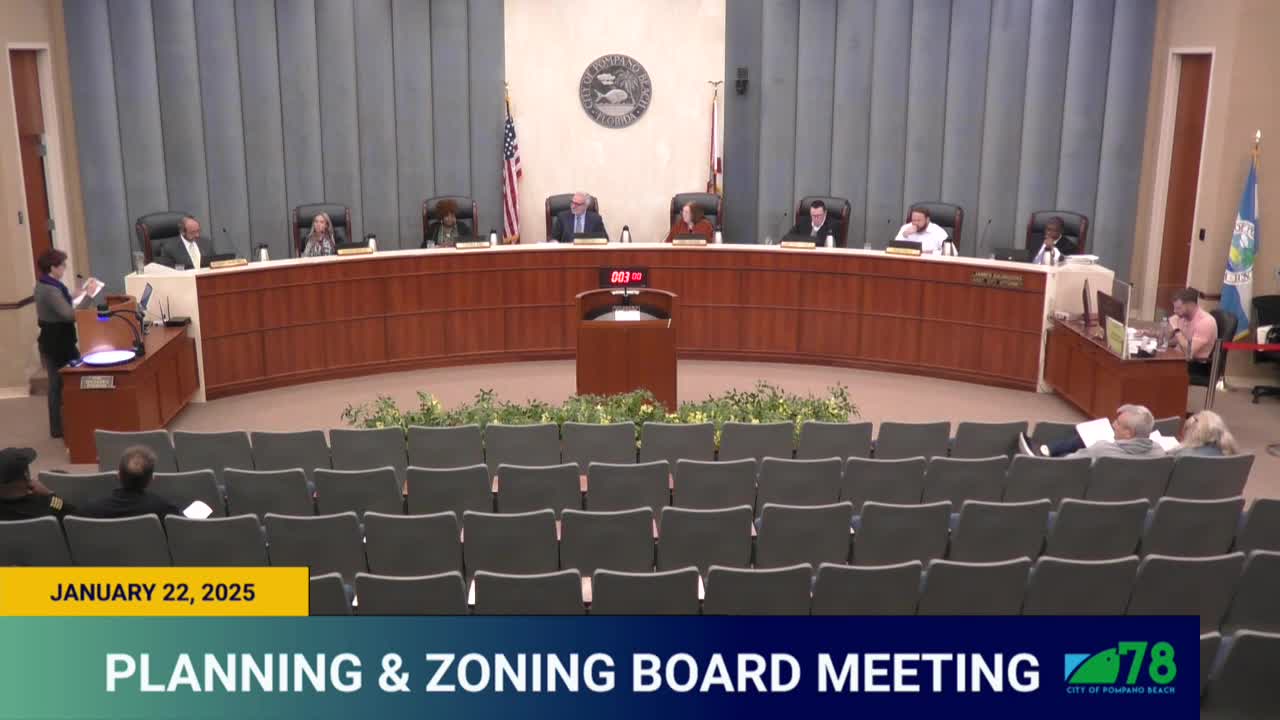
The Pompano Beach Planning & Zoning Board voted unanimously Jan. 22 to recommend approval of a zoning code text amendment (LN 676), a land-use plan amendment for the Air Park, and an amendment to the city's environmentally sensitive lands (ESL) map (LN 560), sending all three items to the City Commission for consideration.
The Pompano Beach Planning & Zoning Board voted unanimously Jan. 22 to recommend approval of a zoning code text amendment (LN 676), a land-use plan amendment for the Air Park, and an amendment to the city's environmentally sensitive lands (ESL) map (LN 560), sending all three items to the City Commission for consideration.
The measures are intended to align city regulations with the Pompano Beach Air Park master plan, create a 100-foot landscape/tree-mitigation buffer along key public frontages, clarify how aviation height and setback limits are applied inside the airpark, and remove four parcels from the ESL map so limited aviation development can proceed. Staff said the changes also explicitly allow vocational/trade schools in the transportation zoning district to avoid permitting delays for potential tenants such as the Barrington Irving Technical Training School (BITS).
Jean Dolan of Development Services told the board the zoning change replaces a 'cookie-cutter' district template with aviation-specific footnotes that mirror current practice and give direction on tree mitigation and site review. "Tree locations and species for mitigation will be selected based on compatible heights to avoid creating aviation obstructions and bird and wildlife attractions that are incompatible with airport operations," Dolan said. The amendment clarifies that building heights and other airspace limitations will continue to be governed by the airport overlay (city code 155-3707) and by aviation engineering review when required.
Board discussion focused on public safety, tree mitigation design and who will review technical matters. Steve Rocco, the airport manager, will have a landscape architect prepare frontage plans for Copens Road, Northeast 5th Avenue and Northeast 10th Street to identify species and planting locations compatible with aviation operations, staff said. The proposed text also says landscaping requirements in section 155-5203 of the code will not apply to aircraft aprons and that required mitigation trees that are inappropriate inside the airfield will be planted prior to certificate of occupancy within the mitigation buffers along the public corridor. The code amendment places on-site drainage responsibility with future lessees to avoid last-minute design surprises.
The board also considered a land-use plan amendment that would reclassify roughly 32.5 acres near the runway protection zone from open space/recreation to transportation to match the airport layout plan in the FAA master plan. Dolan said the airport property totals about 1,035 acres; about 385 acres were previously released from historical deed restrictions and are already used for city parks, schools and other civic purposes. The parcels at issue in this amendment are the remaining areas the FAA expects to be available for aviation development; staff used conservative development assumptions (single-story, 40% lot coverage) to estimate about 283,000 square feet of additional building capacity on the two developable parcels.
A separate but related ESL map amendment would remove four mapped wooded areas (labeled 91, 95, 93 and 92 in staff materials) from the environmentally sensitive lands map. Kimley-Horn environmental scientist Tori Bachelor told the board that field surveys in 2023 found the woods to be heavily invaded by nonnative species such as Brazilian pepper and umbrella tree and that listed species were not found "within or immediately adjacent to" areas 1 through 3. Bachelor said gopher tortoise burrows were observed along the edges of area 4 and recommended a 100% gopher tortoise survey before any development or clearing. "If any [gopher tortoises] are found, then you have to apply for a relocation permit through FWC," she said, describing standard state requirements.
Dolan and Kimley-Horn staff said the airport will still need to follow federal environmental review for work near the runways: some trees must be removed from the runway-visibility zone to restore sight lines between runway ends 15 and 24. That clearing is part of the airport master-plan implementation and will be carried out through the federal NEPA process and (as described in staff presentations) is eligible for Bipartisan Infrastructure Law funding. Staff emphasized that any clearing or construction would be phased and would include species surveys and mitigation before physical work begins.
The board also heard a presentation from Barrington Irving of the Barrington Irving Technical Training School and his partner Jeff Colasanti. Irving described BITS as a workforce-training program that provides short, industry-aligned courses (12'16 weeks) intended to prepare students for immediate employment in maintenance, repair and overhaul roles and related aviation-industry jobs. Irving said BITS currently leases a hangar at the Air Park and has placed equipment there; he said the school's model is supported by private industry partners, workforce organizations and foundations and that "none of these students pay any fees to participate." He described job-placement results from recent cohorts and said the program would seek industrial tenants and partners if a dedicated technical campus is established.
Votes at a glance
- LN 676 (zoning text amendment): Motion to recommend approval made by Carla Coleman; second not specified. Vote: unanimous (7-0) in favor. The amendment adds aviation-specific footnotes, establishes 100-foot street-side tree-mitigation buffers, exempts aircraft aprons from certain landscape code sections, clarifies height/setback review by aviation engineers, and adds vocational/trade schools as a permitted use in the transportation district.
- Air Park Land Use Plan Amendment (LUPA): Motion to recommend approval made by the Planning & Zoning Board chair; second not specified. Vote: unanimous (7-0) in favor. The change converts roughly 32.5 developable acres from open space/recreation to transportation to match the FAA airport layout plan and to make the parcels available for aviation-related development.
- LN 560 (ESL map amendment): Motion to recommend approval made by board member Tundra King; second not specified. Vote: unanimous (7-0) in favor. The amendment removes four mapped wooded areas from the ESL map; staff and consultants said surveyed areas are largely dominated by exotic vegetation, with limited pockets of higher-quality habitat and gopher tortoise burrows along edges that require follow-up surveys and state permitting before any clearing.
What the board approved tonight is advisory; final approval requires multiple next steps. The items will go to the City Commission for first reading, then to Broward County for a consistency review (county adoption is required before a city amendment becomes final), then to the state Department of Economic Opportunity for small-scale plan review and recertification. Staff said parcels must be platted before any development can proceed; the city has begun scoping survey work for that platting and warned the plat process could delay the start of construction by many months.
Public commenters and board members urged careful mitigation and said they want follow-up assurances on tree replacement, wildlife relocation, fire and safety review, and landscaping design. Anne Bosworth, a resident, urged the board to continue parcel-by-parcel scrutiny rather than adopt broad map changes; staff responded that further, project-specific environmental studies and required permitting would take place before any construction.
Planning staff and the airport manager said they will continue to involve the city's urban forester, aviation consulting engineers and federal/state agencies as the project advances.
The Planning & Zoning Board record and staff presentations cite the city's airport overlay (city code 155-3505 and 155-3707), the city landscaping code (155-5203), Chapter 333 of the Florida Statutes (airport zoning), the Growth Management provisions of Chapter 163 (future land-use map procedures), and federal deed-restriction history tied to the Surplus Property Act (1944) as the legal and policy framework guiding the actions.
Next steps
The board's recommendations will be transmitted to the City Commission for public hearings. Staff emphasized that additional environmental fieldwork (including a 100% gopher tortoise survey where required), federal NEPA review for airfield work, FAA coordination on deed restrictions and aviation safety, and platting are required before any ground-disturbing work or tenant build-out can occur.