Get Full Government Meeting Transcripts, Videos, & Alerts Forever!
Get email alerts on the Land Use Fiscal Analysis topic
No spam. Unsubscribe anytime.
Garland fiscal analysis: consultant says city must add about $8 billion in taxable value by FY 2033–34; $207 million streets package proposed for bond
Summary
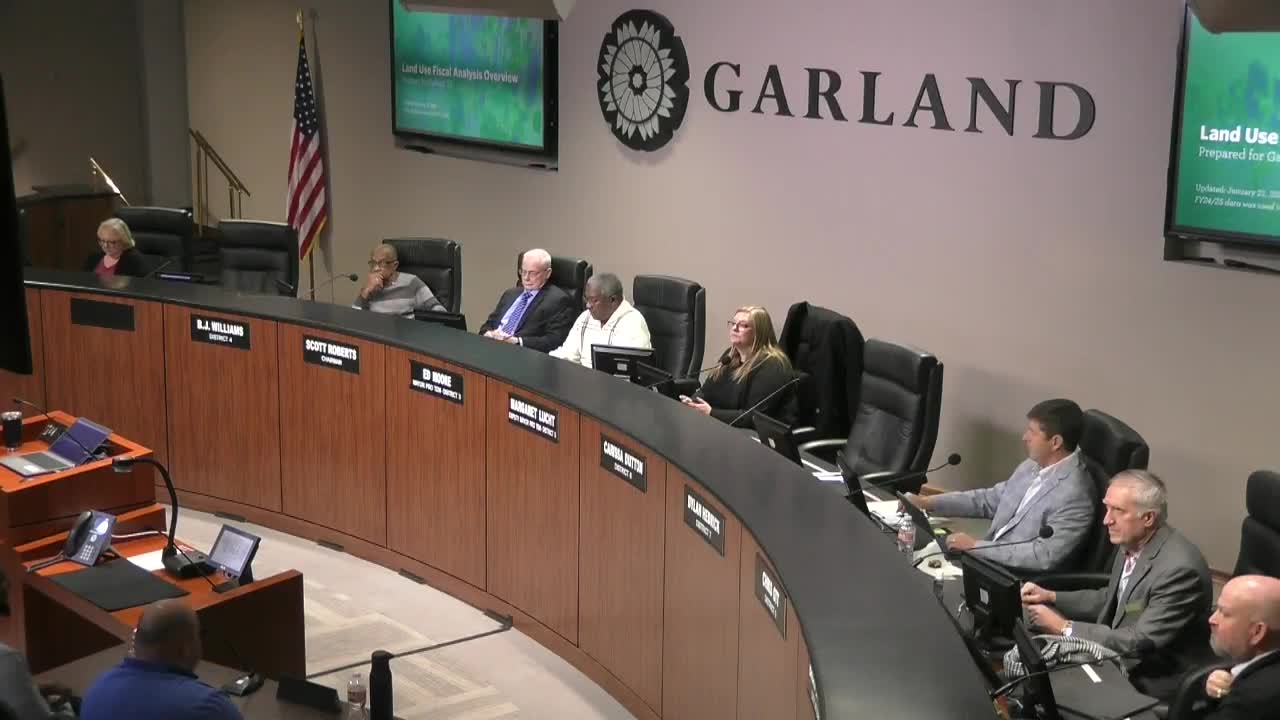
Kevin Shepherd, a consultant with Virginity Consultants, told a joint Garland City Council and Planning Commission workshop that the city’s land‑use fiscal analysis shows Garland must add about $8 billion in taxable value by fiscal year 2033–34 or face service cuts, tax increases or other revenue measures.
Kevin Shepherd, a consultant with Virginity Consultants, told a joint meeting of the Garland City Council and Planning Commission that a fiscal analysis tied to the city’s comprehensive‑plan update shows Garland needs to add roughly $8 billion in taxable value by fiscal year 2033–34 to avoid cuts or tax increases.
Shepherd told elected officials and commissioners the study modeled three levels of analysis: current property‑tax revenue per acre; allocation of general‑fund operating (M&O) costs back to parcels; and a third level adding the debt (Interest & Sinking, or I&S) portion of the tax rate to account for debt‑funded facilities and infrastructure. He said the city’s staff and consultants also factored in a proposed streets bond program the consultant described as roughly $42 million per year for five years — about $207 million in total — that staff intends to fund through the I&S portion of the property‑tax rate if voters approve the bond.
"If the bond election passes, you have things covered on the debt side to take care of the streets," Shepherd said. "On the general fund or on the M&O portion ... we need to find an additional $14,000,000 in property tax revenue on the M&O side" by FY 2033–34; he said that increase corresponds to about $8,000,000,000 in additional taxable value across Garland.
Why it matters: Shepherd framed the analysis as an attempt to align Garland’s land‑use pattern, infrastructure and service model with what residents will pay. He said development pattern — the mix of lot sizes, housing types, commercial blocks and industrial land — is a key lever the city controls that affects taxable value per acre and therefore long‑term fiscal health. The analysis focused primarily on property tax revenue per acre while noting sales tax is also important.
Key findings and numerical details
- Proposed streets bond: Shepherd described a bond program that would require about $42 million per year over roughly five years (about $207 million total) to bring the citywide pavement inventory to an estimated score of 77 ("above average"). Staff proposes funding this with the I&S portion of the tax rate, which Shepherd said could be done without raising the overall tax rate if the bond passes. He emphasized that if the bond fails, the costs would remain and the city would need alternatives such as higher tax rates, new fees or service reductions.
- M&O shortfall: The analysis projects Garland will need about $14 million more in annual property‑tax revenue for the maintenance and operations (M&O) side of the general fund by FY 2033–34 to cover a lean budget scenario. That figure drove the $8 billion taxable‑value target.
- General fund revenue mix: For the FY25 budget Shepherd referenced, about half of Garland’s general fund comes from property and sales taxes; because Garland is largely built‑out, development fees contribute a small share.
- Land‑use productivity: Across many zoning and parcel slices, Shepherd’s model showed smaller lot single‑family neighborhoods and certain multifamily and downtown block patterns generate higher property‑tax revenue per acre than large estate lots or low‑density suburban patterns. He said multifamily — particularly smaller scale multifamily (16–24 units) — often produces strong property‑tax revenue per acre but requires careful cost allocation.
- Industrial strength: Shepherd described industrial land as a substantial fiscal asset for Garland. In his maps the city’s industrial parcels are among the highest taxable‑value-per‑acre areas.
Strategies the presentation identified
- Increase taxable value per acre through: more productive development patterns (smaller lots or additional units on large lots, compatible mixed‑use development, targeted multifamily in appropriate contexts), incremental infill and downtown redevelopment, and maintaining industrial competitiveness.
- Use a growth‑management framework that maps areas to preserve, enhance (incremental change) or redevelop, and pair that with place‑type guidance so residents know what to expect in each neighborhood.
- Make targeted capital investments (for example, a bond program focused on streets) and align the capital‑improvement plan, zoning/code updates, and economic incentives to preferentially support productive redevelopment.
- Explore parking and street‑section changes in coordination with land use (Shepherd noted a construction cost order of magnitude of $1–$2 million per lane‑mile and suggested in some corridors converting lane miles to bike/walk facilities where context supports it).
Questions and staff follow‑up
Council and commission members asked for more apples‑to‑apples comparisons on large‑pad suburban retail vs. downtown blocks (noting parking treatment differs), a zoning diagnostic to identify code changes needed to enable smaller lots and accessory dwelling units (ADUs), and concrete recommendations for incentive tools and where to apply them. Staff and the consultant said follow‑up materials would include interactive maps, detailed parcel‑level charts, and suggested code or development‑agreement approaches to encourage incremental redevelopment.
What was not decided
There were no formal votes or policy adoptions during the workshop. Shepherd and staff presented findings and options; council and commission members asked for additional data, examples and prioritized recommendations to inform the next phases of the comprehensive‑plan update.
Ending
Shepherd said the project will move into the next "explore" phase with staff — testing specific locations and strategies — and that much of the full dataset and detailed slides would be shared with staff and interested council/commission members. He and council members emphasized the importance of communicating the choices and tradeoffs to residents — that lower‑density, auto‑centric development has higher long‑term costs and that capturing additional taxable value will require a mix of targeted redevelopment, incentives and, potentially, votes on capital funding.