Get Full Government Meeting Transcripts, Videos, & Alerts Forever!
Get email alerts on the Opioid Settlement And 1ohio Grants topic
No spam. Unsubscribe anytime.
Toledo officials hear how opioid settlement funds will be split locally, and region’s grant process
Summary
City and regional representatives briefed the Toledo Public Safety & Criminal Justice Reform Committee on opioid settlement disbursements, the 1Ohio Foundation grant process for Region 4 (Lucas County), and how the city can use its local share; committee members raised concerns about speed, accountability and local reach of grants.
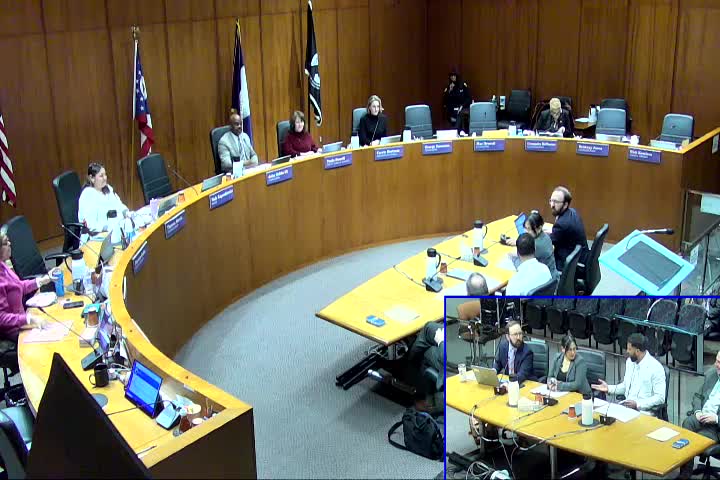
Toledo council members heard an overview Tuesday of how opioid settlement money will be allocated to the city and to Region 4 of the 1Ohio Recovery Foundation, and how the city may use its share for past or future opioid-abatement work.
Councillor Mike Hobbs convened the Public Safety and Criminal Justice Reform Committee meeting and introduced speakers including Steve Spitler, a senior attorney in the city’s Department of Law General Division; Cara Wall, an attorney who helped negotiate the 1Ohio memorandum of understanding (MOU); Matt Bell, CEO of Team Recovery and chair of Region 4’s board; and Scott Silek, Region 4’s liaison to the state-level 1Ohio Foundation board.
The presentation centered on two distinct pools of settlement money. Spitler said the city has received multiple disbursements and described Toledo’s current balance as “11,279,000 and change with no expenditures to date.” Wall and others explained that, under the 1Ohio MOU, 30% of settlement funds that come into Ohio are allocated to local governments, 55% to the statewide 1Ohio Recovery Foundation (distributed to regions through a grant process), and 15% to the state. Wall said the local-government 30% share may be used retroactively to reimburse past opioid-related expenditures if the spending is tied to an abatement strategy.
Why it matters: the distribution rules determine how quickly and for what purposes money can reach first responders, treatment providers and family supports. Committee members repeatedly pressed for clarity on how fast money could be awarded and how the city would ensure the funds reach people and neighborhoods most affected by opioid use.
Key details from presenters
- Two pools and spending rules: Wall outlined that the local-government share (30%) offers more flexibility, including reimbursement for prior expenditures, while the foundation’s 55% is restricted to prospective spending and is awarded through a competitive grant process administered by the 1Ohio Foundation and region-level boards. All spending must tie to one of the abatement strategies included with the MOU.
- Toledo’s and Region 4’s allocation percentages: Wall said Toledo’s portion of the local-government share is 1.0198% (that percentage applies to each disbursement that flows into the Ohio local-government pool). Presenters later said Region 4’s share of the foundation-level funds is 4.702820% of the amount the state allocates to regions.
- Settlement timing and amounts: Wall summarized that settlements and bankruptcies (for example Purdue, Mallinckrodt, retail and distributor settlements) pay out over varying schedules — from six to 18 years — which creates budgeting variability. She said the combined nationwide settlements exceed $46 billion to date and noted that some payouts (for example the distributors’ aggregate settlement) were structured to pay over 18 years.
Region 4 grant process and oversight
Matt Bell described Region 4’s board composition and priorities. The region’s board elected four funding priorities: recovery supports, prevention, services for impacted families and children, and criminal-justice-related services. Bell and Silek described a multi-stage review process: regions score and rank applications using a shared grant platform (AcoyoGo), then recommended applications go to foundation staff for further vetting, an expert panel for evidence review and finally to the 1Ohio Foundation grants committee and board for contract negotiation.
Silek said the foundation staff, the expert panel and the grants committee each verify licensure, evidence basis and financial/reporting readiness before a contract is negotiated. He said that, statewide, demand far outstripped funds in the first grant cycle and that nearly all Region 4 recommendations that were funded have been moved forward. Presenters emphasized that contracts include reporting requirements and financial accountability provisions.
Committee concerns and requests
Multiple council members said they were pleased the region had prioritized recovery and housing, but pressed presenters on speed and local impact. Council members raised concerns that the first-year application cycle was slow relative to community need and asked for clearer timelines, stronger safeguards against grant “paper” applications that do not serve affected families, and better information about which locally based applicants received awards and the amounts.
Presenters acknowledged the first-year delays and said region volunteers and the foundation were working to improve timeliness. They pointed committee members to 1ohiofoundation.org (site name given during the meeting) for detailed listings of awarded grants, meeting minutes and application windows.
Local examples and funded providers mentioned
Committee members and presenters named several providers that applied for or received region/foundation funding or that were involved in local recovery efforts: Center of Hope (Dr. Tracy Pearman), Harbor (named but specific program not detailed in the meeting), Unison Health (Jeff Delay), OhioGuidestone, Neighborhood Properties Inc., Recovery Housing initiatives, and Elvis House (a criminal-justice halfway house). One attendee said a WETQ outreach award was about $530,000 (statement taken from public remarks during the meeting).
Formal committee action recorded
At the meeting’s close a committee member placed a referral asking staff to obtain a quote to deploy a ShotSpotter unit covering one square mile (a request for procurement information; no vote or contract award was recorded during the meeting).
What the city can do next
Presenters repeated that city officials control how Toledo’s local-government share is spent so long as expenditures tie to one of the abatement strategies. Spitler (City Law) indicated the administration and council would work together on legislation to authorize spending from the city’s settlement funds in a future legislative cycle.
Ending: follow-up and next steps
Council leaders asked staff to invite 1Ohio Foundation state staff to a future meeting for a fuller briefing on timelines, contracting and reporting. Committee members asked that presenters provide: (1) the Region 4 map and exhibits referenced at the meeting, (2) a list of funded Region 4 applicants and award amounts located within or operated from the City of Toledo (where available), and (3) updates on proposed city legislation authorizing use of the local share. The committee said it plans a follow-up meeting to hear from funded providers about how their grants will reach families and neighborhoods.