Get Full Government Meeting Transcripts, Videos, & Alerts Forever!
Get email alerts on the Parks Recreation Corp topic
No spam. Unsubscribe anytime.
Board reviews first draft of Menomonee Falls 2025–2030 comprehensive outdoor recreation plan; targets May 1 stewardship grant
Summary
Brian Weidenfeld of MSA presented the first draft review of Menomonee Falls’ 2025–2030 Comprehensive Outdoor Recreation Plan on Jan. 20, highlighting extensive public engagement and draft recommendations for trails, signage and facility upgrades.
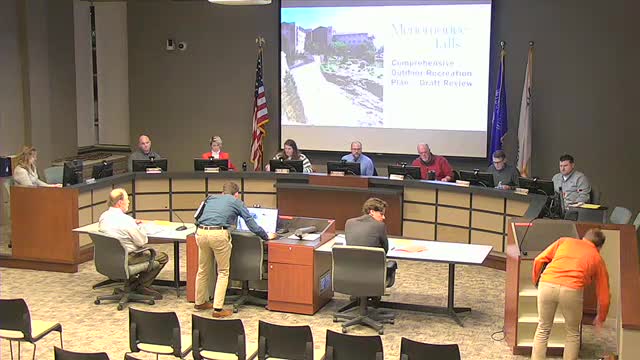
Brian Weidenfeld of MSA Professional Services presented the first draft review of the Village’s 2025–2030 comprehensive outdoor recreation plan (CORP) to the Village Board on Jan. 20. The CORP is a five‑year guidance document used to inventory park and trail assets, set recommendations for improvements, and support applications for state and federal park grants.
Weidenfeld said the draft draws on a summer community survey, pop‑up outreach and focus groups. “We received close to 3,000 responses,” Weidenfeld told trustees, and survey respondents rated village parks and programming highly. Key public priorities identified in the engagement included trail and trail connectivity, restrooms, wayfinding signage and preserving natural areas. The draft calls for expanded trail networks, improved connections to neighboring jurisdictions and targeted signage and vegetation improvements at identified park sites.
Tyler Loggerman, village planner, told the board staff will take comments on the draft, work with MSA and return a final draft in March for potential adoption so the village can be positioned to apply for the Knowles‑Nelson Stewardship grant, which has a May 1 application deadline. The stewardship program prefers projects that connect to natural areas or regional trail networks; Loggerman and Weidenfeld identified a possible grant application to fund a boardwalk segment connecting Mill Pond Park to the Bugline Trail where a wetland crossing is required.
The draft includes a park inventory, trail inventory and needs assessment tied to population projections through 2030. Weidenfeld described maps showing walk sheds, recommended improvements by park site (infrastructure and programming), and implementation guidance including funding strategies and potential partners. MSA is preparing a shorter park‑marketing booklet for online distribution to highlight destination parks and programming.
Trustees asked several clarifying questions: whether school facilities (high‑school pool and North Middle School pool) are counted as public pools in the inventory, access to high‑school fields and track for community use, and how the recently acquired Little League parcel will be handled. Loggerman said the village has discussed shared‑use access with the school district previously and will continue outreach, and that Little League property remains subject to an existing lease during the current transition; any change to public access would be negotiated with the club and district.
Weidenfeld and Loggerman recommended trustees focus their upcoming review on the recommendations and implementation chapters (trail recommendations, undeveloped park sites and funding/partnership strategies). The board agreed to a committee‑of‑the‑whole workshop in March to review the draft in depth.
Ending: Staff will collect board edits and public comments, return a revised final draft in March, and if adopted the document will be used to support grant applications including the Knowles‑Nelson Stewardship grant with a May 1 deadline.