Get Full Government Meeting Transcripts, Videos, & Alerts Forever!
Get email alerts on the Homelessness topic
No spam. Unsubscribe anytime.
Sandy’s medically vulnerable interim housing program reports first-year outcomes, plans senior homelessness task force
Summary
Operators of the medically vulnerable interim housing program (MVP) told the Sandy City Council they served hundreds over the program’s first year, added on-site medical and security services, and plan a senior homelessness task force and facility upgrades in 2025.
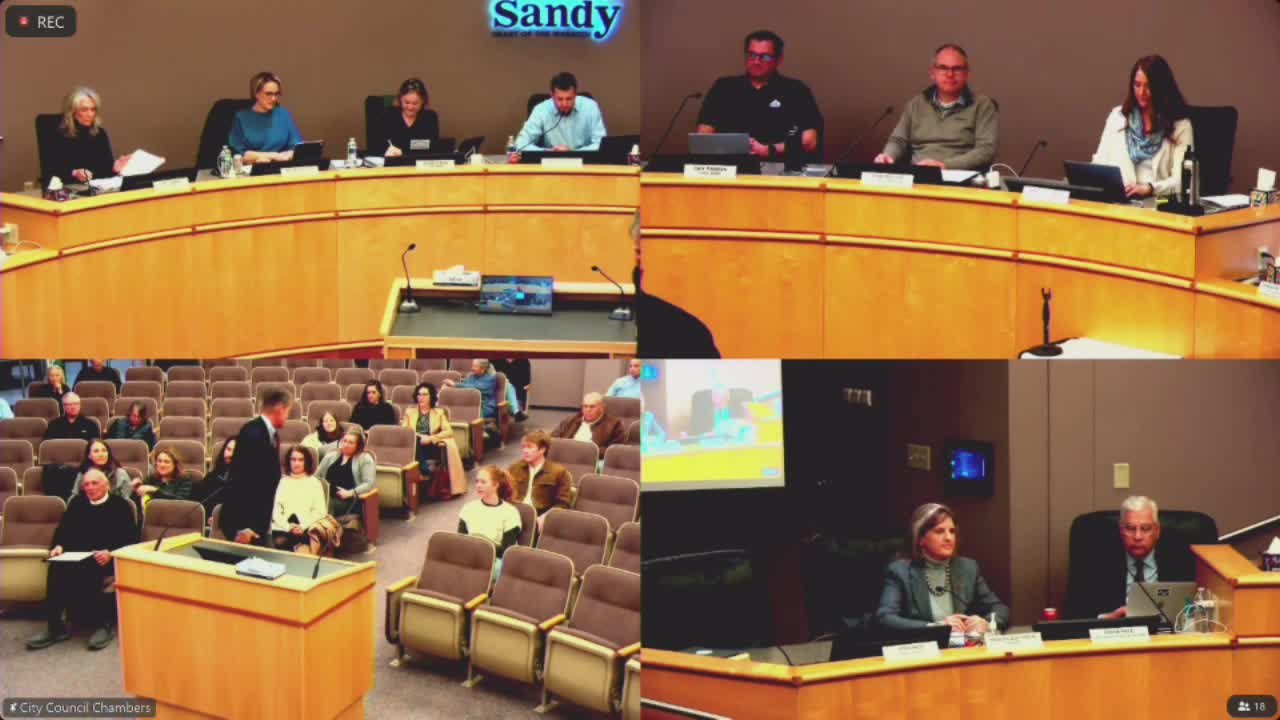
The Road Home, 4th Street Clinic and the conditional-use permit holder Shelter the Homeless presented the final quarterly update on the medically vulnerable interim housing program (MVP) to the Sandy City Council on Jan. 21, saying the program has served hundreds of people, added on-site medical coverage and security, and plans a senior homelessness task force for 2025.
"Guadalupe’s story is a powerful testament to the transformative impact of support, resilience, and determination that this program is able to provide," said Mike Young of The Road Home, describing a program client who moved from MVP into independent housing with a service animal after receiving medical and housing supports.
City and partner officials said the MVP serves people aged 62 or older or those with medical vulnerabilities in a semi-private, short-term residential setting that aims to stabilize health and connect residents to permanent housing or higher levels of care. Presenters said the program’s goals for 2025 include forming a senior homelessness task force housed at the Salt Lake Valley Coalition on Homelessness, continuing facility improvements and growing health services at the site.
Janice Olson, chief operating officer of 4th Street Clinic, said the clinic provided care to 3,139 patients in 2024 (about 87% of people who accessed MVP during the year), and that on-site medical capacity has increased: an additional clinic day, point-of-care lab testing with ARUP processing for complex labs, and a pharmacist focused on diabetes management and medication reconciliation.
4th Street Clinic and The Road Home also expanded emergency medical technician (EMT) coverage to a 6 a.m.–midnight swing shift Monday–Friday. Olson said that, since adding the EMT swing shift in August, incident reports related to EMS calls were down roughly 19% in the measured period. Mike Young said roughly 150 people were sleeping in the program on the night of the council meeting and confirmed that screening and referral processes have been tightened since the program opened.
Shelter the Homeless, the organization identified in the program’s memorandum of understanding and conditional use permit, reported operational and security upgrades over the first year: 24/7 security, a redesigned front entrance with an intercom and Knox Box for emergency access, new wayfinding signage, interior non-slip flooring in shared spaces, a fenced courtyard and exterior paving and landscaping. A shelter representative reported the program provided 81,560 meals over its first 365 days.
Council members asked for clarification about program outcomes and housing transitions. Council member Cindy Sharkey asked where people go after leaving MVP; The Road Home said some residents remain at MVP, some have moved to permanent housing or long-term care, and some were transferred early in the year to other homeless resources when staff determined MVP was not the right level of care. Young said early operational changes make raw cumulative numbers harder to interpret but that screening improvements have reduced mismatches.
Other actions and plans presented for 2025 included installing nurse-call systems in ADA rooms, a facility-wide intercom for announcements, additional security cameras, continued volunteer recruitment (volunteerstheroadhome.org), expansion of transportation services (presenters said more than 100 transports took place in December), and exploring on-site telehealth for specialty care.
Council members and city staff repeatedly commended the partners for the level of coordination with Sandy Police and Fire, increased on-site services and the quarterly reporting process. City administration said grant funding and recent state allocations have supported additional staffing — including specialized homeless officers and firefighter staffing that also support broader city emergency response capacity.
Those presenting said MVP intends to return to the council on an annual basis and will convene the senior homelessness task force in 2025 to coordinate referrals, clinical pathways and housing placements across partners.
Ending: The council did not take a formal vote on new policy tonight; presenters requested continued support and collaboration. City staff said the MVP will provide periodic updates and that partners are focused on stabilizing staffing and refining clinical and housing pathways in the coming year.