Get Full Government Meeting Transcripts, Videos, & Alerts Forever!
Get email alerts on the Solid Waste Disposal topic
No spam. Unsubscribe anytime.
Marion County commissioners back landfill expansion as staff refines rate and bonding options
Summary
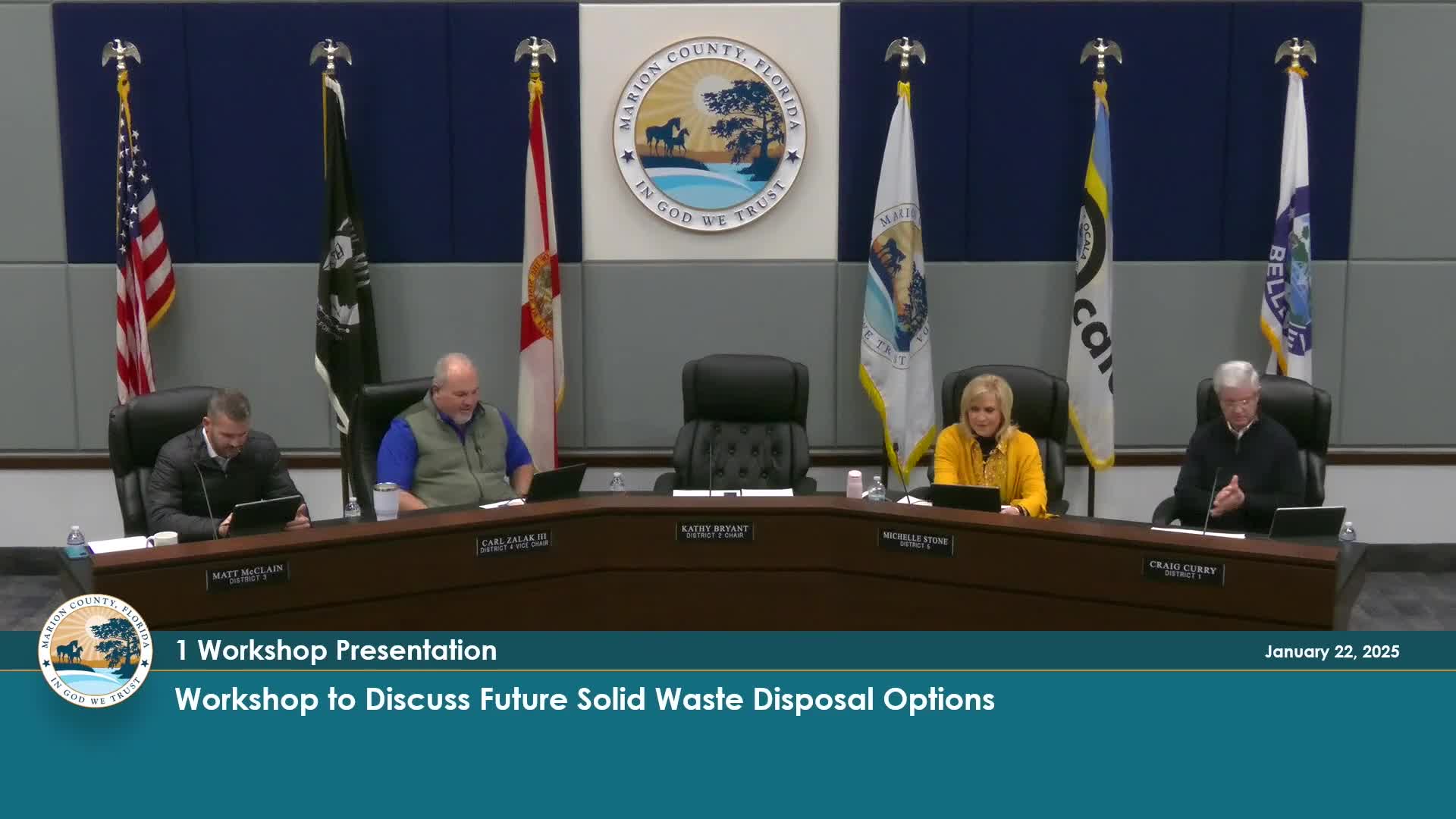
At a workshop, Marion County solid-waste staff and consultants urged expanding the county's baseline landfill as one fiscally defensible path; commissioners asked for more detailed bond- and rate-modeling before setting a final rate plan.
Marion County solid-waste staff and consultants told the Board of County Commissioners at a workshop that the county must choose a path to replace shrinking out-of-county disposal capacity and shore up the fund that pays for disposal, operations and storm debris response.
"Today, we're gonna talk about the future of solid waste disposal options for Marion County," Solid Waste Director Mark Johnson told the commissioners, opening a presentation that summarized current airspace purchases, projected tonnage and options to transfer or landfill locally.
Why it matters: Marion County prepaid for disposal airspace at the Heart of Florida landfill and has consumed roughly 36% of that purchase; staff estimates the county will use about 207,000 tons this year. At the long-term growth scenario used in the financial models (1.56% annually) staff said the county would exhaust Heart of Florida airspace around fiscal 2031; under recent short-term growth rates near 7% the depletion could come a year earlier.
The board's discussion weighed two broad strategies. Transfer stations with third-party disposal would rely on hauling county waste out of the county; county staff said turnkey third-party transfer-and-dispose pricing in recent RFP responses is roughly comparable to current baseline disposal rates but carries higher operating costs and less operational control. Building additional landfill capacity on Marion County's existing baseline footprint would be capital intensive up front but, the presentation said, would provide longer-term control over disposal, possible energy recovery and the ability to manage the waste stream locally.
"Landfilling is a more efficient waste disposal option," Johnson said, listing operational control and a long-term solution among the benefits and noting that permitting and short-term capital are the principal drawbacks. Staff proposed building phases 1 and 2 together on the existing footprint, which consultants estimated would add about 2,700,000 tons of capacity. Using a $60-per-ton assumption, that scenario produced model revenues of roughly $162 million and estimated operations and expansion costs of about $128 million.
Financial pressure and rate choices dominated the commissioners' questions. The county's residential disposal assessment has been $87 since 2008 and, staff said, that level recovers only about two-thirds of 2025 operating and capital needs. Consultants from Stantec and county finance staff presented two rate paths for board consideration: a one-time adjustment that would raise the assessment higher immediately (discussed in the meeting as roughly $215) or a phased-in approach (examples shown in the presentation: $150 in year one, $190 in a later year, then $225). Stantec principal Eric Grama said the one-time increase would build fund balance and reserves more quickly, while a phased approach still meets minimum coverage but grows reserves slower.
"The fund has been operating in a deficit for the past 3 years," Finance Director Jennifer Cole told the board, describing the fund's historical shortfalls and the need to show revenue sufficiency if the county goes to market for bonds.
Budget Director Audrey Fowler cautioned that the county faces broader fiscal pressure and noted the storm and debris risk: "our last huge hurricane was, what, $25,000,000 in debris," she said, arguing for sufficient reserves to avoid borrowing under crisis conditions.
Public commenters representing haulers and local businesses urged keeping local disposal options available. "You wanna control the disposal. You can control the cost. I believe the one-time increase is the way to go," said Jerry Lourenco of Ocala. John Paglia of Florida Express Waste and Recycling told commissioners that preserving local options and keeping transfer capacity near customers improves safety and efficiency.
Where the board landed: Commissioners directed staff to move forward with expanding the baseline landfill footprint and to return to the board at the county's strategic-budget workshop with more detailed bond- and rate-modeling that shows how (a) a phased approach and (b) a one-time adjustment would affect fund balances, debt-coverage ratios and the county's ability to meet a $40 million storm-reserve target. Chair Bridal summarized the direction: "expand the landfill and do what you can that makes strategic sense, both operationally and fiscally, to do it as quick as you can."
The board also agreed that staff should explore marketing any excess airspace or capacity if doing so makes fiscal sense, but several commissioners said any sale should not reduce long-term capacity available to Marion County residents.
Next steps and timing: staff said implementing any new rate structure will require amending the county ordinance, holding a public hearing (targeted for March in the presentation), delivering rate instructions to the budget office by May and to the property appraiser by June. Commissioners asked finance staff and the county's financial advisor to return to the strategic workshop (scheduled by the board) with scenario-level projections that quantify the fund-balance and debt-coverage outcomes under the candidate rate schedules.
The workshop produced direction rather than a binding vote. Commissioners who preferred a one-time increase said it provides faster reserve buildup and stronger bond metrics; others favored a phased increase to reduce immediate rate shock for households. Staff and consultants will prepare more detailed, comparable financial projections for the board before any ordinance changes or public hearings.
Ending: The board adjourned the workshop after commissioners confirmed the path forward: pursue expansion of baseline landfill capacity, refine and return financial scenarios for both one-time and phased rate pathways, and evaluate whether marketing any airspace or accelerating construction is feasible without reducing county resident access to disposal capacity.