Get Full Government Meeting Transcripts, Videos, & Alerts Forever!
Get email alerts on the Policing Arrests topic
No spam. Unsubscribe anytime.
Report: Milwaukee arrests and traffic stops dropped sharply over the last decade
Summary
Rob Henkin, immediate past president of the Wisconsin Policy Forum, and Ari Brown, senior research associate, presented data showing Milwaukee Police Department arrests fell about 82% from 2012 to 2023 and traffic stops fell roughly 81.5% since 2015.
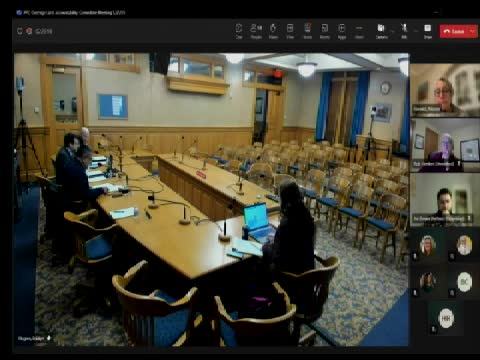
Rob Henkin, immediate past president of the Wisconsin Policy Forum, and Ari Brown, senior research associate with the Wisconsin Policy Forum, presented data to the Fire and Police Commissioners Oversight and Accountability Committee on Jan. 21 showing steep, sustained declines in Milwaukee Police Department arrests and traffic stops over the last decade.
The forum’s report found MPD arrests fell from a little over 51,000 in 2012 to a little over 9,000 in 2023 — a decline the report quantified at 82.3 percent — and that reported traffic stops declined roughly 81.5 percent since 2015. "MPD is making far fewer arrests and traffic stops than it did a decade ago," Brown said during the committee meeting.
The report compared Milwaukee with a set of peer cities with similar populations and found that Milwaukee moved from having the highest arrest rate among the peers in 2012 to near the bottom by 2023. Brown told commissioners, "By 2023, both [arrest and offense rates] were 10th out of 12," citing the peer-city comparison.
Researchers broke arrests into the FBI Uniform Crime Reporting categories used nationwide — taken into custody, on-view arrests and summons/citations — and said the steepest drop was in summons and citations, which are typically for misdemeanors and result in immediate release on recognizance. Brown said summons-and-citation arrests declined by about 95.7 percent overall, and that summons-and-citation counts for some offenses fell by more than 97 percent.
The forum identified multiple factors that likely contributed to the trends, emphasizing there is no single cause. Henkin said the decline reflects a "confluence of factors," including a long-term drop in reported offenses, national shifts in policing after high-profile incidents, staffing declines at MPD, the 2018 Collins settlement and leadership changes at the department. The report also noted a rise in higher-priority calls for service and other demands on officers’ time.
Heather Hoff, a Milwaukee Police Department official who spoke during the meeting, underscored that the Collins settlement and other reforms have increased administrative time per field contact. "On the low end, the report for a field interview now takes about 20 to 30 minutes. On the high end ... it can take over an hour," Hoff said, adding that the Collins settlement requires certain documentation within an officer’s tour of duty.
The forum offered several policy options for city leaders and MPD to consider, including examining staffing and resource allocation, refining approaches to traffic enforcement consistent with Collins-era constitutional safeguards, studying the growth in priority-1 calls for service (medical and other urgent responses) and quantifying how officers spend their time on tasks such as reviewing security-camera footage and medical runs.
Committee members asked detailed questions about the data and possible next steps. One commissioner said the forum’s findings will guide follow-up questioning of the police chief and further committee work. Henkin and Brown said the report is intended to spur further research and discussion rather than to prescribe particular policies.
Votes at the meeting were limited to procedural business; the committee approved a resolution to adopt the Sept. 24, 2024 meeting minutes (FPC 2,11923) by voice vote earlier in the evening.