Get Full Government Meeting Transcripts, Videos, & Alerts Forever!
Get email alerts on the Sign Code topic
No spam. Unsubscribe anytime.
City attorney outlines proposed sign-code changes to permit certain noncommercial signs in rights of way; council asks for refinements
Summary
City attorney presented a proposed amendment to the sign code to allow noncommercial signs in certain right-of-way green spaces under time, place and manner restrictions; council asked staff to return with clarifications on size, distance from traffic devices and contact details on signs.
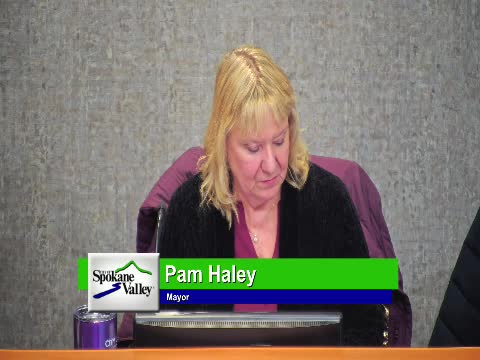
City Attorney Kelly Cogswig presented an administrative report and draft code-text amendment Jan. 21 to revise the Spokane Valley sign code provision governing signs placed within city rights of way (SBMC Title 22, Chapter 110, Section 020).
Cogswig told council that changes in Washington and U.S. Supreme Court case law require sign regulations affecting noncommercial speech to be content neutral and focused on permissible time, place and manner restrictions. The draft language would allow some noncommercial signs in unimproved or green-space portions of the right of way while continuing to prohibit signs that block travel, attach to traffic-control devices, or obstruct clearview triangles. The draft recommends limiting signs to 36 inches wide and 48 inches high (top of sign 48 inches above the ground), keeping signs at least 20 feet from traffic-control devices and not permitting attachment to traffic signals or stop signs.
Cogswig said the proposed amendments would also require signs to be temporary (240 days maximum in a 360-day period, or 14 days after an event placed for advertising an event), to be smooth and free of protruding nails or wires, and to include the sign owner’s name and mailing address for enforcement purposes. Cogswig said the draft aims to align enforcement practice with the city’s long-standing safety-focused exceptions (e.g., preventing signs that block sidewalks or sight lines) and to make the rules clearer for the public and for code enforcement.
Council members raised multiple concerns about details in the draft. Council Member Yeager proposed allowing two of the three contact methods listed on a sign (name, phone, mailing address) and suggested adding email or website as acceptable contact information so that existing campaign signs would not have to be altered. Council Member Wick questioned the proposed 36-inch width as nonstandard and asked whether 48 inches might be more compatible with common sign sizes (4'x4' or 4'x8'). Several council members asked for clarification about how the proposed rules would apply to signs posted on fences adjacent to stormwater facilities or on city-owned undeveloped land and about possible unintended effects on different classes of temporary signs (e.g., business promotional signs vs. campaign signs).
Council Member Al Merkle said residents expressed support for additional regulation of roadside signs such as garage-sale, puppy-sale, and service-advertisement signs. Several council members acknowledged differing views about whether regulation could advantage incumbents and asked staff to consider fairness. Cogswig said staff would return with revisions and additional detail and noted that clearer language could aid enforcement.
Council did not adopt the draft text at this meeting. The council indicated by consensus to have staff bring a refined draft for a first reading, taking into account size standards, acceptable contact information and definitions for areas such as stormwater facilities and traffic-control device setbacks.