Get Full Government Meeting Transcripts, Videos, & Alerts Forever!
Get email alerts on the Groundwater Protection And Monitoring topic
No spam. Unsubscribe anytime.
Lawmakers discuss requiring groundwater baseline testing before some limited mining operations
Summary
Representative Steve Harshman asked the Minerals Committee to give DEQ authority to require groundwater baseline testing before limited mining operations begin in locations where the department identifies potential risk to domestic wells or sensitive aquifers.
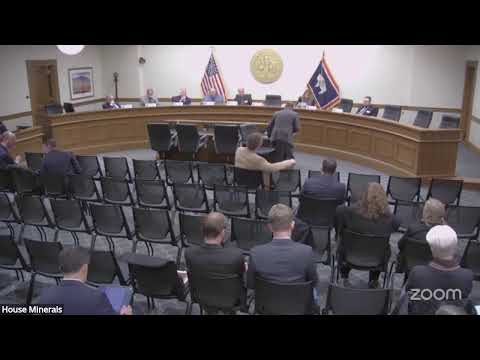
A proposal to give the Department of Environmental Quality (DEQ) explicit authority to require groundwater baseline monitoring before some limited mining operations (LMOs) drew detailed technical discussion at a Minerals, Business & Economic Development Committee hearing.
Representative Steve Harshman introduced the concept as a targeted tool to protect private wells and municipal water supplies in areas where LMOs are proposed near shallow groundwater or sensitive aquifers. He described recent local concern in the Casper area as an impetus: residents there learned of excavation activity only when it began and raised questions about possible effects on shallow wells.
What was proposed: Representative Harshman asked the committee to add language allowing the DEQ to require water quality testing before an LMO commences when the department identifies a potential risk to groundwater. DEQ's Water Quality Division administrator, Jennifer Zigmund, told the committee that the agency supports the concept of baseline sampling and has established programs and experience to perform or supervise such monitoring, but that program implementation raises resource, rulemaking and operational questions.
DEQ technical position and resource note: Administrator Zigmund said baseline data are important to determine pre‑existing water quality and to detect change over time. She noted that in some parts of Wyoming natural groundwater chemistry may not meet domestic protection standards because of underlying geology; having a baseline helps distinguish natural conditions from new impacts. The department said its fiscal note assumes operators perform baseline sampling with DEQ oversight and that DEQ would provide verification sampling as needed; if DEQ itself were required to do statewide baseline sampling for every LMO, the agency estimated a need for one additional full‑time natural resource analyst (ENNR 9) and associated rulemaking and oversight resources to evaluate roughly 15–20 LMOs per year.
How metrics could work: When asked for metrics the department suggested depth to groundwater as the primary indicator of when baseline testing would be most likely required; shallow groundwater is the scenario of greatest concern. Zigmund said the department would prefer to capture the decision framework in rulemaking so that operators and communities clearly understand where monitoring would be required and where it would not.
Public‑interest and industry views: Local residents and conservation groups testified they want the ability to obtain reliable baseline testing and clearer notification. Carolyn Griffith of the Casper Mountain Preservation Alliance and Michael Fernald, also of Casper, urged that wells be tested before excavation at locations where groundwater may be vulnerable. Industry witnesses including Joe Evers of Wyoming Rare USA and consultants said baseline testing is useful and that, in practice, LMOs are often accompanied by other permitting steps (air permits, local planning/zoning) and do not happen in isolation. Some industry representatives opposed adding mandatory DEQ‑conducted statewide sampling, arguing that operator‑conducted sampling with DEQ oversight is a workable approach.
Practical considerations: Administrator Zigmund stressed that sampling depends on access to private wells and that, if a landowner refused access, DEQ could not sample that well. She also warned that baseline sampling alone does not assign causation if water quality changes later; subsequent investigations would be needed to determine whether any change resulted from the LMO or other watershed factors. DEQ said it can complete rulemaking with existing staff but would need an additional field analyst to carry out statewide oversight at the scale discussed in its fiscal note.
Committee next steps and timing: Committee members questioned whether the statutory language should place the monitoring responsibility on the operator rather than on DEQ and whether the effective date should allow time for rulemaking. DEQ officials said clarifying that the operator conducts the initial monitoring and that DEQ provides oversight would reduce DEQ's direct sampling burden but would not eliminate the need for some additional staff if the program is applied broadly across the state.
Quotes: "We certainly support the concept of getting baseline water quality data," Wyoming DEQ Water Quality Administrator Jennifer Zigmund told the committee. Representative Harshman said the measure "doesn't require it but [says] the DEQ can require [testing] if they say 'this is kind of a unique area.'" Carolyn Griffith warned that "once that water is damaged and gone, it's too late." Industry representatives said the LMO pathway can be a "tool in the toolbox" to permit limited, lower‑impact work while full permitting proceeds.
What to watch: If the committee or floor adopts statutory language requiring more routine baseline sampling the DEQ and the Legislature will need to resolve the program's operational model (operator sampling with DEQ oversight versus DEQ‑led sampling), the precise metrics that trigger testing (for example, groundwater depth thresholds), and the funding and staffing approach for verification and oversight.