Get Full Government Meeting Transcripts, Videos, & Alerts Forever!
Get email alerts on the Mining Law And Regulation topic
No spam. Unsubscribe anytime.
Committee advances changes to limited mining operations, raises bonding for new sites
Summary
The Minerals, Business & Economic Development Committee advanced House Bill 10 — which expands limited mining operations to additional non‑coal minerals, eliminates the small mine permit category going forward and raises bond amounts for new operations — and approved an amendment adding limestone to a minerals list. A narrower pairing, House Bill
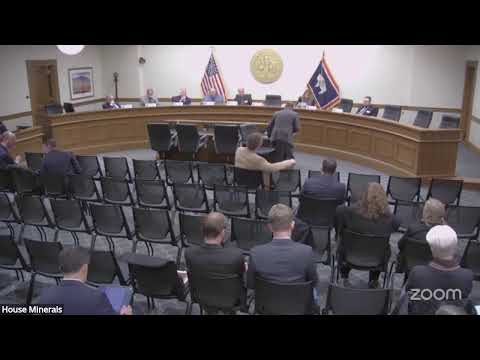
The Minerals, Business & Economic Development Committee on a voice and roll-call sequence advanced House Bill 10, a package of changes to the state's limited mining operation (LMO) framework, and approved a technical amendment to add limestone to a list of covered minerals. Lawmakers also discussed House Bill 15, a pared‑down bill that would make only bonding changes; that bill was left without a motion and was not advanced.
Supporters said the bill updates bonding to reflect inflation and streamlines regulatory categories; opponents warned that expanding LMO eligibility to additional hard‑rock minerals could reduce public review and risk impacts to groundwater and neighboring wells.
Why it matters: House Bill 10 would broaden the types of minerals eligible for the LMO notification pathway, raise per‑acre bond levels for LMOs that commence after July 1, 2025, and remove the separate small mine permit category going forward. The legislation alters timelines for state review and for operators to post additional bonds, and codifies a number of existing Land Quality Division (LQD) practices in statute. Proponents said those changes would make oversight more efficient and help new mineral development move forward; critics said the expansion reduces opportunities for public input and called for stronger baseline groundwater testing near some operations.
What the bill does: According to testimony from Todd Parfit, Director of the Wyoming Department of Environmental Quality (DEQ), House Bill 10 "expands the applicability of limited mine operations to include all non coal minerals" (with an exception for uranium and thorium regulated under the NRC agreement‑state program), raises per‑acre bond levels for LMOs starting after July 1, 2025, and removes the small mine permit category for future operations. Brandy O'Brien, LQD administrator, provided a line‑by‑line explanation that the bill: (a) grandfathers existing LMOs to current bond levels; (b) sets new per‑acre bond rates for non‑quarry LMOs at $5,000 per acre for operations commencing after July 1, 2025 while grandfathering pre‑existing operations at $2,000 per acre; (c) sets quarry LMOs at $3,000 per acre if commenced before July 1, 2025 and $7,000 per acre if commenced after that date; (d) allows an operator to post either the per‑acre bond or a full cost (engineering) bond, whichever is lower; and (e) requires full cost bonding for certain new mineral categories (for example, gold, lithium or nickel) where the LMO model does not match the scale or risk profile.
Timing and operational changes: The bill extends the LQD's review time to determine whether an increased bond is necessary from 90 days to 150 days, and it gives operators 45 days (instead of 30) to post any required additional bond. It also shortens DEQ's standard reclamation performance waiting period codified for bond release (two successful growing seasons to establish permanent cover).
Supporters' arguments: Industry and economic development speakers said the changes would streamline oversight and help Wyoming capitalize on new mineral development. Kyle Wendland, Director of Fossil Fuels at the Wyoming Energy Authority, told the committee that LMOs are meant to be limited in scope — "15 acre or less sites" — and described LMOs as an administrative tool that helps operators test, prove and, where appropriate, move projects into a full mine permit. Joe Evers, president of Wyoming Rare USA (a subsidiary of American Rare Earths), said the LMO pathway "provides a very useful interim step between the full permit to mine and the license to explore," enabling companies to produce small quantities for testing and marketing while they pursue larger permits. Trade and business groups including the Associated General Contractors of Wyoming, Knife River, the Wyoming Business Alliance and Americans for Prosperity voiced support for HB10 or the bonding changes in HB15.
Opponents' concerns: Multiple witnesses representing local residents and conservation groups urged caution. Carolyn Griffith, chair of the Casper Mountain Preservation Alliance, said the current LMO notification process can leave nearby homeowners with minimal recourse and urged stronger protections for groundwater and public notification. The Wyoming Outdoor Council and the Greater Yellowstone Coalition said expanding LMO eligibility to a broad set of non‑coal minerals likely would increase the number of LMO applications and reduce public input compared with the small mine permit process. Several civic speakers urged the committee to advance bonding changes only (HB15) and address any LMO expansion at a later date with added safeguards.
Committee action and votes: Representative Kevin Larson moved HB10 and Representative Campbell seconded. Representative Larson offered an amendment to add "limestone" to a mineral list on page 3; the amendment (moved by Larson, seconded by Representative Knapp) was adopted by voice vote. The committee then took a roll‑call on HB10. The record shows eight named members voting "aye" (Representative Campbell, Representative Knapp, Representative Larson, Representative Riggins, Representative Schmidt, Representative Tarver, Representative Weber and Chairman Heiner); the committee reported the final tally as 8 to 1 and the bill was advanced with the adopted amendment. House Bill 15 (the bond‑only variant) received no motion and was not advanced at the hearing.
Quotes: "This bill expands the applicability of limited mine operations to include all non coal minerals," DEQ Director Todd Parfit told the committee. Brandy O'Brien, the Land Quality administrator, said the bill "requires a bond of $5,000 per acre of affected lands" for many LMOs commencing after July 1, 2025 and explained options allowing a full cost bond in place of per‑acre rates. Opponents framed the expansion differently: Carolyn Griffith said the process leaves "the burden of proof" on residents and warned that "once that water is damaged and gone, it's too late." The Wyoming Outdoor Council said it "supports updated bonding levels for reclamation, and is not opposed to limited mining operations as they currently stand," but opposed HB10's broader mineral inclusion because it "will undoubtedly create more conflicts."
Details and context: The committee heard examples from DEQ showing past forfeiture shortfalls: for a roughly 7‑acre reclamation, the shortfall under the 2014 bond rate was about $19,950 compared with actual reclamation bids, while another 3.7‑acre example showed a $5,000 shortfall; with higher per‑acre rates the department said the bonds would have come much closer to actual reclamation costs. DEQ officials said LMOs are notification‑based, not permits, and an LMO filing does not include a public comment period in the way a small mine permit or a full mine permit does. The bill's drafters said grandfathering language preserves current bond amounts for operations that commenced prior to July 1, 2025.
What happens next: The committee advanced HB10 with the limestone amendment and named Representative Larson as the committee sponsor to carry the bill to the floor. HB15 was not moved at the hearing and remains pending.
Ending note: The hearing drew both industry representatives seeking faster, cheaper exploration and permitting tools and residents and conservation groups urging stronger baseline monitoring and public participation safeguards, especially where LMOs are proposed near private wells or populated areas.