Get Full Government Meeting Transcripts, Videos, & Alerts Forever!
Get email alerts on the Age Verification topic
No spam. Unsubscribe anytime.
House Judiciary advances bill requiring age verification for pornographic websites
Summary
The House Judiciary Committee voted 9-0 to advance House Bill 43, which would require websites that publish pornographic material to implement age verification and creates private civil remedies for violations while prohibiting retention of identifying data.
CHEYENNE — The House Judiciary Committee on Monday advanced House Bill 43, a measure that would require internet sites that publish pornographic material to perform age verification before allowing access and to delete identifying data after verification. The committee voted 9-0 to move the bill to the full House.
Sponsor Representative Wally, presenting the bill, said the measure aims to reduce children’s unintentional and intentional exposure to pornographic material. “I have long been concerned … about the safety of children online,” Representative Wally said during the bill presentation.
The bill defines covered platforms and harmful material, borrows several definitions from existing Wyoming statutes and federal law, and directs covered sites to block access unless a user’s age is verified. It prohibits age-verification providers or platforms from retaining identifying information after access has been granted and creates private causes of action for parents and guardians for violations. Remedies listed in the bill include actual damages and attorney fees; the text also addresses multiple incidents of repeated violations and allows recovery even if a portion of the law is later declared unconstitutional. The sponsor told the committee the measure would be effective July 1, 2025.
Supporters, including tech vendors and child-protection and faith-based groups, said reasonable, non-burdensome verification methods exist and that age checks are already used in other contexts. Ian Corby, a witness who represents age-verification technology providers, described several verification methods, including ID-plus-selfie checks and facial-age estimation, and said such services can return only an over/under-18 confirmation without transmitting personal data. “We can tell, within 1 or 2 years your actual age,” Corby said, describing one commonly used technique.
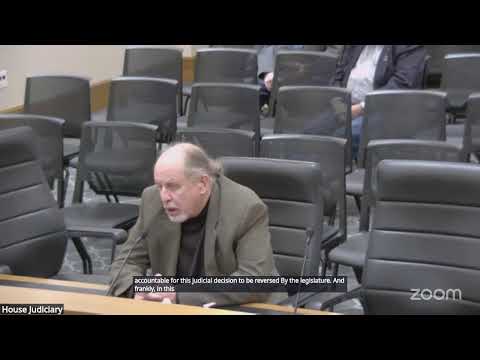
Public comments and witnesses raised both support and concerns. Supporters and advocacy groups described harms to minors and cited statistics about early exposure. Christina Rangel of Exodus Cry and others testified about violent or abusive content on major adult platforms and said age verification is one way to restrict access to minors. Opponents, including the Wyoming Library Association, warned HB 43’s current definitions could unintentionally sweep in library platforms such as large e-book and database services and could create constitutional risks; Conrado Saldivar of the association told the committee HB 43 “risks creating significant barriers to information access while posing constitutional challenges.” TechNet and industry representatives proposed technical clarifications and a content-threshold approach used in other states.
Committee members discussed scope, constitutional risk, enforcement, and practical effects. Representative Chastick pressed whether the bill would reach illegal child sexual abuse material (which is already criminal), while the sponsor and witnesses argued the bill focuses on source platforms and civil remedies aimed at reducing minors’ exposure. The bill’s text includes an explicit exclusion of search engines and states that enforcement of the statute is to be through private civil actions rather than public prosecution.
After floor-by-floor review and brief floor comments from members who said they would study library impacts and possible amendments, the committee adopted no amendments at the hearing and the motion to advance was moved by Vice Chairman Singh and seconded by Representative Webb. Roll call yielded nine ayes and no recorded no votes.
The bill now heads to the full House, where members indicated they may consider amendments to clarify scope for libraries and third-party providers.
Votes at a glance: House Bill 43 — Motion to advance to the House floor moved by Vice Chairman Singh, seconded by Representative Webb; committee roll call recorded 9 ayes, 0 noes; outcome: advanced to the House floor.