Get Full Government Meeting Transcripts, Videos, & Alerts Forever!
Get email alerts on the Reproductive Health Medication Abortion topic
No spam. Unsubscribe anytime.
Committee advances 48‑hour ultrasound requirement for medication abortion after hours of testimony
Summary
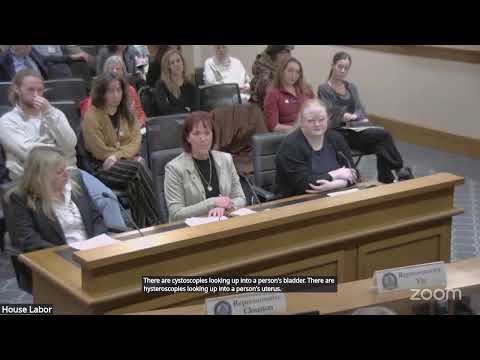
After hours of testimony from medical providers, advocacy groups and members of the public, the House Labor, Health & Social Services Committee voted to advance House Bill 64, requiring an ultrasound at least 48 hours before dispensing medication for a chemical abortion; the vote was recorded 7‑1 with one member excused.
The House Labor, Health & Social Services Committee advanced House Bill 64, which would require a pregnant person to receive an ultrasound at least 48 hours before receiving medication for a chemical (medication) abortion and to be given the opportunity to view an active ultrasound and, if audible, hear fetal cardiac activity.
Representative Chip Nyman, the bill sponsor, framed the measure as a patient‑safety and compassion provision. He told the committee that chemical abortions have increased and that an ultrasound is necessary to confirm gestational age, rule out ectopic pregnancy and protect a woman's health.
"The performance of an ultrasound is standard of care for any proposed obstetrical or gynecological procedure," Nyman said in his opening remarks, adding that "an ultrasound ... establishes the age and weight and location of that pregnancy." He said the FDA‑approved chemical abortion regimen is authorized only through 10 weeks' gestation and argued that medications sent by mail without an exam can place women at risk.
Opponents, including medical providers and reproductive‑rights groups, said the bill would interfere with the doctor‑patient relationship, delay care for rural patients and impose medically unnecessary mandates. Katie Knetter, executive director of Wellspring Health Access, the state's procedural and medication abortion provider, said a 48‑hour waiting requirement would push some patients past the window for medication abortion and could force them to undergo procedural abortion instead.
"This creates an additional burden for women in rural areas who must already travel to seek healthcare," Knetter said. "According to the American College of Obstetricians and Gynecologists, most abortion care globally is provided without ultrasound examination. It should be left to the evaluating physician to decide if an ultrasound is necessary."
Dr. Renee Hinkle, an OB‑GYN in Cheyenne, told the committee that current standards of care do not require routine ultrasound for medication abortion when patients meet screening criteria and that complications from medication abortion are rare relative to the risks of pregnancy.
Advocacy groups including Pro Choice Wyoming, the ACLU of Wyoming and Wyoming United for Freedom opposed the bill, calling it government overreach and warning of litigation under the Wyoming Constitution's health‑care decision protections. Supporters appearing in public comment — including state senators, right‑to‑life organizations and private citizens — argued the proposal protects women and unborn children and cited reported adverse events tied to the abortion pill in national reporting.
Representative Guggenmoss moved the bill; Representative McCann seconded. The committee clerk recorded the vote as 7 in favor, 1 opposed and 1 excused. Representative Yen was recorded as the lone "no." The chair announced that Speaker Nyman would present the bill on the floor.
Members raised a range of questions: whether the requirement should be limited to medication abortions only, whether resource centers would provide ultrasounds for patients in practice, and whether the provision should include a sunset or a repeal mechanism if court rulings make it unnecessary. The sponsor said the bill is written to operate during the current interim while court litigation continues and that its provisions are subject to any controlling legislation.
Public testimony in the hearing included roughly a dozen in‑room speakers and additional online witnesses; testimony represented medical professionals, advocacy organizations, clergy, former and current elected officials and private citizens. The committee's action advances the measure to the House floor where additional debate may occur.
Votes at a glance: House Bill 64 — Motion to advance moved by Representative Guggenmoss, seconded by Representative McCann; clerk recorded committee vote as 7 yes, 1 no, 1 excused.