Get Full Government Meeting Transcripts, Videos, & Alerts Forever!
Get email alerts on the Municipal Energy Generation topic
No spam. Unsubscribe anytime.
Lawmakers hear cities’ bid to build power on municipal sites, including capped landfills; committee takes no action
Summary
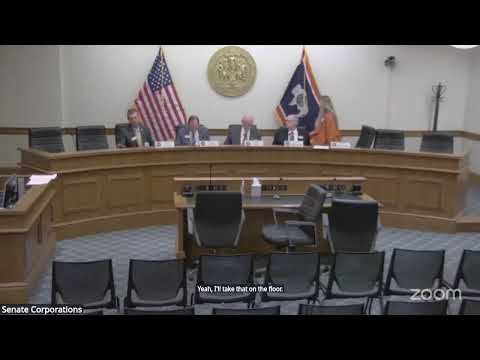
The Senate Corporations, Elections & Political Subdivisions Committee heard testimony on Senate File 54, a proposal that would permit municipal ownership or development of electricity production facilities on city-owned property — including capped landfills — but the committee took no action to advance the bill.
The Senate Corporations, Elections & Political Subdivisions Committee heard testimony on Senate File 54, a proposal that would permit municipal ownership or development of electricity production facilities on city-owned property — including capped landfills — but the committee took no action to advance the bill.
Cheyenne officials and municipal association representatives told the panel the measure grew from local interest in using otherwise unusable parcels to generate revenue for city services. "We have a site...a capped area of approximately 100 acres" at the Cheyenne landfill, Councilman Mark Rennie said, and the city has investigated building a small solar array there. Bob McLaren, representing WAM, said the association supports the bill as an additional revenue option for municipalities.
Opponents included utilities and wholesale power providers who warned of risks to certificated service territories and the leverage municipalities hold in franchise negotiations. "We are protective of our member owners' certificated service territories," a representative of Tri-State Generation and Transmission told the committee. Black Hills Energy confirmed it has worked with third-party developers on large projects serving local loads and noted technical and regulatory hurdles when integrating intermittent resources.
Committee members questioned technical claims in testimony. Rennie described potential output from the proposed landfill array as "14 to 20 megawatts per year," which senators and staff flagged as a mixed unit (capacity vs. energy produced). Senators also pressed whether municipalities building generation would unduly pressure franchised utilities in negotiations because municipalities hold franchise authorities.
Witnesses said municipalities would be required under the bill to contract with the locally certificated utility before operating — a provision intended to address utility concerns — but several utility witnesses said that clause did not eliminate territorial or leverage issues. Supporters said municipal projects are aimed at modest local revenue and resilience rather than large-scale competition with utilities. Opponents said third-party developers or existing utilities could and sometimes do develop similar projects without municipal entry into the generation business.
After testimony from Cheyenne officials, business and chamber representatives, Tri-State and local utility witnesses, and others, the committee asked for no motion to advance the bill at that hearing. The measure remains available for future consideration; no committee vote or amendments were recorded at this session.
The discussion focused on practical matters — site constraints on capped landfills, interactions with franchise agreements, queueing at transmission interconnections, and whether municipal entry would be permitted only after a power purchase agreement with the certificated utility. Committee members asked staff and witnesses for further technical details that were not provided at the hearing.