Get Full Government Meeting Transcripts, Videos, & Alerts Forever!
Get email alerts on the Public Safety Communications topic
No spam. Unsubscribe anytime.
Chesapeake officials briefed on pilot to use Amazon Connect for nonemergency public-safety calls
Summary
At a Jan. 21 work session, city officials reviewed a plan to pilot Amazon Connect, an AI-powered system to answer nonemergency public-safety calls with the goal of reducing dispatcher workload and improving 911 answer times.
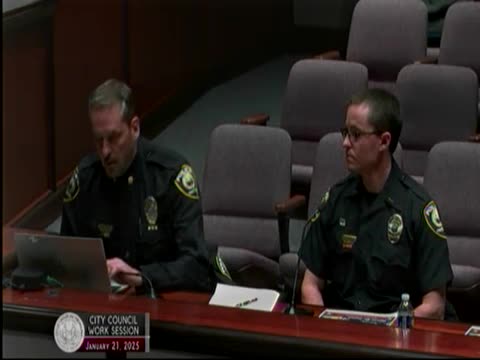
Chesapeake City Council was briefed Jan. 21 on a planned pilot to use Amazon Connect, an artificial-intelligence system, to answer the city’s nonemergency public-safety phone line and reduce pressure on 911 telecommunicators.
The briefing, led by Lieutenant Justin Bowman, the city’s 9-1-1 coordinator, outlined staffing and call-volume pressures driving the effort and described how the system would work. "Our current staffing is we have 46 of 68 positions filled. We have a 33% vacancy," Bowman said, citing the center’s vacancies and overtime. He told council the system would be used only on the nonemergency line and that callers could always opt to reach a live dispatcher: "Amazon Connect ... will only be for our nonemergency line. It will not be for the 9 1 1 line."
Why it matters: City staff said freeing dispatchers from routine, nonurgent calls should make more telecommunicators available to answer 911 calls, improve compliance with National Emergency Number Association (NENA) answer-time standards, and reduce burnout among a high-stress workforce. Bowman said Chesapeake averages about 20,000 calls a month and that dispatchers logged roughly 11,500 overtime hours last year. The 2024 year-end figures cited in the briefing were 110,612 total 911 calls and 127,366 nonemergency contacts, with an average 911 answer time of 14.82 seconds.
How it would work: City presenters said the AI would recognize natural-language requests on the nonemergency line — for example, questions about trash pickup or how to pay a ticket — and provide automated responses or send links via text or email. Bowman showed a short demonstration recording of a conversational, automated greeting and said dispatchers would still be able to take over calls when needed. He said workflows can be configured so calls identified as emergencies are routed to 911 telecommunicators.
Cost and evidence from other jurisdictions: Bowman described the service as month-to-month, usage-based and without an annual contract; the most recent estimate shown to council was about $26,100 per month in usage fees versus roughly $39,100 per month to staff a call taker. He also cited Virginia Beach’s experience since April 2024, where he reported Amazon Connect processed about 259,521 nonemergency contacts through December and handled about 45.01% of those contacts.
Council discussion and next steps: City Manager (presented to council as the manager) said the city plans to "launch as a pilot," and stressed the desire to balance technology adoption with maintaining Chesapeake’s "small town feel." Council members asked whether the technology would reduce vacancies; presenters said the pilot is expected to reduce workload and stress but is not projected to directly reduce current staffing vacancies. Assistant Chief Major Landfair and Dan Constantino, the city’s chief information officer, described the system as a "force multiplier." Constantino said, "Artificial intelligence is making our way, its way into all facets of technology today, and call centers is a natural place to place it."
No formal council vote was taken; staff said the matter will move forward as a pilot implementation and be monitored. Presenters said the municipality can disable the service at any time because the agreement is usage based. Staff identified anticipated benefits as a projected 30–40% reduction in nonemergency calls handled by live telecommunicators (based on vendor estimates), faster 911 answer times, and the ability to deliver information by text or email.
Playbook and safeguards: Presenters said workflows are customizable, that automated voice prompts are user-configurable, and that callers would be given the option to connect with a live dispatcher at any point. The briefing emphasized the nonemergency-only scope of the pilot and repeated that 911 calls would remain handled by human telecommunicators.
What’s next: Staff said they will proceed with a pilot phase and continue to report outcomes to council; a schedule for the pilot’s start date and formal evaluation metrics were not specified during the Jan. 21 work session.