Get Full Government Meeting Transcripts, Videos, & Alerts Forever!
Get email alerts on the School Construction Policy topic
No spam. Unsubscribe anytime.
Orange County adopts school capital funding policies; commissioners debate project-management models
Summary
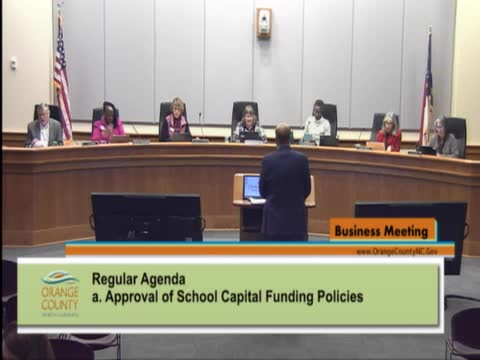
Orange County adopted school capital funding policies on Jan. 21, 2025 and discussed options for managing large, multi‑year school construction projects funded by the bond.
The Orange County Board of Commissioners adopted school capital funding policies on Jan. 21, 2025 and spent the meeting’s longest segment discussing project management options for school construction funded by the recently approved bond.
Budget Director Kirk Bond presented the final policy documents that the board had reviewed in prior work sessions and at a school facilities meeting. The board approved the policies after adding two clarifications requested during the discussion: define “Board” to mean the Board of County Commissioners in the preamble and clarify that in emergency reallocations funds to be reallocated must come from existing district bond and CIP funds. The board voted to adopt the policy with those two wording changes.
Commissioners then held an extended discussion of three broad project-management models for the multi‑year school construction program: 1) school-district-led project management (the status quo), 2) county-controlled project management via an interlocal agreement, and 3) joint management arrangements. County staff presented pros and cons for each approach, noting the county cannot unilaterally take over district responsibilities without an interlocal agreement and that the county’s principal leverage is control of funding.
Staff and commissioners discussed building internal county capacity (including hiring a county staff member to provide earlier warnings and more frequent updates) and the option to use outside program or project managers. School district representatives in the audience said the districts prefer to manage projects but expect to contract for project managers rather than use only existing district staff.
County staff noted procurement/delivery methods (design-bid-build, construction manager at risk, design-build) differ in how they allocate risk and affect schedule and subcontractor selection; a school representative explained design-build and CM at risk and said districts are evaluating those options. Commissioners emphasized the need for clear processes to avoid overruns and to preserve board priorities (equity, sustainability, long-term operating costs) through design and construction decisions.
No formal decision was made on which project-management model to adopt. Staff were asked to return with further analysis and to continue discussions with school district leadership; commissioners suggested quarterly updates for oversight and reporting as the program advances.
The board set a timeline to continue discussion at future meetings, with staff noting February work sessions and later February BOCC meetings available for follow-up.