Get Full Government Meeting Transcripts, Videos, & Alerts Forever!
Get email alerts on the Developmental Preschool topic
No spam. Unsubscribe anytime.
OSPI and DCYF describe special‑education preschool responsibilities, transitions from ESIT to school services
Summary
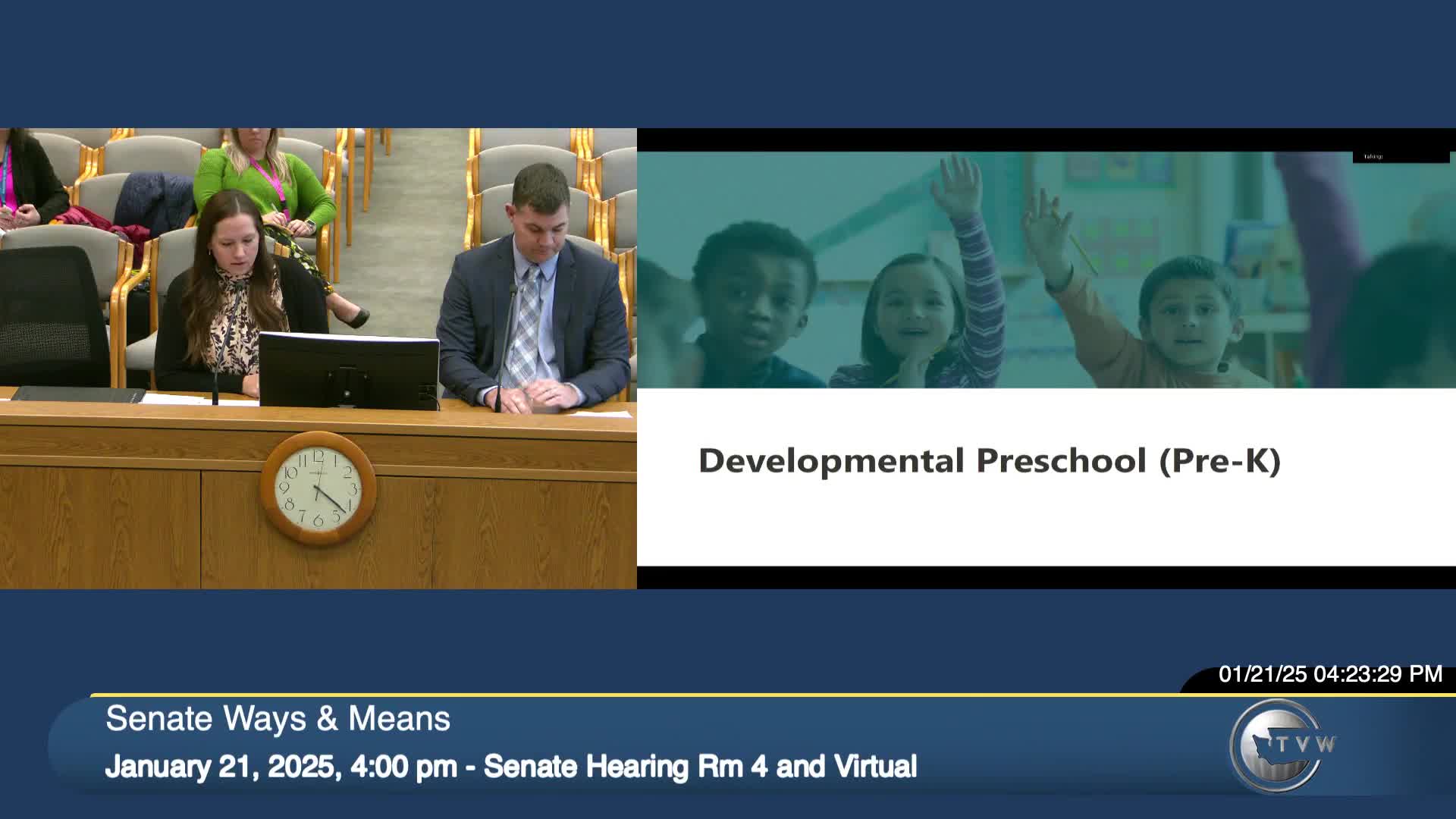
OSPI and DCYF sketched how special‑education services for children ages 0–5 are divided between ESIT (birth–3) and school district responsibility (ages 3–5), described federal funding formulas that contribute to preschool special‑education funding, and discussed local coordination and inclusion strategies.
OSPI and DCYF officials told the Senate Ways & Means Committee that responsibility for children with developmental delays is split by age band and by federal program rules: Early Support for Infants and Toddlers (ESIT) serves eligible birth–3 children under IDEA Part C, while school districts provide special‑education services for children ages 3–22, including developmental preschool for ages 3–5 under IDEA Part B.
OSPI’s presentation explained that school districts must provide a continuum of placement options for students with disabilities and that preschool‑age students with Individualized Education Programs (IEPs) are included in federal special‑education funding formulas. OSPI described the two federal IDEA funding streams relevant to 3–5‑year‑olds: Section 611 (age 3–22) and Section 619 (targeted to ages 3–5), and explained how state special‑education funding uses an annual average headcount multiplied by the district special‑education BEA rate (and then a multiplier) to determine allocations.
DCYF said ESIT services are provided primarily in children’s homes or community early‑learning settings and that ESIT is a payer of last resort; eligibility in Washington State requires a 25% delay in one developmental domain. DCYF reported serving nearly 25,000 children in federal fiscal year 2023 and said local lead agencies and community‑based organizations (including nonprofits, school districts and public‑health jurisdictions) deliver services under DCYF contracts in most areas.
Both agencies described active coordination for transitions: ESIT staff work with families beginning around 2½ years old to plan transitions into school‑district developmental preschool where appropriate, and OSPI and DCYF said local partnerships exist so children can receive services either in school settings or in community programs depending on local arrangements and family needs. DCYF noted that developmental‑preschool dosage and duration vary locally—some programs provide a few hours a week, others more time—and that services can be delivered in multiple settings when IEPs require it.
OSPI reiterated that developmental preschool is funded through the state special‑education formula, which is headcount‑based rather than prototypical‑model funding, and OSPI provided a brief example of the mechanics used to calculate those allocations. OSPI also noted recent rule updates (chapter 392‑172A) aligning preschool special‑education language with federal least‑restrictive environment requirements.
Committee members asked how local providers and districts share identification and referral work; both agencies described common referral sources (pediatricians, childcare providers and family members) and local Child Find efforts that connect families to districts for evaluation and IEP determination.
Agency staff agreed to share detailed briefing materials, including ESIT demographic breakdowns and federal reporting data, with committee staff for follow‑up.