Get Full Government Meeting Transcripts, Videos, & Alerts Forever!
Get email alerts on the Children S Museum topic
No spam. Unsubscribe anytime.
Mid Columbia Children's Museum presents feasibility findings, seeks site and funding for Tri-Cities location
Summary
Leaders of the Mid Columbia Children's Museum told the Richland City Council they have completed a feasibility phase funded with private donations and are seeking site selection, concept-design funding and public partnership to move a permanent children's museum forward in the Tri‑Cities area.
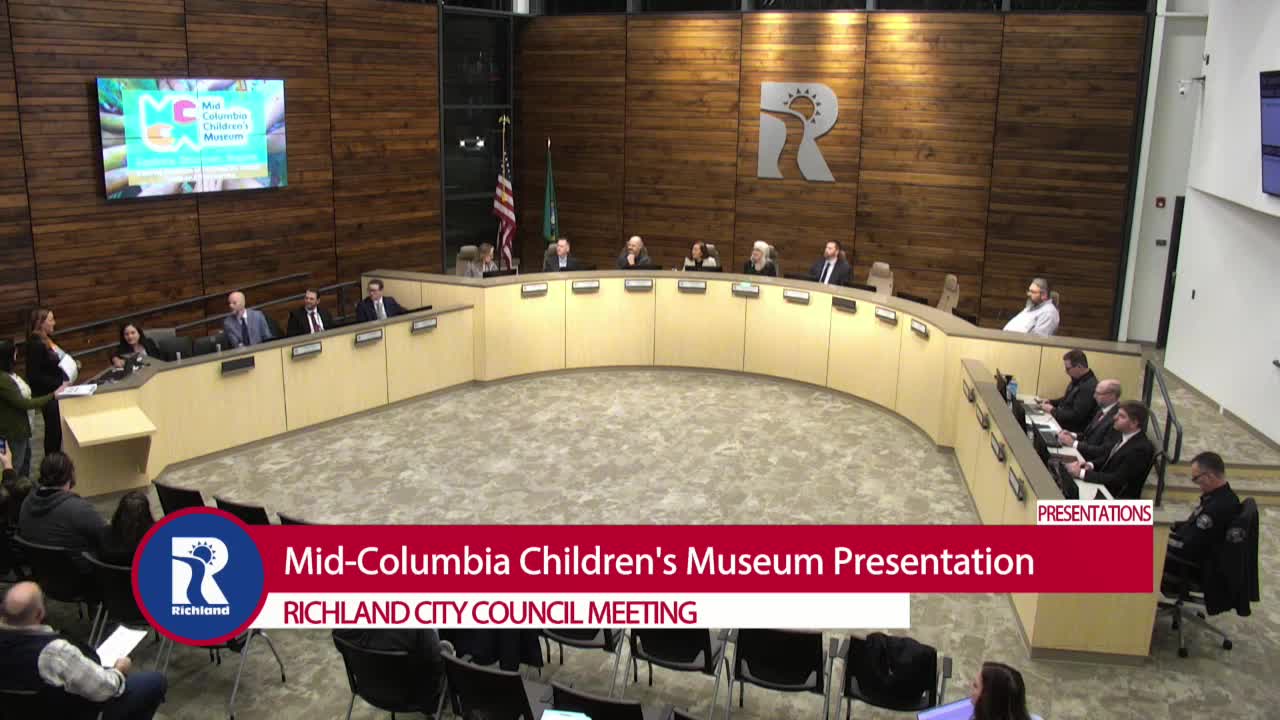
Chelsea Blair, president of the Mid Columbia Children's Museum board, told the Richland City Council on a January 2025 meeting that the volunteer-led nonprofit has completed much of its feasibility work and is asking local partners for help securing a site and funding for concept and exhibit design.
The museum, Blair said, is focused on early learning and STEAM exposure for Tri‑Cities children. “A children's museum is helping children find their why,” Blair said, adding that hands-on experiences increase creativity, problem solving and kindergarten readiness. She cited local readiness and assessment statistics from the group's research: 63 percent of children lack access to high-quality early education, and 54 percent lag in kindergarten math readiness, with nearly half testing below third-grade level by third grade.
The nut of the museum's request is site-selection and concept-design funding. Beth Crocker, vice president of the board, said the feasibility study — paid for with roughly $200,000 in private contributions — is expected to wrap up in the first quarter of 2025. The study assessed three candidate sites, including two properties in the city of Richland: Bradley Landing and Columbia Park West. “Once we select a site we would be moving forward with putting that idea of a museum, size of museum into an actual concept and schematic design,” Crocker said.
The feasibility consultants named by the presenters are Cameron Boodram of M Goodwin Museum Planning (feasibility/business planning) and Alyssa Rupp with Frame Integrated Design (concept and schematic design). The consultants provided preliminary size and cost ranges: a smaller option a little over 20,000 gross square feet (about 13,800 square feet of exhibit space) with an estimated total project cost of $34–$39 million; and a larger option just under 30,000 square feet (about 20,000 exhibit space) with an estimated total project cost of $46–$52 million. Those totals, Crocker said, include hard and soft construction costs, site work and an operating endowment sized to open the facility.
The board reported operational projections including preliminary annual attendance estimates of about 124,000 to 177,000 visitors, staffing of roughly 14–18 full-time-equivalent positions and a projected operating budget in the range of $1 million to $1.5 million. The presenters said community events held during 2024 drew more than 10,000 visitors and that the museum has partnerships with parks and recreation departments, libraries and other local nonprofits.
Blair and Crocker said the museum has been identified by the Tri Cities Legislative Council as one of five priority projects for the year and that representatives will seek state-level support during upcoming legislative days in Olympia. The board asked the city for assistance with site selection and for consideration of a public–private partnership and potential future bond support to advance a capital campaign.
Council members voiced support and raised practical concerns. Council member Van Dyke noted possible land-use conflicts, saying another organization (the performing arts center) is reportedly considering some of the same waterfront parcels. Council member Luxon said the museum would “bridge” the school system and library offerings and expressed interest in partnership. Council member Meyer urged persistence and suggested council assistance with the site-selection process.
The presentation and Q&A combined community need, private fundraising history and consultant estimates but did not include a formal city commitment of funds or a site decision. Blair and Crocker said the board will continue feasibility work, finalize the site assessment and return with more detailed concept materials after the feasibility phase and site selection are completed.
Ending: The board will wrap up the feasibility phase in the first quarter of 2025 and pursue concept design and state advocacy; the council expressed general support and noted site conflicts to be resolved before any public funding commitments are made.